Review
. 2008;12(6):236.
doi: 10.1186/cc7101. Epub 2008 Nov 25.

Bench-to-bedside review: Quorum sensing and the role of cell-to-cell communication during invasive bacterial infection

Affiliations
Review

Bench-to-bedside review: Quorum sensing and the role of cell-to-cell communication during invasive bacterial infection

Shadaba Asad et al. Crit Care. 2008.

Abstract

Bacteria communicate extensively with each other and employ a communal approach to facilitate survival in hostile environments. A hierarchy of cell-to-cell signaling pathways regulates bacterial growth, metabolism, biofilm formation, virulence expression, and a myriad of other essential functions in bacterial populations. The notion that bacteria can signal each other and coordinate their assault patterns against susceptible hosts is now well established. These signaling networks represent a previously unrecognized survival strategy by which bacterial pathogens evade antimicrobial defenses and overwhelm the host. These quorum sensing communication signals can transgress species barriers and even kingdom barriers. Quorum sensing molecules can regulate human transcriptional programs to the advantage of the pathogen. Human stress hormones and cytokines can be detected by bacterial quorum sensing systems. By this mechanism, the pathogen can detect the physiologically stressed host, providing an opportunity to invade when the patient is most vulnerable. These rather sophisticated, microbial communication systems may prove to be a liability to pathogens as they make convenient targets for therapeutic intervention in our continuing struggle to control microbial pathogens.


Figures
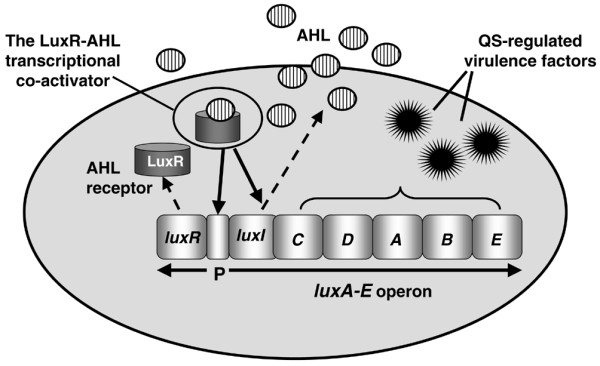
Figure 1
Figure 1
Autoinducer type 1 quorum sensing signal system in Gram-negative bacteria. The autoinducer type 1 quorum sensing (QS) system found in Vibrio fischeri, and many homologous variations on the system in other Gram-negative bacteria. AHL, acyl homoserine lactone; luxR/luxI, autoinducer type 1 system in Vibrio spp.; P, promoter site.
Figure 2
Figure 2
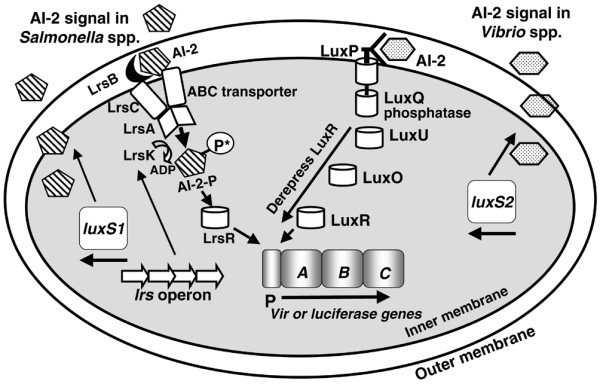
Two types of autoinducer type 2 quorum sensing systems in different genera of Gram-negative bacteria. The two autoinducer type 2 (AI-2) quorum sensing signal systems found in Salmonella spp. and in Vibrio spp. ABC, ATP-binding cassette transporter; Lrs, LuxS regulated; P, promoter site; P*, phosphorylated; Vir, virulence.
Figure 3
Figure 3
Autoinducer type 3/epinephrine quorum sensing system in enteric Gram-negative bacteria. AI-3, autoinducer type 3; EHEC, enterohemorrhagic Escherichia coli; LEE, locus for enterocyte effacement; flh, flagella regulon; P, promoter site; P*, phosphorylated; Qse, AI-3 system in enteric bacteria.
Figure 4
Figure 4
Accessory gene regulator quorum sensing system in Staphylococcus aureus. Homologous short peptide signaling systems exist in other Gram-positive bacterial species and genera. agr, accessory gene regulator; AIP, autoinducer peptide; P, promoter site; P*, phosphorylated protein; RAP, RNAIII-activating protein; RIP, RNAIII-inhibiting peptide; TRAP, target of RNAIII-activating protein.

References

    1. Miller MB, Bassler BL. Quorum sensing in bacteria. Annu Rev Microbiol. 2001;55:165–199. doi: 10.1146/annurev.micro.55.1.165. - DOI - PubMed
    1. Greenberg EP. Bacterial communication and group behavior. J Clin Invest. 2003;112:1288–1290. - PMC - PubMed
    1. Cámara M, Williams P, Hardman A. Controlling infection by tuning in and turning down volume of bacterial small-talk. Lancet Infect Dis. 2002;2:667–676. doi: 10.1016/S1473-3099(02)00447-4. - DOI - PubMed
    1. Williams P. Quorum sensing, communication and cross-kingdom signaling in the bacterial world. Microbiology. 2007;153:3923–3928. doi: 10.1099/mic.0.2007/012856-0. - DOI - PubMed
    1. Bassler BL. Small talk. Cell-to-cell communication in bacteria. Cell. 2002;109:421–424. doi: 10.1016/S0092-8674(02)00749-3. - DOI - PubMed

MeSH terms