. 2009 Feb 4;256(1-2):53-64.
doi: 10.1016/j.tox.2008.11.002. Epub 2008 Nov 11.

Sexually dimorphic regulation and induction of P450s by the constitutive androstane receptor (CAR)

Affiliations

Sexually dimorphic regulation and induction of P450s by the constitutive androstane receptor (CAR)

J P Hernandez et al. Toxicology. .

Abstract

The constitutive androstane receptor (CAR) is a xenosensing nuclear receptor and regulator of cytochrome P450s (CYPs). However, the role of CAR as a basal regulator of CYP expression nor its role in sexually dimorphic responses have been thoroughly studied. We investigated basal regulation and sexually dimorphic regulation and induction by the potent CAR activator TCPOBOP and the moderate CAR activator Nonylphenol (NP). NP is an environmental estrogen and one of the most commonly found environmental toxicants in Europe and the United States. Previous studies have demonstrated that NP induces several CYPs in a sexually dimorphic manner, however the role of CAR in regulating NP-mediated sexually dimorphic P450 expression and induction has not been elucidated. Therefore, wild-type and CAR-null male and female mice were treated with honey as a carrier, NP, or TCPOBOP and CYP expression monitored by QPCR and Western blotting. CAR basally regulates the expression of Cyp2c29, Cyp2b13, and potentially Cyp2b10 as demonstrated by QPCR. Furthermore, we observed a shift in the testosterone 6alpha/15alpha-hydroxylase ratio in untreated CAR-null female mice to the male pattern, which indicates an alteration in androgen status and suggests a role for androgens as CAR inverse agonists. Xenobiotic-treatments with NP and TCPOBOP induced Cyp2b10, Cyp2c29, and Cyp3a11 in a CAR-mediated fashion; however NP only induced these CYPs in females and TCPOBOP induced these CYPs in both males and females. Interestingly, Cyp2a4, was only induced in wild-type male mice by TCPOBOP suggesting Cyp2a4 induction is not sensitive to CAR-mediated induction in females. Overall, TCPOBOP and NP show similar CYP induction profiles in females, but widely different profiles in males potentially related to lower sensitivity of males to either indirect or moderate CAR activators such as NP. In summary, CAR regulates the basal and chemically inducible expression of several sexually dimorphic xenobiotic metabolizing P450s in a manner that varies depending on the ligand.


Conflict of interest statement

Note: The authors have no conflicts of interest to declare

Figures
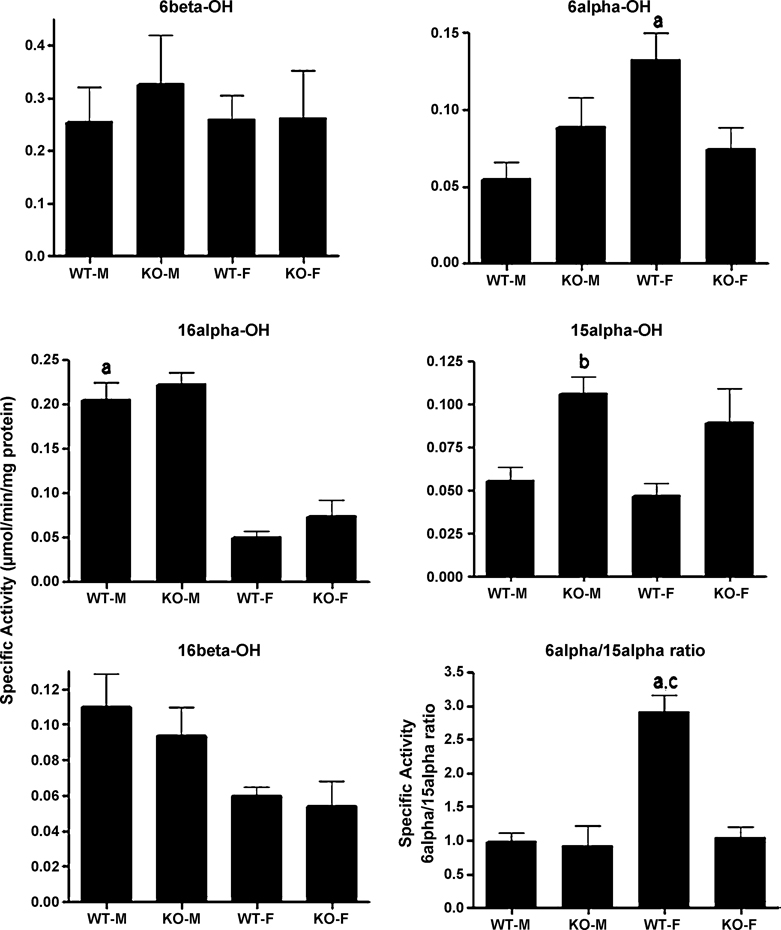
Fig. 1
Fig. 1. Gender differences in testosterone hydroxylation in wild-type and CAR-null mice
Testosterone hydroxylation in the 6β-, 16α-, 16β-, and 6α-positions were determined and compared between male and female wild-type and CAR-null mice. The results are shown as mean specific activity (µmol/min/mg protein) ± SD (n = 5–6). An (a) indicates a significant difference between wild-type male (WT-M) and wild-type female (WT-F) mice, a (b) indicates a significant difference between WT-M and CAR-null male (KO-M) mice, and a (c) indicates a significant difference between wild-type female (WT-F) and CAR-null female (KO-F) mice by ANOVA followed by Fisher’s PLSD test as the post-hoc test (p < 0.05).
Fig. 2
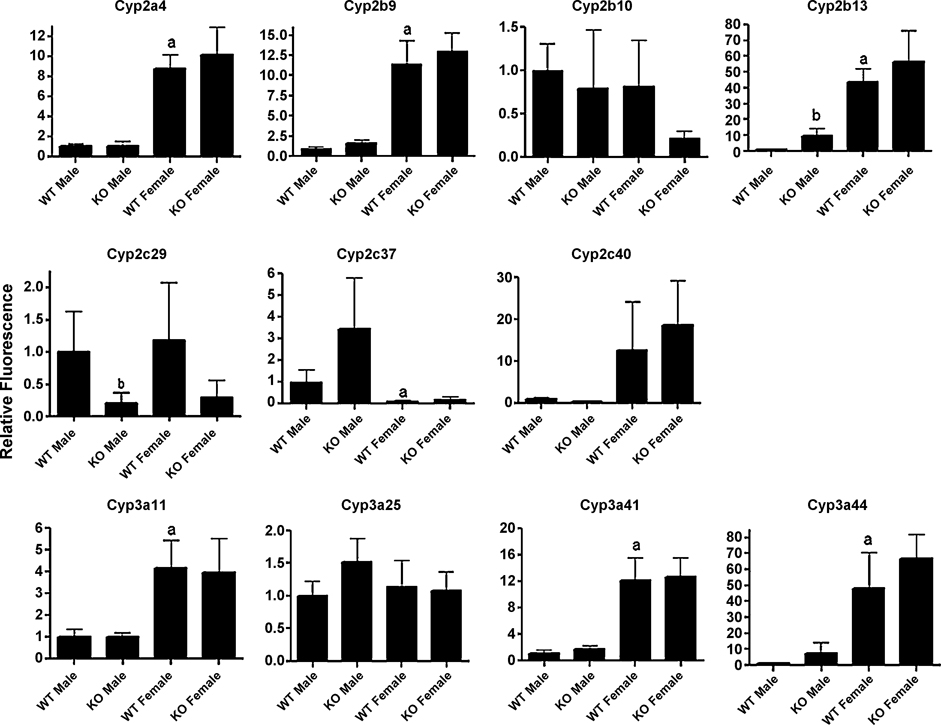
Fig. 2. Gender differences in expression of specific CYP isoforms in wild-type and CAR-null mice
Quantitative real-time PCR (QPCR) was performed as described in the Materials and Methods and used to determine gender and CAR-regulated expression of P450s in untreated mice. The results are shown as relative activity ± SD (n = 5–6). An (a) indicates a significant difference between wild-type male (WT-M) and wild-type female (WT-F) mice, a (b) indicates a significant difference between WT-M and CAR-null male (KO-M) mice, and a (c) indicates a significant difference between wild-type female (WT-F) and CAR-null female (KO-F) mice by ANOVA followed by Fisher’s PLSD as the post-hoc test (p < 0.05).
Fig. 3
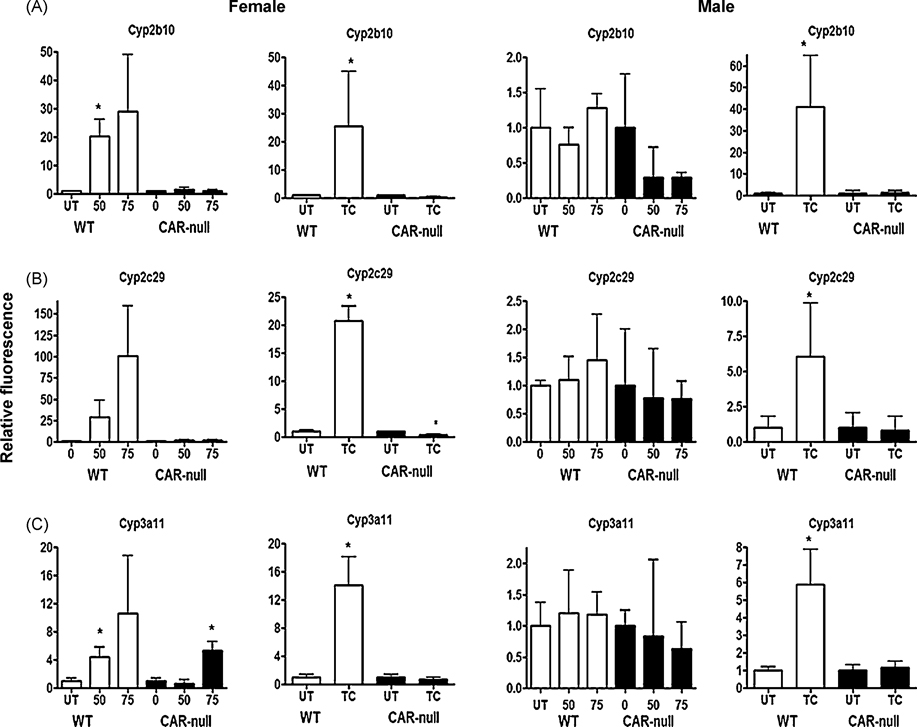
Fig. 3. Cyp2b10, Cyp2c29, and Cyp3a11 show similar patterns of gene expression following treatment with NP or TCPOBOP in wild-type and CAR-null male and female mice
QPCR was performed as described in the Materials and Methods. On the X-axis, 0, 50, 75 refers to treatment with NP and TC refers to treatment with TCPOBOP. Data are expressed as mean ± SD (n = 5–6) for each of the different P450s in males and females. An asterisk indicates a significant difference from the untreated wild-type or CAR-null mice (p < 0.05). Statistical significance was determined by ANOVA followed with Fisher’s PLSD as the post-hoc test in NP-treated mice compared to their corresponding wild-type or CAR-null controls. Statistical significance was determined by Student’s t-tests in TC-treated mice compared to their corresponding wild-type or CAR-null controls.
Fig. 4
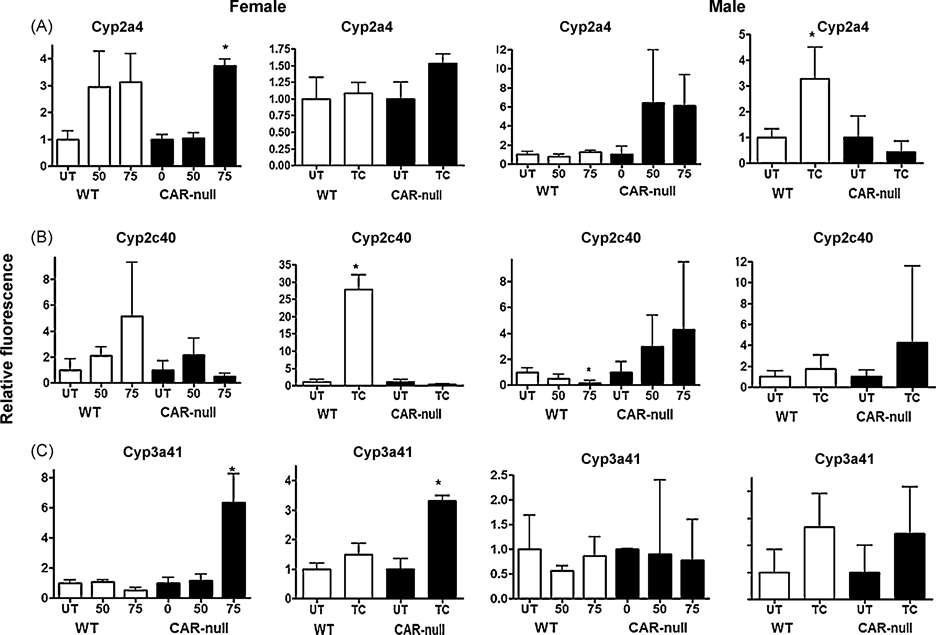
Fig. 4. Cyp2a4, Cyp2c40, and Cyp3a41 show differential patterns of regulation following treatment with NP or TCPOBOP in wild-type or CAR-null male and female mice
QPCR was performed as described in the Materials and Methods. On the X-axis, 0, 50, 75 refers to treatment with NP and TC refers to treatment with TCPOBOP. Data are expressed as mean ± SD (n = 5–6) for each of the different P450s in males and females. An asterisk indicates a significant difference from the untreated wild-type or CAR-null mice (p < 0.05). Statistical significance was determined by ANOVA followed with Fisher’s PLSD as the post-hoc test in NP-treated mice compared to their corresponding wild-type or CAR-null controls. Statistical significance was determined by Student’s t-tests in TC-treated mice compared to their corresponding wild-type or CAR-null controls.
Fig. 5
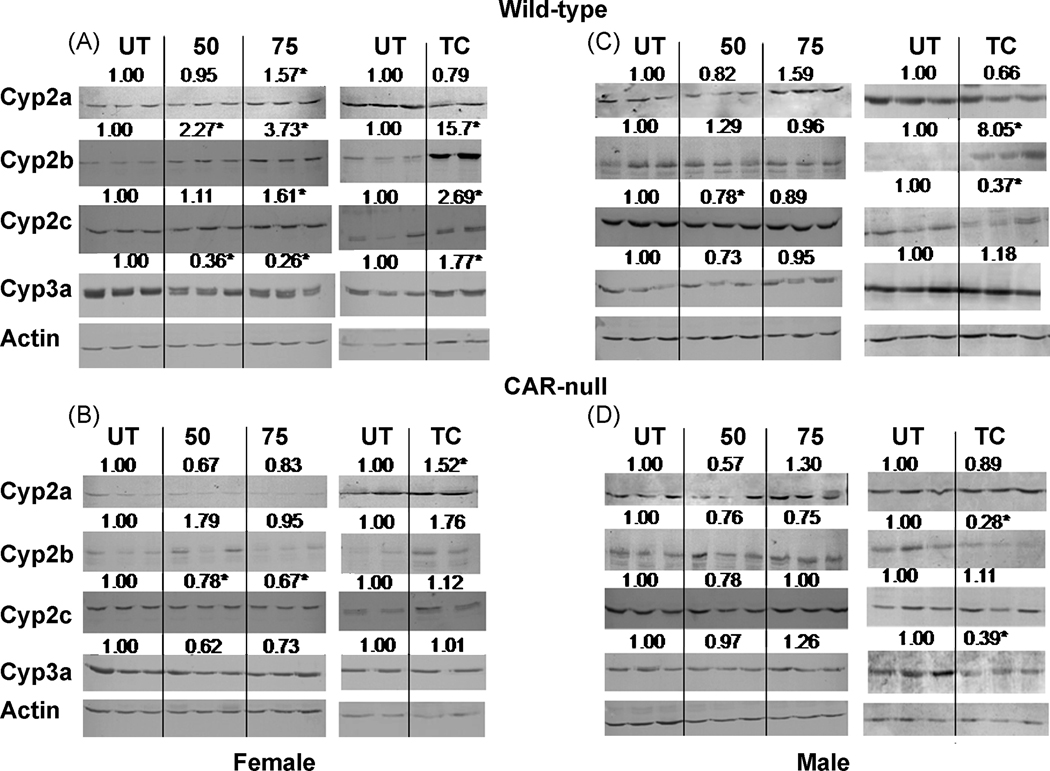
Fig. 5. Western blots of hepatic microsomes from NP and TCPOBOP-treated wild-type and CAR-null male and female mice
Western blots were performed and visualized as described in the Materials and Methods. Blots were quantified densitometrically and the relative mean differential expression as compared to the controls is reported above the blots. An asterisk indicates a significant difference from the corresponding untreated mice by ANOVA followed by Fisher’s PLSD for NP-treated mice, and Student’s t-test for TC-treated mice (p < 0.05).
Fig. 6
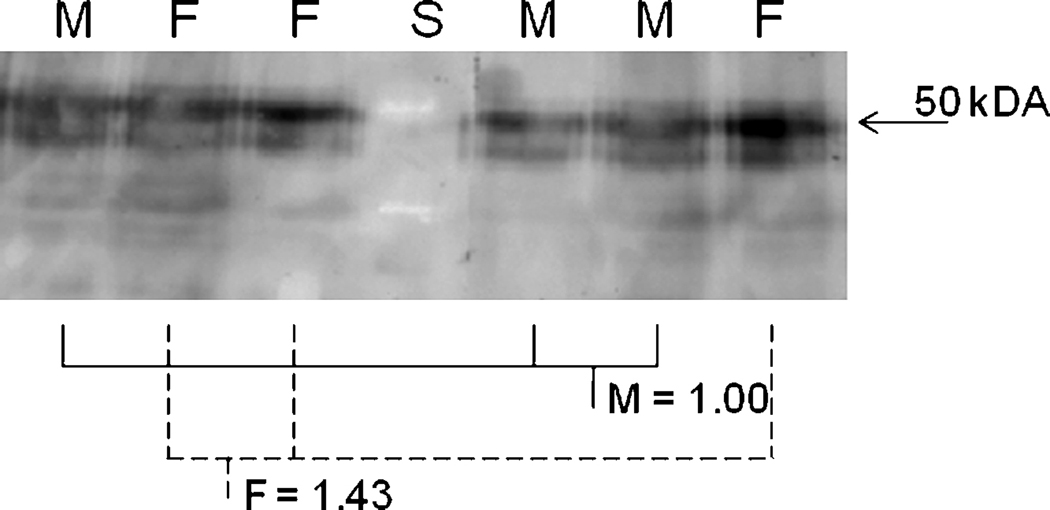
Fig. 6. Western blots of immunoprecipitated CAR protein from untreated wild-type male and female mice
Immunoprecipitation and Western blotting was performed as described in the Materials and Methods. Blots were quantified densitometrically and the relative mean expression compared to the male mice is reported. M = male (solid lines); F = female (dashed lines). There were no significant differences as determined by Student’s t-test (p < 0.05).

References

    1. Acevedo R, Villanueva H, Parnell PG, Chapman LM, Gimenez T, Gray SL, Baldwin WS. The contribution of hepatic steroid metabolism to serum estradiol and estriol concentrations in nonylphenol treated MMTVneu mice and its potential effects on breast cancer incidence and latency. J. Appl. Toxicol. 2005;25:339–353. - PubMed
    1. Anakk S, Kalsotra A, Kikuta Y, Huang W, Zhang J, Staudinger JL, Moore DD, Strobel HW. CAR/PXR provide directives for Cyp3a41 gene regulation differently from Cyp3a11. Pharmacogenomics J. 2004;4:91–101. - PubMed
    1. Arukwe A, Knudsen FR, Goksoyr A. Fish zona radiata (eggshell) protein: A sensitive biomarker for environmental estrogens. Environ. Health Perspect. 1997;105:418–422. - PMC - PubMed
    1. Baes M, Gulick T, Choi H-S, Martinoli MG, Simha D, Moore DD. A New Orphan Member of the Nuclear Hormone Receptor Superfamily That Interacts with a Subset of Retinoic Acid Response Elements. Mol. Cell Biol. 1994;14:1544–1552. - PMC - PubMed
    1. Baldwin WS, LeBlanc GA. The anti-carcinogenic plant compound indole-3-carbinol differentially modulates P450-mediated steroid hydroxylase activities in mice. Chem-Biol. Interac. 1992;83:155–169. - PubMed

Publication types

MeSH terms