


Comment
doi: 10.1016/j.cell.2008.11.004.
Lighting up the stressed ER
Affiliations
- PMID: 19041740
- PMCID: PMC3117787
- DOI: 10.1016/j.cell.2008.11.004
Item in Clipboard
Comment
Lighting up the stressed ER
Cell.
.
Abstract
Balancing the capacity for protein maturation with changes in protein flux through the endoplasmic reticulum (ER) is crucial for maintaining ER homeostasis. In this issue, Merksamer et al. (2008) exploit a redox-sensitive fluorescent protein to monitor the environment inside the ER of living yeast, illuminating how this organelle responds to different perturbations.
Figures
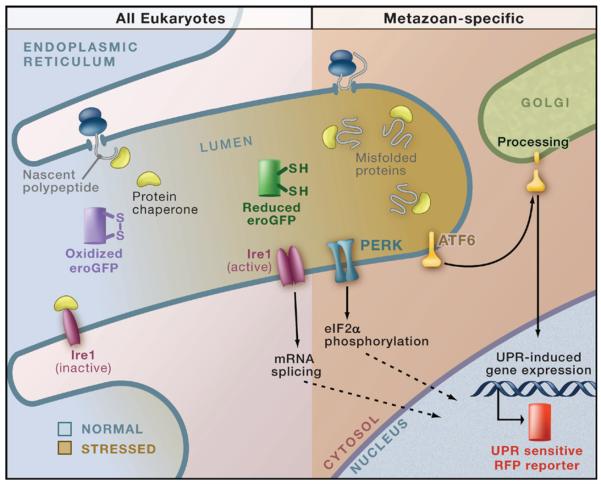
The environment of the endoplasmic reticulum (ER) and activation of the unfolded protein response (UPR) can be monitored using a redox-sensitive green fluorescent protein (eroGFP) probe and a UPR-responsive red fluorescent protein (RFP) expression reporter, respectively (Merksamer et al., 2008). The eroGFP probe changes its excitation spectrum depending on the oxidation state of two engineered cysteines. Under normal conditions (left), the protein maturation capacity of the ER can meet the poly-peptide substrate load. During ER stress (right), the processing capacity of the ER is saturated, resulting in an accumulation of misfolded proteins (bound to chaperones) that initiates the UPR. Merksamer et al. (2008) find that accumulation of misfolded proteins can alter the redox state of eroGFP, making it a useful reporter of the ER environment. The UPR pathways include the universally conserved stress sensor Ire1 and the metazoan-specific stress sensors PERK (PKR-like ER resident kinase) and ATF6. Each of these functions by different mechanisms to initiate signaling pathways that activate transcription of numerous UPR-responsive genes (Ron and Walter, 2007).
Comment on
-
Real-time redox measurements during endoplasmic reticulum stress reveal interlinked protein folding functions.Cell. 2008 Nov 28;135(5):933-47. doi: 10.1016/j.cell.2008.10.011. Epub 2008 Nov 20. Cell. 2008. PMID: 19026441 Free PMC article.
References
Publication types
MeSH terms
Grants and funding
LinkOut - more resources
Full Text Sources
Molecular Biology Databases
