. 2009 Jan;46(3):366-74.
doi: 10.1016/j.molimm.2008.10.024. Epub 2008 Nov 29.

Altered peptide ligands can modify the Th2 T cell response to the immunodominant 161-175 peptide of LACK (Leishmania homolog for the receptor of activated C kinase)

Affiliations

Altered peptide ligands can modify the Th2 T cell response to the immunodominant 161-175 peptide of LACK (Leishmania homolog for the receptor of activated C kinase)

Kirk D C Jensen et al. Mol Immunol. 2009 Jan.

Abstract

Following Leishmania major infection, the early LACK (Leishmania homolog of receptors for activated C kinase)-induced IL-4 response appears to determine disease susceptibility in BALB/c mice. Therefore, we sought to manipulate the pathogenic T cell responses to the immunodominant epitope with the use of altered peptide ligands (APLs). Conservative and non-conservative substitutions for each amino acid of the LACK 161-175 peptide determinant were tested for their stimulatory capacity in four different LACK-reactive T cell systems. From these results, we propose a likely LACK 163-171/I-A(d) core peptide register and show that APLs with changes at putative T cell receptor (TCR) contacts provide the greatest potential for immune deviation. In particular, the TCR-contact H164V APL expanded Th1 cells upon in vitro recall of naïve splenocytes from LACK-specific BV4 T cell receptor transgenic mice and stimulated IFN-gamma secretion from a Th2-committed LACK-reactive T cell line. We also observed that non-conservative substitutions flanking the core determinant had strong agonistic effects for proliferation and Th1/Th2 modulation. However, upon immunization, the H164V APL considerably downregulated proliferation and cytokine responses to the wild type LACK 161-175 peptide, while immunization with the weak agonist, MHC contact APL S171K, increased the IFN-gamma/IL-4 ratio to the wild type peptide. In these instances, a hyporesponsive T cell response to the wild-type peptide was achieved by immunizing with an APL possessing non-conservative substitutions at TCR contact sites, while immune deviation was accomplished using a weak-agonist APL that retained the core determinant. Thus, certain LACK-APLs are able to induce T cell responses with a protective phenotype in an infectious disease such as leishmaniasis.


Figures
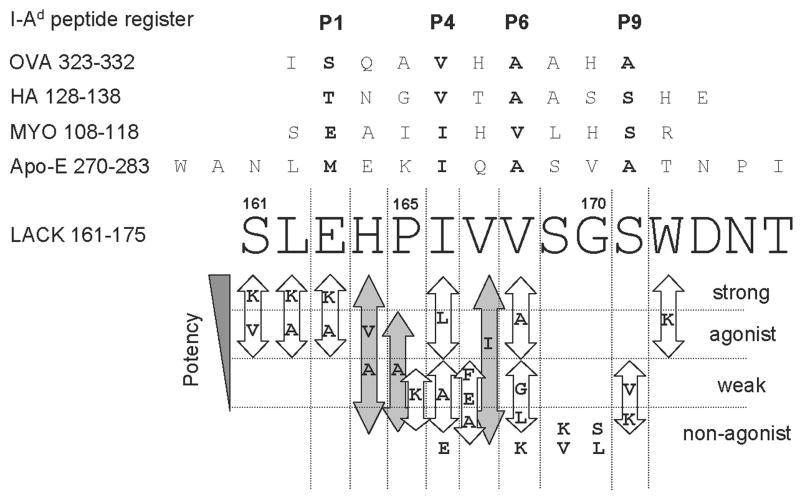
Figure 1
Figure 1. LACK APLs reveal the core determinant spanning residues 163–171 and summary of the proliferative responses of all tested cell systems: LMR17, “Moses”, “Bruce” and naïve LACK-BV4 transgenic T cells
The I-Ad peptide register of OVA 323–332 (Sette et al., 1987), HA 128–138 (Sette et al., 1988), MYO 108–118 (England et al., 1995; Sette et al., 1988) and Apo-E 270–283 (Hunt et al., 1992) are referenced in comparison to LACK 161–175. The amino acids contacting P1, P4, P6 and P9 I-Ad pockets are in bold type. Log fold differences in the half maximal peptide dose response values with respect to wild type peptide distinguish strong-agonist, agonist and weak-agonist (see Material and Methods). Substitutions at the base of the figure elicited no proliferative response in any of the cell types tested. Substitutions that induced varying degrees of proliferation are grouped within arrows; grey arrows indicate substitutions that ranged from non-agonist to strong agonist (i.e. ≤100 fold differences in potency) in the four T cell systems tested.
Figure 2
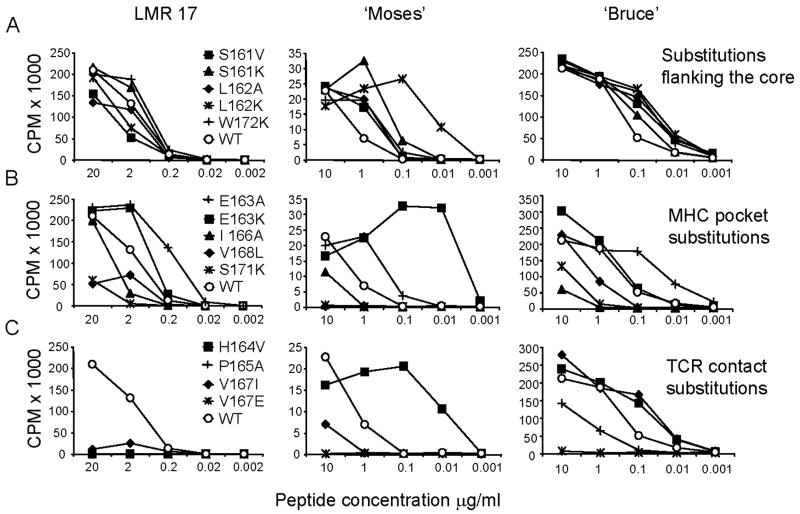
Figure 2. T cell proliferative responses to different categories of LACK APLs
A. APLs with alterations flanking the core region (aa 161, 162 and 172); B. APLs with changes within potential MHC contacts (aa 163, 166, 168 and 171); and, C. APLs with residue substitutions at putative TCR contact sites (aa 164, 167, 169 and 170). Representative peptide dose (μg/ml) response curves of a LACK-reactive hybridoma, LMR 17 (left column), and T cell lines “Moses” and “Bruce” (middle and right columns respectively) to the wild type LACK 161–175 peptide (empty circles: ○), or various analogs (filled symbols) tested for all panels. IL-2 secretion by LMR 17 was monitored by the proliferation of HT-2 cells. Cellular proliferation was monitored by 3H-thymidine incorporation 3 days post-stimulation with peptides and antigen presenting cells (see Material and Methods). Cells were harvested and radiation was detected with scintillation fluid and plotted as counts per minute (CPM). One representative experiment is shown of the 3 performed.
Figure 3
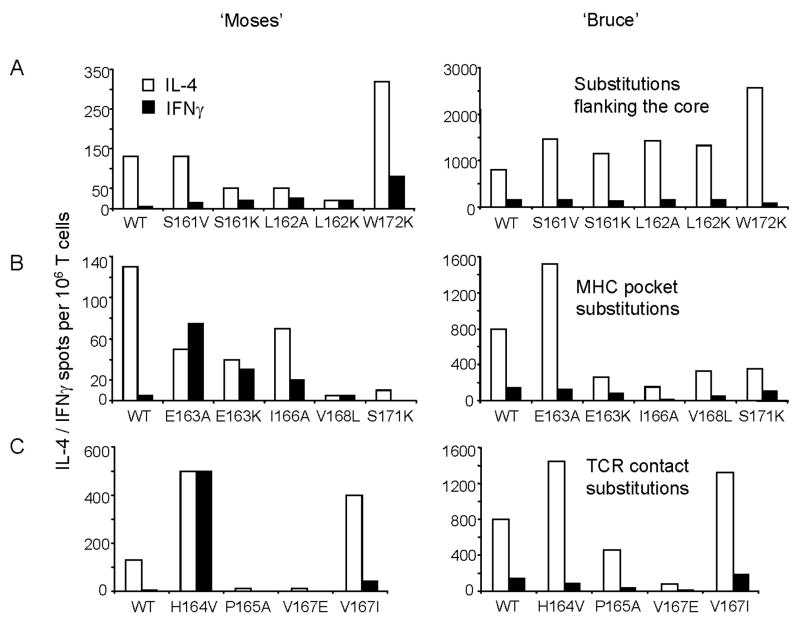
Figure 3. Residue substitutions located at the flanks or within the core determinant of LACK can promote IFNγ secretion of a Th2 LACK-reactive T cell line
A. APLs with alterations flanking the core region (aa 161, 162 and 172); B. APLs with changes within potential MHC contacts (aa 163, 166, 168 and 171); and, C. APLs with residue substitutions at putative TCR contact sites (aa 164, 167, 169 and 170). Th2 LACK-specific T cell lines generated from LACK-BV4 TCR transgenic mice, “Moses” (left) and “Bruce” (right), were monitored for the frequency of cytokine secreting cells per million cells: IL-4 (white bars) and IFNγ (black bars) in response to WT peptide (first set of bars in each figure) or LACK APLs by ELISA spot (see Material and Methods). This experiment was performed 3 or more times; the standard deviation of duplicate wells was less than 10%.
Figure 4
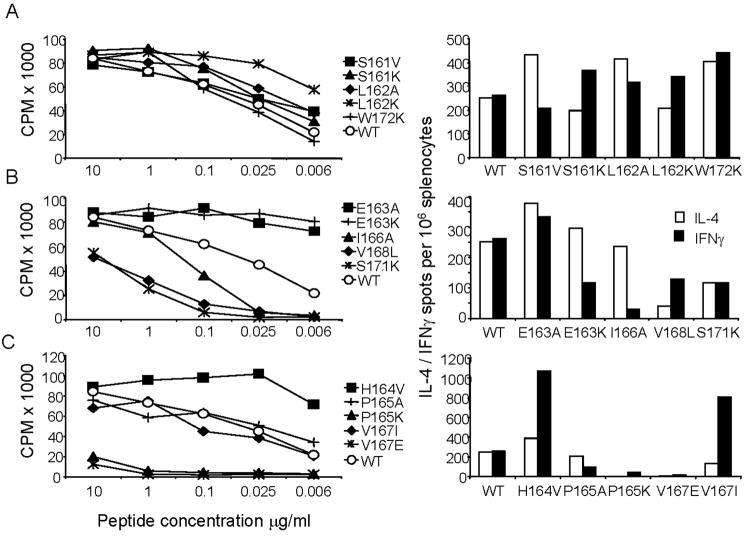
Figure 4. LACK APLs can modulate the IFNγ and IL-4 cytokine response of Th0 naïve LACK-BV4 transgenic T cells, with heightened sensitivity at TCR contact sites
A. APLs with alterations flanking the core region (aa 161, 162 and 172); B. APLs with changes within potential MHC contacts (aa 163, 166, 168 and 171); and, C. APLs with residue substitutions at putative TCR contact sites (aa 164, 167, 169 and 170). Proliferative responses of naïve LACK-BV4 TCR transgenic splenocytes to the w/t LACK 161–175 peptide (empty circles: ○), or various analogs (filled symbols) for all left panels. The frequency of cytokine producing cells among naïve LACK-BV4 transgenic cells in response to w/t LACK or analogs by ELISA spot (all right panels). Bars in white represent IL-4 spots per 106 splenocytes, bars in black represent IFNγ spots per 106 splenocytes (the standard deviation of duplicate wells was less than 10%.). One representative of 3 experiments is depicted.
Figure 5
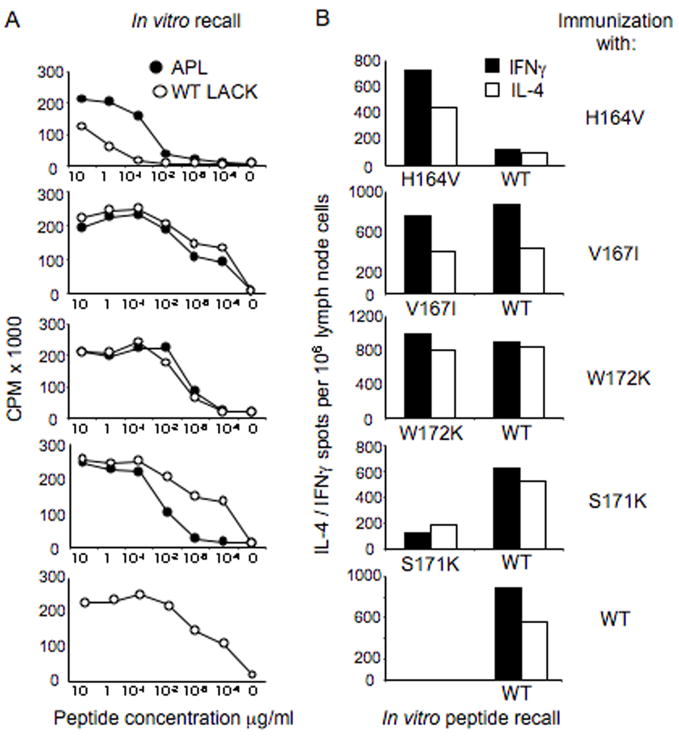
Figure 5. Immunization with LACK APLs in LACK-BV4 transgenic mice alters the recall response to the wild type LACK peptide
A. Proliferative response of draining lymph node cells from LACK-BV4 TCR transgenic mice immunized with either peptide analogs or with LACK wild type peptide and recalled in vitro against both the immunizing (black symbols) and the wild type peptide (white symbols). B. Frequency of IFNγ (black bars) and IL-4 producing cells (white bars) from immunized mice following in vitro recall with w/t LACK peptide or immunizing analogs; the standard deviation of duplicate wells was less than 10%. One representative experiment of 2 is displayed.

References

    1. Anderson RP, van Heel DA, Tye-Din JA, Jewell DP, Hill AV. Antagonists and non-toxic variants of the dominant wheat gliadin T cell epitope in coeliac disease. Gut. 2006;55:485–91. - PMC - PubMed
    1. Arnold PY, La Gruta NL, Miller T, Vignali KM, Adams PS, Woodland DL, Vignali DA. The majority of immunogenic epitopes generate CD4+ T cells that are dependent on MHC class II-bound peptide-flanking residues. J Immunol. 2002;169:739–49. - PubMed
    1. Borbulevych OY, Baxter TK, Yu Z, Restifo NP, Baker BM. Increased immunogenicity of an anchor-modified tumor-associated antigen is due to the enhanced stability of the peptide/MHC complex: implications for vaccine design. J Immunol. 2005;174:4812–20. - PMC - PubMed
    1. Carson RT, Vignali KM, Woodland DL, Vignali DA. T cell receptor recognition of MHC class II-bound peptide flanking residues enhances immunogenicity and results in altered TCR V region usage. Immunity. 1997;7:387–99. - PubMed
    1. Dai S, Huseby ES, Rubtsova K, Scott-Browne J, Crawford F, Macdonald WA, Marrack P, Kappler JW. Crossreactive T Cells spotlight the germline rules for alphabeta T cell-receptor interactions with MHC molecules. Immunity. 2008;28:324–34. - PMC - PubMed

Publication types

MeSH terms