Review
. 2009 Jan;30(1):1-7.
doi: 10.1016/j.tips.2008.10.001. Epub 2008 Nov 29.

Should peripheral CB(1) cannabinoid receptors be selectively targeted for therapeutic gain?

Affiliations
Review

Should peripheral CB(1) cannabinoid receptors be selectively targeted for therapeutic gain?

George Kunos et al. Trends Pharmacol Sci. 2009 Jan.

Abstract

Endocannabinoids, endogenous lipid ligands of cannabinoid receptors, mediate a variety of effects similar to those of marijuana. Cannabinoid CB(1) receptors are highly abundant in the brain and mediate psychotropic effects, which limits their value as a potential therapeutic target. There is growing evidence for CB(1) receptors in peripheral tissues that modulate a variety of functions, including pain sensitivity and obesity-related hormonal and metabolic abnormalities. In this review we propose that selective targeting of peripheral CB(1) receptors has potential therapeutic value because it would help to minimize addictive, psychoactive effects in the case of CB(1) agonists used as analgesics, or depression and anxiety in the case of CB(1) antagonists used in the management of cardiometabolic risk factors associated with the metabolic syndrome.


Figures
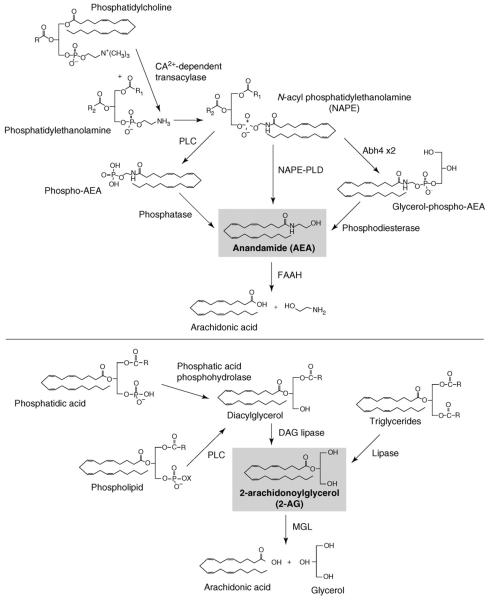
Figure 1
Figure 1
Enzymatic pathways of the biosynthesis and degradation of the two main endocannabinoids, anandamide and 2-arachidonoylglycerol. Note that both endocannabinoids can be generated by multiple, parallel biosynthetic pathways, whereas their enzymatic degradation occurs predominantly through a single, selective pathway. Selective inhibition of the degrading enzymes FAAH and MGL might have therapeutic potential in conditions where an increase in endocannabinoid tone is desirable.
Figure 2
Figure 2
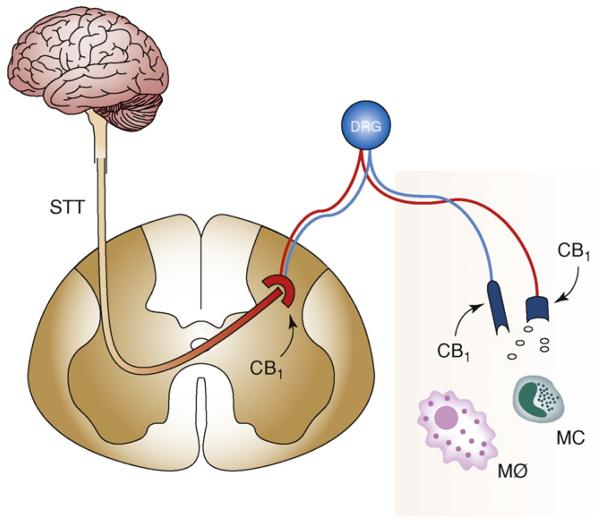
Peripheral mechanism of CB1-mediated analgesia in inflammatory/neuropathic pain. CB1 receptors in DRG neurons are axonally transported to peripheral sensory nerve terminals via C fibers. Their activation by locally released endocannabinoids or exogenous CB1 agonists counteracts inflammatory/neuropathic pain. STt, spinothalamic tract; DRG, dorsal root ganglion; MC, mast cell; Mø, macrophage.
Figure 3
Figure 3
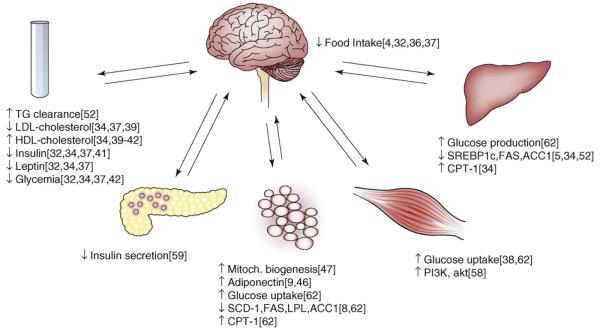
Metabolic/hormonal effects of CB1 receptor blockade or ablation mediated at sites in the brain and various peripheral tissues. Numbers next to individual effects are corresponding original reports as listed in References.

References

    1. Pacher P, et al. The endocannabinoid system as an emerging target of pharmacotherapy. Pharmacol. Rev. 2006;58:389–462. - PMC - PubMed
    1. Liu J, et al. Multiple pathways involved in the biosynthesis of anandamide. Neuropharmacology. 2008;54:1–7. - PMC - PubMed
    1. Kathuria S, et al. Modulation of anxiety through blockade of anandamide hydrolysis. Nat. Med. 2003;9:76–81. - PubMed
    1. Di Marzo V, et al. Leptin-regulated endocannabinoids are involved in maintaining food intake. Nature. 2001;410:822–825. - PubMed
    1. Osei-Hyiaman D, et al. Endocannabinoid activation at hepatic CB1 receptors stimulates fatty acid synthesis and contributes to diet-induced obesity. J. Clin. Invest. 2005;115:1298–1305. - PMC - PubMed

Publication types

MeSH terms

Substances