. 2009 Jan 15;587(2):379-99.
doi: 10.1113/jphysiol.2008.159129. Epub 2008 Dec 1.

Excitatory and inhibitory intermediate zone interneurons in pathways from feline group I and II afferents: differences in axonal projections and input

Affiliations

Excitatory and inhibitory intermediate zone interneurons in pathways from feline group I and II afferents: differences in axonal projections and input

B A Bannatyne et al. J Physiol. .

Abstract

The aim of the present study was to compare properties of excitatory and inhibitory spinal intermediate zone interneurons in pathways from group I and II muscle afferents in the cat. Interneurons were labelled intracellularly and their transmitter phenotypes were defined by using immunocytochemistry. In total 14 glutamatergic, 22 glycinergic and 2 GABAergic/glycinergic interneurons were retrieved. All interneurons were located in laminae V-VII of the L3-L7 segments. No consistent differences were found in the location, the soma sizes or the extent of the dendritic trees of excitatory and inhibitory interneurons. However, major differences were found in their axonal projections; excitatory interneurons projected either ipsilaterally, bilaterally or contralaterally, while inhibitory interneurons projected exclusively ipsilaterally. Terminal projections of glycinergic and glutamatergic cells were found within motor nuclei as well as other regions of the grey matter which include the intermediate region, laminae VII and VIII. Cells containing GABA/glycine had more restricted projections, principally within the intermediate zone where they formed appositions with glutamatergic axon terminals and unidentified cells and therefore are likely to be involved in presynaptic as well as postsynaptic inhibition. The majority of excitatory and inhibitory interneurons were found to be coexcited by group I and II afferents (monosynaptically) and by reticulospinal neurons (mono- or disynaptically) and to integrate information from several muscles. Taken together the morphological and electrophysiological data show that individual excitatory and inhibitory intermediate zone interneurons may operate in a highly differentiated way and thereby contribute to a variety of motor synergies.


Figures

Figure 1
Figure 1. An ipsilaterally projecting glutamatergic interneuron
A, a reconstruction of the soma, dendrites and initial course of the axon of interneuron C in Fig. 6. B and C, series of confocal microscope images showing terminals of this interneuron and their relationships with immunoreactivity for neurotransmitter markers. Ba and Ca show projected images of the axon (red) through a number of optical sections; panels b–d show single optical sections illustrating axon terminals (red, arrowheads) and neurotransmitter markers: the sequence in Bb–d shows that the terminals are immunoreactive for VGLUT2 (blue) but not GAD (green). Cb–d, no association was found with either VGLUT1 (shown in blue) or gephyrin (shown in green). Da–d, a series of single optical sections showing contacts between the terminals of this axon (red, arrows) and the soma (a and b) and dendrites (c and d) of motoneurons labelled with antibodies raised against ChAT (green) in the lateral motor nucleus of the L6 segment. VGLUT2 immunoreactivity is shown in blue. Scale bars: A 100 μm; Ba–d 5 μm Ca 5 μm; Cb–d 2 μm; Da, Dc 5 μm; Db, Dd 2 μm.
Figure 6
Figure 6. Projection areas of excitatory interneurons
A–N Circles represent somata and thick lines stem axons, and shading summarizes locations of terminals for all rostrocaudal levels where terminals were observed. Arrows indicate rostral and/or caudal projections where the axon could be followed more than 250 μm in either direction from the soma. ‘m’ indicates presence of synaptic contacts with interneurons. Cells are grouped depending on whether the axonal projections were ipsilateral (A–E), bilateral (F–I, M, N) or contralateral (J–L) and also on the basis of their dominant excitatory input from group I or from group II afferents. gr I < gr II and gr I > gr II at the bottom of each frame indicate that in neurons depicted in this frame monosynaptic EPSPs evoked from group I afferents were smaller or larger than EPSPs from group II afferents.
Figure 7
Figure 7. Projection areas of inhibitory interneurons
A–V, projection areas of 22 interneurons grouped depending on their dominant excitatory input from group I (A–K) or II afferents (L–V). Circles represent somata and thick lines stem axons, and shading summarizes locations of terminals for all rostrocaudal levels where terminals were observed as in Fig. 6. Arrows indicate rostral and/or caudal projections where the axon could be followed more than 250 μm in either direction from the soma.
Figure 7
Figure 7. Projection areas of inhibitory interneurons
A–V, projection areas of 22 interneurons grouped depending on their dominant excitatory input from group I (A–K) or II afferents (L–V). Circles represent somata and thick lines stem axons, and shading summarizes locations of terminals for all rostrocaudal levels where terminals were observed as in Fig. 6. Arrows indicate rostral and/or caudal projections where the axon could be followed more than 250 μm in either direction from the soma.
Figure 2
Figure 2. An ipsilaterally projecting glycinergic interneuron
A, reconstruction of the soma, dendrites and initial course of the axon of interneuron M in Fig. 7. B–C, series of confocal microscope images showing terminals of this interneuron and their relationship with immunoreactivity for neurotransmitter markers. Panel a in each case shows a projected image of the axon (red) through a number of optical sections; panels b–d show single optical sections illustrating axon terminals (red, arrowheads) and neurotransmitter markers. The sequence in Bb–d shows that the terminals are apposed to gephyrin puncta (green) but do not contain VGLUT1 (blue) and the images in Cb–d confirm that there is no association with either VGLUT2 (shown in blue) or GAD (shown in green). Scale bars: A 100 μm; Ba, Ca 10 μm; Bb–d 5 μm; Cb–d 2 μm.
Figure 3
Figure 3. Postsynaptic targets of inhibitory interneurons
Series of images showing contacts formed by terminals of inhibitory interneurons J, D and M in Fig. 7 with ventral horn neurons. Note that all of the putative contacts are associated with gephyrin immunoreactivity, thus confirming that they are synaptic in nature. A, a motoneuron which is labelled positively for ChAT (blue). B, a gephyrin rich cell at the border between lamina VII and IX. C, a lamina VII cell with a high density of VGLUT1 terminals on proximal areas of the dendritic tree. Left hand panels (a) show images projected from several sections; small panels (b–d, e–g) show details of the axon (red), apposed gephyrin puncta (green) and either ChAT (A, blue) or VGLUT1 (C, blue). Insets Ba and Ca show projected images of the axon collaterals present in each section. Scale bars: Aa, Ba, Ca 5 μm; panels b–d and e–g 2 μm.
Figure 4
Figure 4
Immunocytochemistry of a GABAergic/glycinergic interneuron A, reconstruction of the soma, dendrites and initial course of the stem axon (arrow) of one of the interneurons (A in Fig. 8). The axon of this cell entered the dorsal column (border indicated by grey line and arrowheads on right). B–D, series of confocal microscope images showing terminals of the interneuron and their relationships with immunoreactivity for neurotransmitter markers. Panel a in each case shows a projected image of the axon (red) through a number of optical sections; panels b–d show single optical sections illustrating axon terminals (red, arrowheads). Terminals of this interneuron were immunoreactive for GAD (B and C; green) and associated with gephyrin puncta (D; green). Terminals were frequently observed apposed to profiles that were immunoreactive for VGLUT1 (Bd, Cd; blue). Scale bars: A 100 μm; Ba, Ca 10 μm; Bb–d 5 μm; Cb–d 2 μm.
Figure 8
Figure 8. Axonal projection areas of GABAergic/glycinergic interneurons
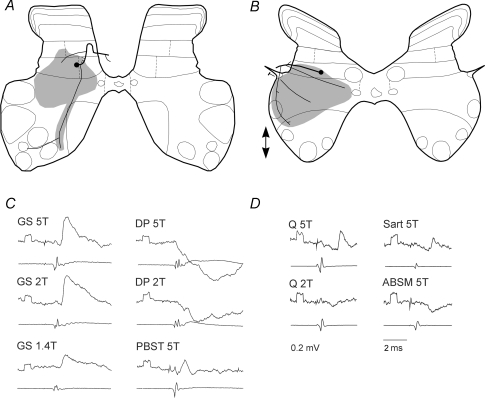
A and B, location and reconstruction of axonal projections of two interneurons. Circles represent somata and thick lines stem axons, and shading summarizes locations of terminals for all rostrocaudal levels where terminals were observed. Arrows indicate rostral and/or caudal projections where the axon could be followed more than 250 μm in either direction from the soma of interneuron B. C and D, intracellular records from these interneurons obtained at the beginning of the injection of the marker by passing 5 nA depolarizing current (upper traces) and records from the cord dorsum of the afferent volleys (lower traces). They show that the first interneuron was excited by group I afferents of gastrocnemius–soleus (GS) and posterior biceps–semitendinosus (PBST) and the second by group II afferents of quadriceps (Q) and sartorius (Sart) and that they were inhibited by group I and II afferents of DP and by group II afferents of anterior biceps–semimembranosus (ABSM), respectively. The latencies of the EPSPs were 0.9 ms in C and 2.7 and 2.9 ms in D, in both cases from group I afferent volleys, and compatible with monosynaptically evoked actions of group I and group II afferents, respectively. 5T, 2T and 1.4T, stimulus intensity expressed in multiples of threshold intensities. In this and in the following figures all the records are averages of 10 or 20 consecutive single sweeps. Negativity is downwards in intracellular records and upwards in records of afferent volleys. Rectangular pulses at the beginning of the records are calibration pulses (0.2 mV). Time calibration (2 ms) in D is for all of the records.
Figure 5
Figure 5. Location of excitatory and inhibitory interneurons
Location of cell bodies of labelled interneurons. Circles, squares and stars represent cells with ipsilateral, contralateral and bilateral projections, respectively; open symbols denote glutamatergic, filled black symbols glycinergic and filled grey symbols GABAergic cells.
Figure 9
Figure 9. Examples of PSPs evoked in four excitatory interneurons and four inhibitory interneurons
Upper and lower traces in each panel are averaged intracellular records (negativity downwards; obtained during passage of 5 nA of depolarizing current) and records from the cord dorsum (negativity upwards), respectively. Intracellular records from the top to bottom are from excitatory interneurons labelled K, B, H and E in Fig. 6 and from inhibitory interneurons labelled G, E, K and T in Fig. 7, as indicated in each panel. Amplitudes of these records have been normalized to make it easier to compare the declining phases of EPSPs in the left and right columns. In the three top rows, amplitudes of EPSPs evoked from group I afferents exceeded those from group II afferents; they were evoked in excitatory interneurons projecting contralaterally, ipsilaterally and bilaterally, respectively, and in three ipsilaterally projecting inhibitory interneurons. In contrast, in the bottom row EPSPs evoked from group I afferents were smaller than those from group II afferents; they were evoked in ipsilaterally projecting excitatory and inhibitory interneurons. First dotted lines indicate the arrival of afferent volleys from group I afferents. Second and third dotted lines indicate the approximate onset of EPSPs from group I and from group II afferents in the left and right columns and of IPSPs of group I origin and EPSPs of group II origin in the middle row. Rectangular pulses at the beginning of records are voltage calibration pulses (0.2 mV). Time calibration (4 ms) is for all records.
Figure 10
Figure 10. Examples of reversal of IPSPs at the end of labelling
A and B–D, upper traces: averaged intracellular records from two interneurons (A in Fig. 7 and H in Fig. 6); lowest traces in each panel are from the cord dorsum. Black records were taken during ejection of the marker by passage of 5 nA depolarizing current and grey records after the current was reduced to 0.5 or 0 nA and the cells repolarized. Dotted lines in A, B and C indicate afferent volleys and the onset of monosynaptic EPSPs and disynaptic IPSPs from group I afferents. Note large IPSPs following EPSPs during the depolarization and their subsequent reversal. Note also that IPSPs were evoked not only from group I afferents (B and C) and group II afferents (A and B) but also from the MLF (D).
Figure 11
Figure 11. Main projection areas of excitatory and inhibitory intermediate zone interneurons compared with projection areas of dorsal horn and lamina VIII interneurons
Circles represent excitatory and inhibitory interneurons located in the dorsal horn (left), the intermediate zone (middle) and lamina VIII (right). Different shades are used for the three subpopulations of intermediate zone interneurons (projecting bilaterally, ipsilaterally or contralaterally). Rectangular spaces to the left and right of these circles represent ipsilateral (i) and contralateral (co) projection areas within the dorsal horn, intermediate zone and the ventral horn, including motor nuclei. Data for dorsal horn interneurons are from Bannatyne et al. (2006) and those for ventral horn lamina VIII interneurons were reported previously (Bannatyne et al. 2003) and in the companion paper (Jankowska et al. 2009).

References

    1. Aggelopoulos NC, Burton MJ, Clarke RW, Edgley SA. Characterization of a descending system that enables crossed group II inhibitory reflex pathways in the cat spinal cord. J Neurosci. 1996;16:723–729. - PMC - PubMed
    1. Aggelopoulos NC, Edgley SA. Segmental localisation of the relays mediating crossed inhibition of hindlimb motoneurons from group II afferents in the anaesthetized cat spinal cord. Neurosci Lett. 1995;185:60–64. - PubMed
    1. Alstermark B, Kummel H. Transneuronal labelling of neurones projecting to forelimb motoneurones in cats performing different movements. Brain Res. 1986;376:387–391. - PubMed
    1. Alvarez FJ, Dewey DE, Harrington DA, Fyffe REW. Cell-type specific organization of glycine receptor clusters in the mammalian spinal cord. J Comp Neurol. 1997;379:150–170. - PubMed
    1. Angel MJ, Guertin P, Jimenez T, McCrea DA. Group I extensor afferents evoke disynaptic EPSPs in cat hindlimb extensor motorneurones during fictive locomotion. J Physiol. 1996;494:851–861. - PMC - PubMed

Publication types

MeSH terms

LinkOut - more resources