


Triple receptor-negative breast cancer: the effect of race on response to primary systemic treatment and survival outcomes
- PMID: 19047281
- PMCID: PMC4516695
- DOI: 10.1200/JCO.2008.17.9952
Triple receptor-negative breast cancer: the effect of race on response to primary systemic treatment and survival outcomes
Abstract
Purpose: The goal of this study was to describe the effect of race on pathologic complete response (pCR) rates and survival outcomes in women with triple receptor-negative (TN) breast cancers.
Patients and methods: Four hundred seventy-one patients with TN breast cancer diagnosed between 1996 and 2005 and treated with primary systemic chemotherapy were included. pCR was defined as no residual invasive cancer in the breast and axillary lymph nodes. Overall survival (OS) and recurrence-free survival (RFS) were estimated using the Kaplan-Meier product-limit method and compared between groups using the log-rank test. Cox proportional hazards models were fitted for each survival outcome to determine the relationship of patient and tumor variables with outcome.
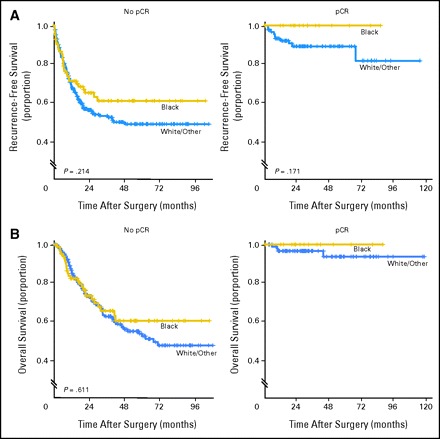
Results: Median follow-up time was 24.5 months. One hundred patients (21.2%) were black, and 371 patients (78.8%) were white/other race. Seventeen percent of black patients (n = 17) and 25.1% of white/other patients (n = 93) achieved a pCR (P = .091). Three-year RFS rates were 68% (95% CI, 56% to 76%) and 62% (95% CI, 57% to 67%) for black and white/other patients, respectively, with no significant difference observed between the two groups (P = .302). Three-year OS was similar for the two racial groups. After controlling for patient and tumor characteristics, race was not significantly associated with RFS (hazard ratio [HR] = 1.08; 95% CI, 0.69 to 1.68; P = .747) or OS (HR = 1.08; 95% CI, 0.69 to 1.68; P = .735) when white/other patients were compared with black patients.
Conclusion: Race does not significantly affect pCR rates or survival outcomes in women with TN breast cancer treated in a single institution under the same treatment conditions.
Figures
Comment in
-
African American women who receive primary anthracycline- and taxane-based chemotherapy for triple-negative breast cancer suffer worse outcomes compared with white women.J Clin Oncol. 2009 Aug 1;27(22):e35-7; author reply e38-9. doi: 10.1200/JCO.2008.21.5509. Epub 2009 Jun 29. J Clin Oncol. 2009. PMID: 19564528 Free PMC article. No abstract available.
References
-
- Kamangar F, Dores GM, Anderson WF: Patterns of cancer incidence mortality, and prevalence across five continents: Defining priorities to reduce cancer disparities in different geographic regions of the world. J Clin Oncol 24:2137-2150, 2006 - PubMed
-
- Berry DA, Cronin KA, Plevritis SK, et al: Effect of screening and adjuvant therapy on mortality from breast cancer. N Engl J Med 353:1784-1792, 2005 - PubMed
-
- Early Breast Cancer Trialists’ Collaborative Group: Effects of chemotherapy and hormonal therapy for early breast cancer on recurrence and 15-year survival: An overview of the randomised trials. Lancet 365:1687-1717, 2005 - PubMed
-
- Overgaard M, Jensen MB, Overgaard J, et al: Postoperative radiotherapy in high-risk postmenopausal breast-cancer patients given adjuvant tamoxifen: Danish Breast Cancer Cooperative Group DBCG 82c randomised trial. Lancet 353:1641-1648, 1999 - PubMed
-
- Piccart-Gebhart MJ, Procter M, Leyland-Jones B, et al: Trastuzumab after adjuvant chemotherapy in HER2-positive breast cancer. N Engl J Med 353:1659-1672, 2005 - PubMed
MeSH terms
Substances
Grants and funding
LinkOut - more resources
Full Text Sources
Medical
