Comparison of parent-only vs family-based interventions for overweight children in underserved rural settings: outcomes from project STORY
- PMID: 19047538
- PMCID: PMC3782102
- DOI: 10.1001/archpedi.162.12.1119
Comparison of parent-only vs family-based interventions for overweight children in underserved rural settings: outcomes from project STORY
Abstract
Objective: To assess the effectiveness of parent-only vs family-based interventions for pediatric weight management in underserved rural settings.
Design: A 3-arm randomized controlled clinical trial.
Setting: All sessions were conducted at Cooperative Extension Service offices in underserved rural counties.
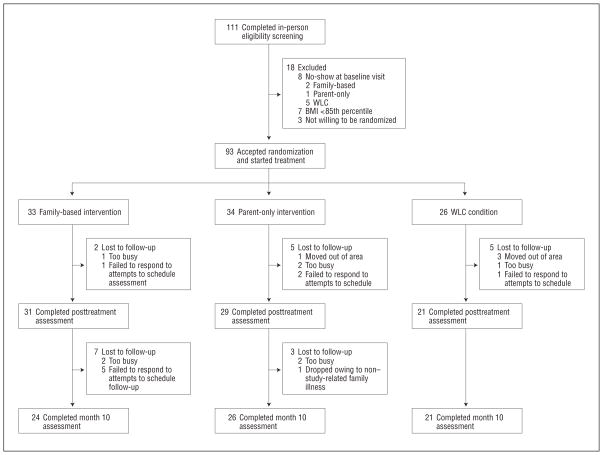
Participants: Ninety-three overweight or obese children (8-14 years old) and their parent(s).
Intervention: Families were randomized to (1) a behavioral family-based intervention, (2) a behavioral parent-only intervention, or (3) a wait-list control group.
Outcome measure: The primary outcome measure was change in children's standardized body mass index (BMI).
Results: Seventy-one children completed posttreatment (month 4) and follow-up (month 10) assessments. At the month 4 assessment, children in the parent-only intervention demonstrated a greater decrease in BMI z score (mean difference [MD], 0.127; 95% confidence interval [CI], 0.027 to 0.226) than children in the control condition. No significant difference was found between the family-based intervention and the control condition (MD, 0.065; 95% CI, -0.027 to 0.158). At month 10 follow-up, children in the parent-only and family-based intervention groups demonstrated greater decreases in BMI z score from before treatment compared with those in the control group (MD, 0.115; 95% CI, 0.003 to 0.220; and MD, 0.136; 95% CI, 0.018 to 0.254, respectively). No difference was found in weight status change between the parent-only and family-based interventions at either assessment.
Conclusions: A parent-only intervention may be a viable and effective alternative to family-based treatment of childhood overweight. Cooperative Extension Service offices have the potential to serve as effective venues for the dissemination of obesity-related health promotion programs.
Figures


Comment in
-
Treating pediatric obesity: generating the evidence.Arch Pediatr Adolesc Med. 2008 Dec;162(12):1191-2. doi: 10.1001/archpedi.162.12.1191. Arch Pediatr Adolesc Med. 2008. PMID: 19047549 No abstract available.
-
Parent-only interventions may be effective for weight loss in overweight children in rural areas.J Pediatr. 2009 May;154(5):776. doi: 10.1016/j.jpeds.2009.02.046. J Pediatr. 2009. PMID: 19364569 No abstract available.
References
-
- Eberhardt MS, Ingram DD, Makuc DM, et al. Urban and Rural Health Chartbook: Health, United States, 2001. Hyattsville, MD: National Center for Health Statistics; 2001.
-
- Economic Research Services. Rural Conditions and Trends. Vol. 4. Washington, DC: US Dept of Agriculture; 1993.
-
- Pearson TA. Report of the Conference on Socioeconomic Status and Cardiovascular Disease and Health. Bethesda, MD: National Heart, Lung, and Blood Institute; 1996. Socioeconomic status and cardiovascular disease in rural populations; pp. 101–108.
-
- Brownson RC, Housemann RA, Brown DR, et al. Promoting physical activity in rural communities: walking trail access, use, and effects. Am J Prev Med. 2000;18(3):235–241. - PubMed