Comparative Study
. 2009 Mar 19;113(12):2843-50.
doi: 10.1182/blood-2008-06-165340. Epub 2008 Dec 1.

Transferrin-a modulates hepcidin expression in zebrafish embryos

Affiliations
Comparative Study

Transferrin-a modulates hepcidin expression in zebrafish embryos

Paula G Fraenkel et al. Blood. .

Abstract

The iron regulatory hormone hepcidin is transcriptionally up-regulated in response to iron loading, but the mechanisms by which iron levels are sensed are not well understood. Large-scale genetic screens in the zebrafish have resulted in the identification of hypochromic anemia mutants with a range of mutations affecting conserved pathways in iron metabolism and heme synthesis. We hypothesized that transferrin plays a critical role both in iron transport and in regulating hepcidin expression in zebrafish embryos. Here we report the identification and characterization of the zebrafish hypochromic anemia mutant, gavi, which exhibits transferrin deficiency due to mutations in transferrin-a. Morpholino knockdown of transferrin-a in wild-type embryos reproduced the anemia phenotype and decreased somite and terminal gut iron staining, while coinjection of transferrin-a cRNA partially restored these defects. Embryos with transferrin-a or transferrin receptor 2 (TfR2) deficiency exhibited low levels of hepcidin expression, however anemia, in the absence of a defect in the transferrin pathway, failed to impair hepcidin expression. These data indicate that transferrin-a transports iron and that hepcidin expression is regulated by a transferrin-a-dependent pathway in the zebrafish embryo.


Figures
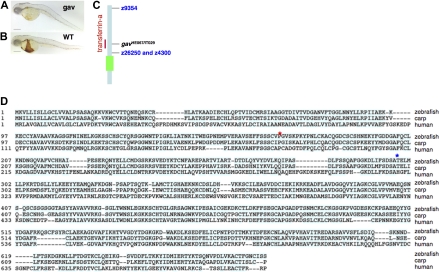
Figure 1
Figure 1
The zebrafish mutant gavi. At 48 hpf, staining for hemoglobin with o-dianisidine revealed that the homozygous gavi (gav) mutant embryo (A) has decreased hemoglobin staining compared with a wild-type sibling (B). The scale bar represents 200 μm. Intermediate resolution mapping of the gavi mutation, using bulk segregant analysis, revealed that the mutation was on linkage group 2, near the transferrin-a locus (C). The green box represents the centromere. A protein sequence alignment (D) illustrates the relationship of the zebrafish transferrin-a protein sequence to transferrins from other species. Conserved residues are shaded light blue. The predicted truncation sites in the zebrafish mutants are indicated by asterisks: gavIT029 (red) and gavHE067 (blue).
Figure 2
Figure 2
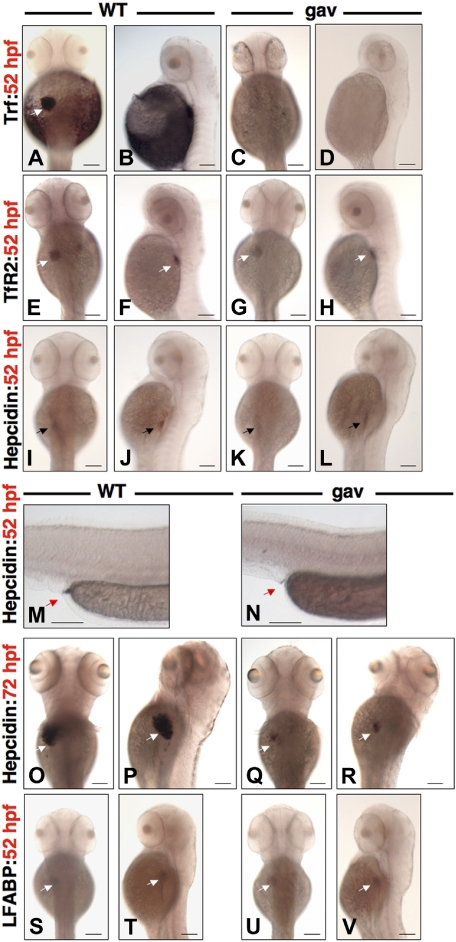
Phenotypic characterization of gavi. Whole mount in situ hybridization for transferrin-a (A-D), TfR2 (E-H), hepcidin (I-R), and LFABP (S-V) for WT siblings (A,B,E,F,I,J,M,O,P,S,T) versus gavIT029 (C,D,G,H,K,L,N,Q,R,U,V) in dorsal and lateral views at 52 hpf (A-N,S-V) and 72 hpf (O-R). White arrow indicates the liver. Black arrow indicates the foregut. Red arrow indicates the proctodeum (terminal gut). The scale bar represents 100 μm.
Figure 3
Figure 3
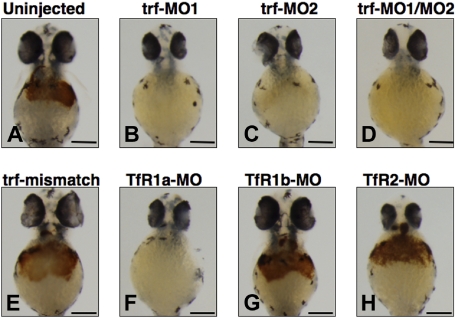
Effect of morpholino knockdown of transferrin-a or TfRs on o-dianisidine staining for hemoglobin at 48 hpf. Uninjected embryos (A) exhibited normal levels of hemoglobin, while morpholino knockdown of transferrin-a via injection of trf-MO1 (B) targeting the ATG, or trf-MO2 (C) targeting the exon 4 donor, or coinjection of trf-MO1/trf-MO2 (D) produced anemia. In contrast, coinjection of mismatch controls trf-MO1M/trf-MO2M (E) failed to produce anemia. Morpholino knockdown of the erythroid-specific transferrin receptor (TfR1a; F) resulted in anemia, while knockdown of the ubiquitously expressed transferrin receptor (TfR1b; G) or TfR2 (H) did not cause anemia. The scale bar represents 200 μm.
Figure 4
Figure 4
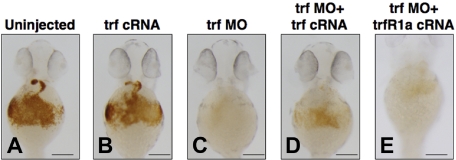
Coinjection of transferrin-a or TfR1a cRNA rescues anemia in transferrin-a morphants. O-dianisidine staining for hemoglobin at 48 hpf comparing (A) uninjected WT, (B) overexpression of transferrin-a cRNA, (C) morpholino knockdown of transferrin-a, (D) coinjection of transferrin-a cRNA with transferrin-a morpholino, (E) coinjection of TfR1a cRNA with transferrin-a morpholino. The scale bar represents 200 μm.
Figure 5
Figure 5
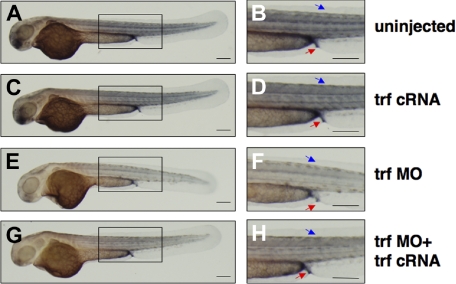
Coinjection of transferrin-a cRNA improves somite iron stores in transferrin-a morphants. DAB-enchanced Perl stain for ferric iron at 52 hpf in (A,B) uninjected WT, (C,D) transferrin-a cRNA overexpression, (E,F) morpholino knockdown of transferrin-a, (G,H) coinjection of transferrin-a cRNA with transferrin-a morpholino. Red arrow indicates the proctodeum. Blue arrow indicates the somites. The scale bar represents 200 μm.
Figure 6
Figure 6
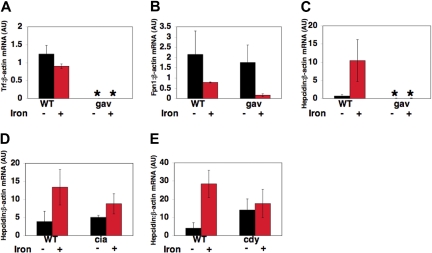
Changes in gene expression in gavi and other hypochromic mutants. At 52 hpf, zebrafish embryos were either injected with iron dextran or anesthetized, but not injected. RNA was obtained from pools of anemic mutants and their wild-type siblings at 72 hours after fertilization, 18 hours after iron injection. Quantitative multiplex real-time RT-PCR, normalized to β-actin expression, was performed for transferrin-a (A), fpn1 (B), and hepcidin (C-E) in gavIT029 (A-C), TfR1a-deficient chianti (ciaTu25f) mutants (D) and DMT1-deficient chardonnay (cdyTe216) mutants (E). Gene expression is reported as fold increase over calibrator, a WT uninjected control pool. *P < .05 compared with WT uninjected controls.
Figure 7
Figure 7
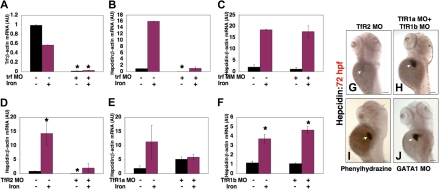
Effect of morpholino knockdown of transferrin-a or TfRs on gene expression. Transferrin-a expression was reduced after morpholino knockdown of transferrin-a (A). Hepcidin expression was also reduced after knockdown of transferrin-a (B), but not after injection of a mismatch morpholino with 5 nucleotide substitutions (C). Knockdown of TfR2 (D) resulted in low hepcidin expression that failed to increase significantly after iron dextran injection. In contrast, knockdown of TfR1a (E) or TFR1b (F) did not impair baseline hepcidin expression, although the response to iron injection was blunted in TfR1a morphants. (G-J) Whole mount in situ hybridization at 72 hpf, in the absence of iron injection. Decreased hepcidin expression was observed in TfR2 morphant embryos (G), while knockdown of TfR1a and TfR1b in combination (H) failed to reduce hepcidin expression. Producing anemia by treatment of embryos with phenylhydrazine (I) or morpholino knockdown of GATA1 (J) resulted in strong hepcidin expression. White arrow marks the liver. *P < .05 compared with embryos that were neither injected with iron dextran nor morpholino.

References

    1. Aisen P. Transferrin receptor 1. Int J Biochem Cell Biol. 2004;36:2137–2143. - PubMed
    1. Fleming MD, Romano MA, Su MA, Garrick LM, Garrick MD, Andrews NC. Nramp2 is mutated in the anemic Belgrade (b) rat: evidence of a role for Nramp2 in endosomal iron transport. Proc Natl Acad Sci U S A. 1998;95:1148–1153. - PMC - PubMed
    1. Garrick MD, Gniecko K, Liu Y, Cohan DS, Garrick LM. Transferrin and the transferrin cycle in Belgrade rat reticulocytes. J Biol Chem. 1993;268:14867–14874. - PubMed
    1. Kawabata H, Yang R, Hirama T, et al. Molecular cloning of transferrin receptor 2. A new member of the transferrin receptor-like family. J Biol Chem. 1999;274:20826–20832. - PubMed
    1. Kawabata H, Germain RS, Vuong PT, Nakamaki T, Said JW, Koeffler HP. Transferrin receptor 2-alpha supports cell growth both in iron-chelated cultured cells and in vivo. J Biol Chem. 2000;275:16618–16625. - PubMed

Publication types

MeSH terms

Associated data