


doi: 10.1080/17470210802453977.
Epub 2008 Dec 1.
Core verbal working-memory capacity: the limit in words retained without covert articulation
Affiliations
- PMID: 19048451
- PMCID: PMC2693080
- DOI: 10.1080/17470210802453977
Item in Clipboard
Core verbal working-memory capacity: the limit in words retained without covert articulation
Q J Exp Psychol (Hove).
2009 Jul.
Abstract
Verbal working memory may combine phonological and conceptual units. We disentangle their contributions by extending a prior procedure (Chen & Cowan, 2005) in which items recalled from lists of previously seen word singletons and of previously learned word pairs depended on the list length in chunks. Here we show that a constant capacity of about 3 chunks holds across list lengths and list types, provided that covert phonological rehearsal is prevented. What remains is a core verbal working-memory capacity.
Figures
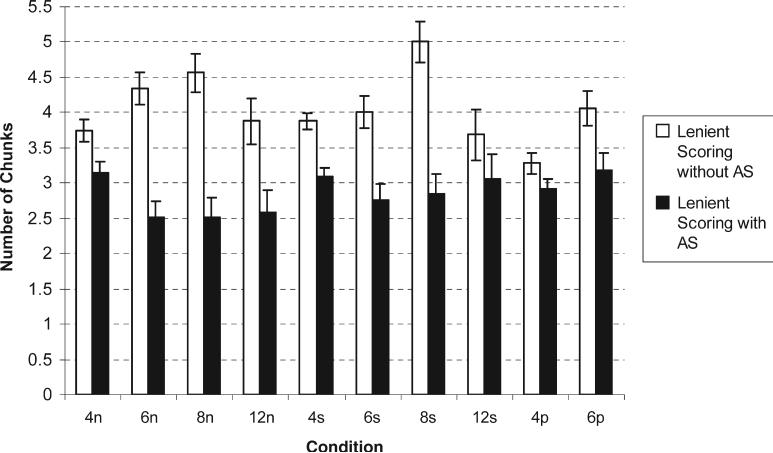
Memory of chunks in immediate serial recall as a function of list conditions under lenient scoring. AS = articulatory suppression. The error bars indicate standard errors of the mean.
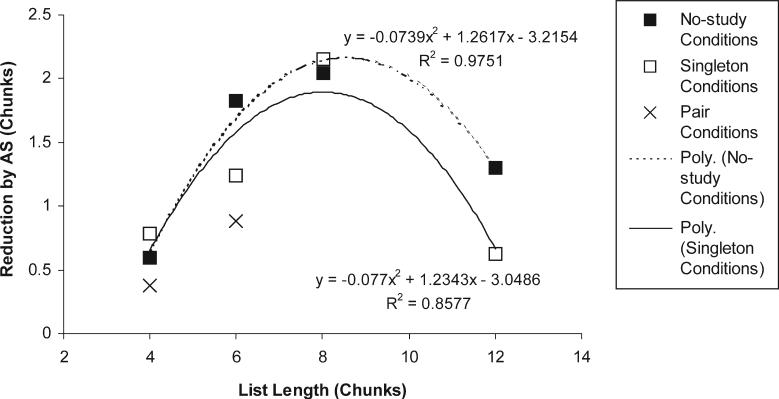
Polynomial regressions of the mean performance reduction in chunks caused by articulatory suppression (AS), across the number of chunks in the list, separately for no-study and singleton conditions. Paired conditions also are shown.
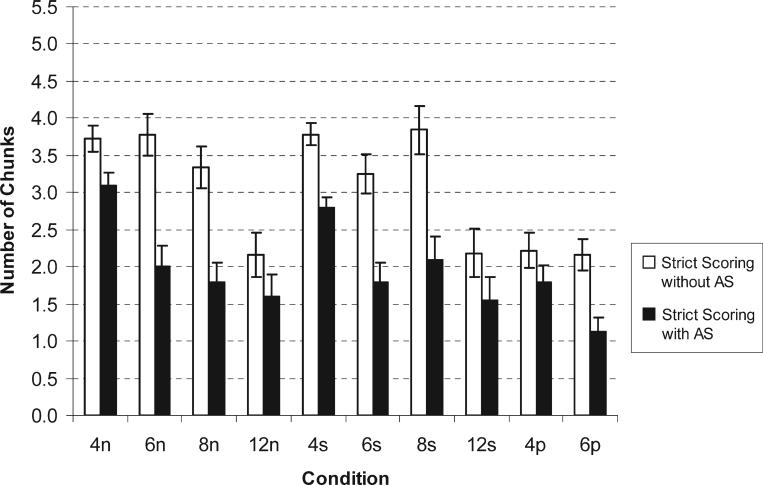
Memory of chunks in immediate serial recall as a function of list conditions under strict scoring. AS = articulatory suppression. The error bars indicate standard errors of the mean.
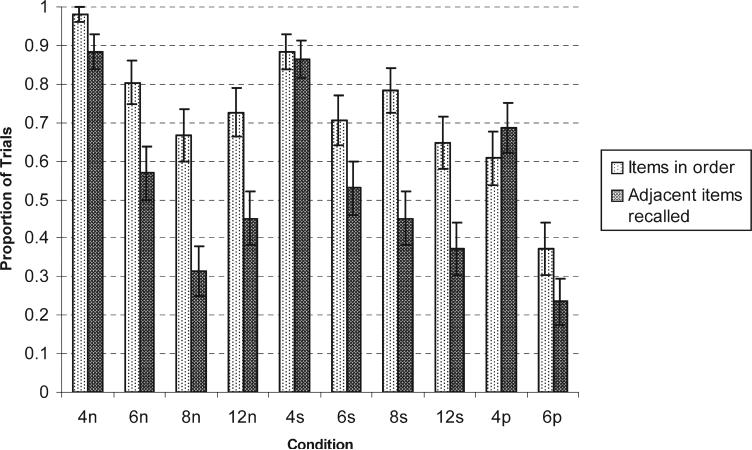
Proportion of trials in which the recalled items were in the correct order (regardless of whether all items were recalled) and proportion of trials in which the recalled items were from adjacent positions on the input list, collapsed across the two experiments. The error bars indicate standard errors of the mean.
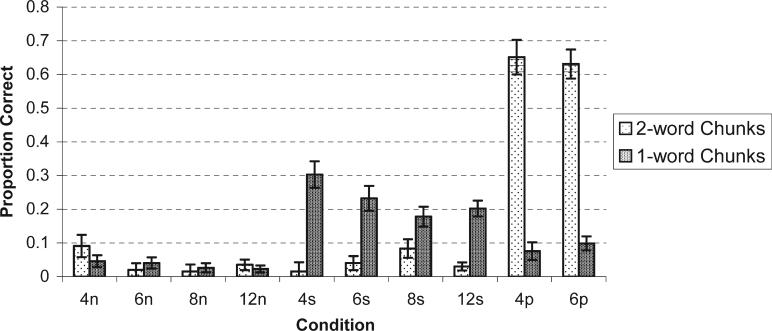
Proportion of chunks recalled in final free recall as a function of list conditions. The error bars indicate standard errors of the mean.
References
-
- Baddeley A. Oxford psychology series, No. 11: Working memory. Clarendon Press/Oxford University Press; New York: 1986.
-
- Baddeley A. The episodic buffer: A new component of working memory? Trends in Cognitive Sciences. 2000;4:417–423. - PubMed
-
- Baddeley A. The magic number and the episodic buffer. Behavioral and Brain Sciences. 2001;24:117–118.
-
- Baddeley AD, Hitch GJ. Working memory. In: Bower GA, editor. The psychology of learning and motivation: Advances in research and theory. Vol. 8. Academic Press; New York: 1974. pp. 47–89.
-
- Baddeley AD, Lewis V, Vallar G. Exploring the articulatory loop. Quarterly Journal of Experimental Psychology: Human Experimental Psychology. 1984;36A:233–252.
Publication types
MeSH terms
Grants and funding
LinkOut - more resources
Full Text Sources
