. 2009 Mar 1;124(5):1161-8.
doi: 10.1002/ijc.24025.

At what costs will screening with CT colonography be competitive? A cost-effectiveness approach

Affiliations

At what costs will screening with CT colonography be competitive? A cost-effectiveness approach

Iris Lansdorp-Vogelaar et al. Int J Cancer. .

Abstract

The costs of computed tomographic colonography (CTC) are not yet established for screening use. In our study, we estimated the threshold costs for which CTC screening would be a cost-effective alternative to colonoscopy for colorectal cancer (CRC) screening in the general population. We used the MISCAN-colon microsimulation model to estimate the costs and life-years gained of screening persons aged 50-80 years for 4 screening strategies: (i) optical colonoscopy; and CTC with referral to optical colonoscopy of (ii) any suspected polyp; (iii) a suspected polyp >or=6 mm and (iv) a suspected polyp >or=10 mm. For each of the 4 strategies, screen intervals of 5, 10, 15 and 20 years were considered. Subsequently, for each CTC strategy and interval, the threshold costs of CTC were calculated. We performed a sensitivity analysis to assess the effect of uncertain model parameters on the threshold costs. With equal costs ($662), optical colonoscopy dominated CTC screening. For CTC to gain similar life-years as colonoscopy screening every 10 years, it should be offered every 5 years with referral of polyps >or=6 mm. For this strategy to be as cost-effective as colonoscopy screening, the costs must not exceed $285 or 43% of colonoscopy costs (range in sensitivity analysis: 39-47%). With 25% higher adherence than colonoscopy, CTC threshold costs could be 71% of colonoscopy costs. Our estimate of 43% is considerably lower than previous estimates in literature, because previous studies only compared CTC screening to 10-yearly colonoscopy, where we compared to different intervals of colonoscopy screening.


Figures
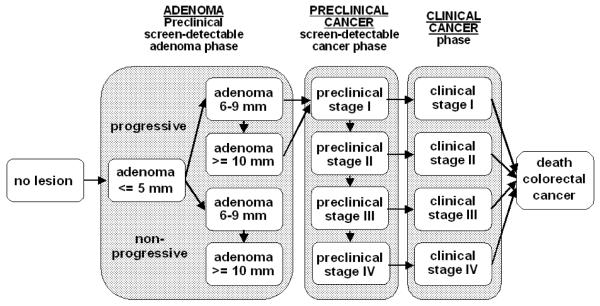
Figure 1
Figure 1
Adenoma and cancer stages in the MISCAN-Colon model. Cancer stages correspond to the American Joint Committee on Cancer / International Union Against Cancer staging system for CRC. Adenomas are categorized by size. The size-specific prevalence of adenomas as well as the proportion of adenomas that ever develop into cancer is dependent on age. It is assumed that the proportion of progressive adenomas increases from 16% at age 65 years to 37% at age 75 years, and 96% at age 100 years. It is assumed that 50% of non-progressive adenomas will remain 6-9 mm stage until death and that 50% will progress to the ≥10 mm stage. For progressive adenomas, it is assumed that 30% will develop through the sequence ≤5 mm adenoma → 6-9 mm adenoma → preclinical cancer stage I and that 70% will develop through the sequence ≤5 mm adenoma →6-9 mm adenoma → ≥10 mm adenoma → preclinical cancer stage I. The mean duration time for progressive adenoma is assumed to be 16.4 years (with an exponential distribution). The mean duration time for preclinical cancer is assumed to be 2 years (stage I), 1 year (stage II), 1.5 years (stage III), and 0.8 years (stage IV).
Figure 2
Figure 2
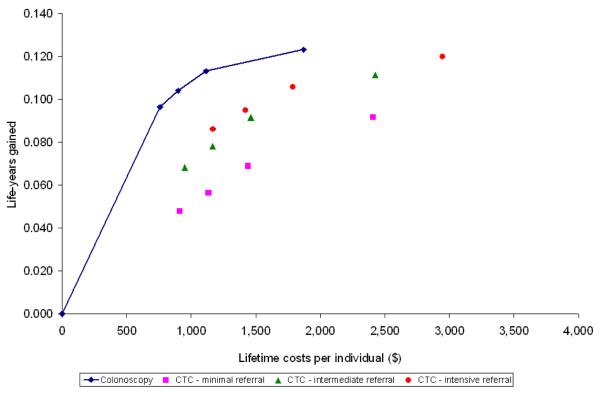
The net costs required over a lifetime and the life-years gained (3% discounted and compared to a situation without screening) for screening a cohort of 50-year olds according to different colonoscopy and CTC screening strategies varying with respect to screening interval and referral threshold. Lifetime costs include costs for screening, diagnostic and surveillance colonoscopy minus the savings from treatment compared to a situation without screening. The blue diamonds represent the colonoscopy strategies; the pink squares CTC strategies with minimal referral, the green triangles CTC with intermediate referral and the orange circles CTC strategies with intensive referral. From left to right the symbols per strategy represent intervals of 20, 15, 10 and 5 years. The solid line represents the cost-effectiveness of colonoscopy screening strategies, corresponding with Table 3. CTC costs are equal to colonoscopy costs in figure 2A, half of colonoscopy costs in figure 2B, and one third of colonoscopy costs in figure 2C. Figure 2a: CTC costs equal to colonoscopy costs Figure 2b: CTC costs half of colonoscopy costs Figure 2c: CTC costs one third of colonoscopy costs
Figure 2
Figure 2
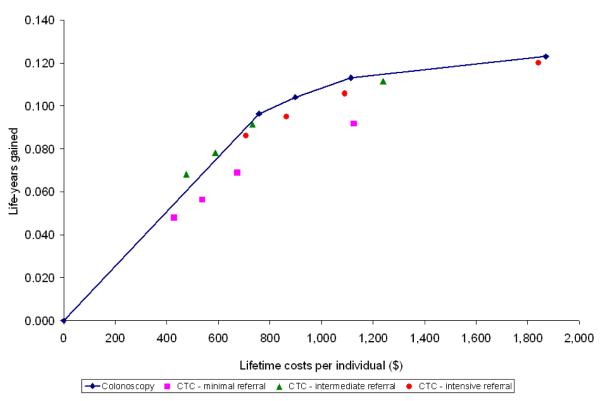
The net costs required over a lifetime and the life-years gained (3% discounted and compared to a situation without screening) for screening a cohort of 50-year olds according to different colonoscopy and CTC screening strategies varying with respect to screening interval and referral threshold. Lifetime costs include costs for screening, diagnostic and surveillance colonoscopy minus the savings from treatment compared to a situation without screening. The blue diamonds represent the colonoscopy strategies; the pink squares CTC strategies with minimal referral, the green triangles CTC with intermediate referral and the orange circles CTC strategies with intensive referral. From left to right the symbols per strategy represent intervals of 20, 15, 10 and 5 years. The solid line represents the cost-effectiveness of colonoscopy screening strategies, corresponding with Table 3. CTC costs are equal to colonoscopy costs in figure 2A, half of colonoscopy costs in figure 2B, and one third of colonoscopy costs in figure 2C. Figure 2a: CTC costs equal to colonoscopy costs Figure 2b: CTC costs half of colonoscopy costs Figure 2c: CTC costs one third of colonoscopy costs
Figure 2
Figure 2
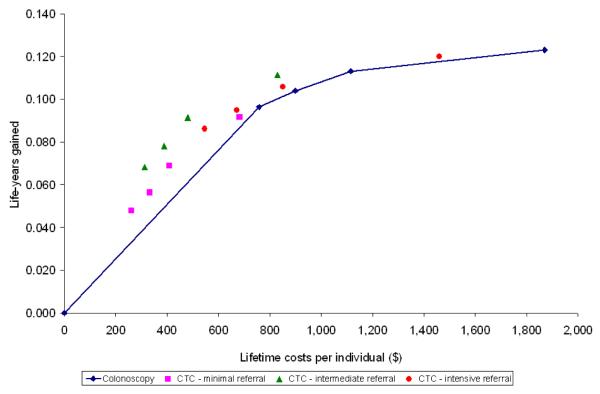
The net costs required over a lifetime and the life-years gained (3% discounted and compared to a situation without screening) for screening a cohort of 50-year olds according to different colonoscopy and CTC screening strategies varying with respect to screening interval and referral threshold. Lifetime costs include costs for screening, diagnostic and surveillance colonoscopy minus the savings from treatment compared to a situation without screening. The blue diamonds represent the colonoscopy strategies; the pink squares CTC strategies with minimal referral, the green triangles CTC with intermediate referral and the orange circles CTC strategies with intensive referral. From left to right the symbols per strategy represent intervals of 20, 15, 10 and 5 years. The solid line represents the cost-effectiveness of colonoscopy screening strategies, corresponding with Table 3. CTC costs are equal to colonoscopy costs in figure 2A, half of colonoscopy costs in figure 2B, and one third of colonoscopy costs in figure 2C. Figure 2a: CTC costs equal to colonoscopy costs Figure 2b: CTC costs half of colonoscopy costs Figure 2c: CTC costs one third of colonoscopy costs
Figure 3
Figure 3
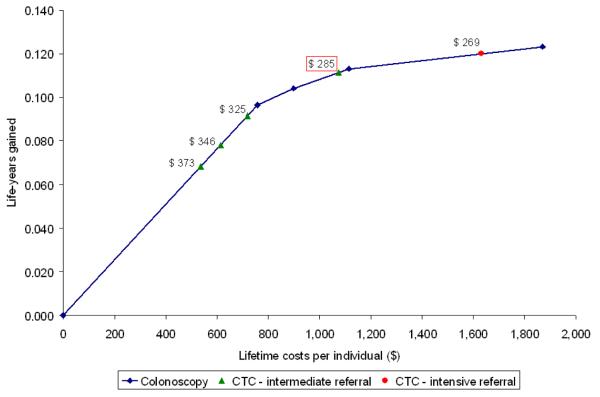
The threshold costs of non-dominated CTC strategies for which the strategies are a cost-effective alternative to colonoscopy screening. The green triangles represent CTC screening with intermediate referral. From left to right the triangles represent screening intervals of 20, 15, 10 and 5 years. The orange circle represents CTC screening every 5 years with intensive referral. The costs next to the symbols per strategy indicate the threshold unit costs for CTC to be cost-effective compared to colonoscopy screening. The boxed cost is the threshold costs for 5-yearly CTC with intermediate referral, the strategy with similar life-years gained as 10-yearly colonoscopy.

Comment in

References

    1. Jemal A, Siegel R, Ward E, Hao Y, Xu J, Murray T, Thun MJ. Cancer statistics, 2008. CA Cancer J Clin. 2008;58:71–96. - PubMed
    1. Faivre J, Dancourt V, Lejeune C, Tazi MA, Lamour J, Gerard D, Dassonville F, Bonithon-Kopp C. Reduction in colorectal cancer mortality by fecal occult blood screening in a French controlled study. Gastroenterology. 2004;126:1674–80. - PubMed
    1. Hardcastle JD, Chamberlain JO, Robinson MH, Moss SM, Amar SS, Balfour TW, James PD, Mangham CM. Randomised controlled trial of faecal-occult-blood screening for colorectal cancer. Lancet. 1996;348:1472–7. - PubMed
    1. Kronborg O, Fenger C, Olsen J, Jorgensen OD, Sondergaard O. Randomised study of screening for colorectal cancer with faecal-occult-blood test. Lancet. 1996;348:1467–71. - PubMed
    1. Mandel JS, Church TR, Ederer F, Bond JH. Colorectal cancer mortality: effectiveness of biennial screening for fecal occult blood. J Natl Cancer Inst. 1999;91:434–37. - PubMed

Publication types

MeSH terms