


Review
doi: 10.1194/jlr.R800092-JLR200.
Epub 2008 Dec 2.
The role of adaptive T cell immunity in atherosclerosis
Affiliations
- PMID: 19050311
- PMCID: PMC2674704
- DOI: 10.1194/jlr.R800092-JLR200
Item in Clipboard
Review
The role of adaptive T cell immunity in atherosclerosis
J Lipid Res.
2009 Apr.
Abstract
There is now solid evidence that T cell adaptive immunity is involved in atherogenesis. While initial studies have focused on the pathogenic arm of the immune response, more recent work clearly suggests an important role for several subsets of regulatory T cells in the protection against lesion development. Here, we review the current knowledge on the role of both pathogenic and regulatory adaptive T cell immunity in atherosclerosis, generated mainly from the study of mouse models of the disease.
Figures
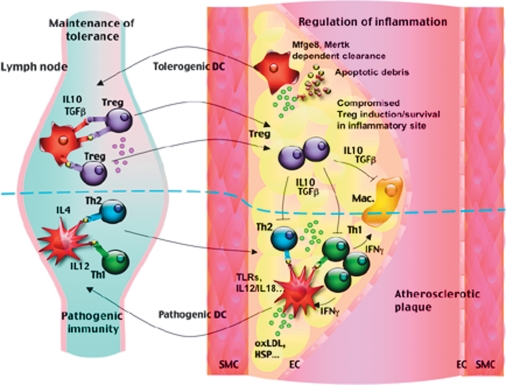
Antigen presentation and induction of antigen-specific pathogenic and regulatory T cells in the context of atherosclerosis. Antigen presentation most likely occurs within the secondary lymphoid organs, and primed T cells are reactivated within the lesions. DC activation and maturation by self-altered structures, in part through toll-like receptors (TLRs), lead to induction/maintenance of pathogenic immunity. Phagocytic clearance of apoptotic debris through milk fat globule-EGF factor 8 (Mfge8) or mer tyrosine kinase receptor (mertk) is required for induction/maintenance of regulatory immunity. The proinflammatory plaque environment is permissive to the induction/maintenance of pathogenic T cells but impairs the development of regulatory immunity. Thus, in order to maintain a Treg cell response, DCs would need to continuously traffic to peripheral lymphoid organs.
References
-
- Tedgui A., and Z. Mallat. 2006. Cytokines in atherosclerosis: pathogenic and regulatory pathways. Physiol. Rev. 86 515–581. - PubMed
-
- Weber C., A. Zernecke, and P. Libby. 2008. The multifaceted contributions of leukocyte subsets to atherosclerosis: lessons from mouse models. Nat. Rev. Immunol. 8 802–815. - PubMed
-
- Zhou X., A. K. Robertson, C. Hjerpe, and G. K. Hansson. 2006. Adoptive transfer of CD4+ T cells reactive to modified low-density lipoprotein aggravates atherosclerosis. Arterioscler. Thromb. Vasc. Biol. 26 864–870. - PubMed
-
- Liu P., Y. R. Yu, J. A. Spencer, A. E. Johnson, C. T. Vallanat, A. M. Fong, C. Patterson, and D. D. Patel. 2008. CX3CR1 deficiency impairs dendritic cell accumulation in arterial intima and reduces atherosclerotic burden. Arterioscler. Thromb. Vasc. Biol. 28 243–250. - PubMed
Publication types
MeSH terms
LinkOut - more resources
Full Text Sources
Other Literature Sources
Medical
