


Review
doi: 10.1080/10253890802506409.
Glucocorticoid receptor dynamics and gene regulation
Affiliations
- PMID: 19051126
- PMCID: PMC6319377
- DOI: 10.1080/10253890802506409
Item in Clipboard
Review
Glucocorticoid receptor dynamics and gene regulation
Stress.
2009 May.
Abstract
The glucocorticoid receptor regulates the expression of a large number of genes in mammalian cells. The interaction of this receptor with regulatory elements has been discovered to be highly dynamic, with occupancy states measured in seconds, rather than minutes or hours. This finding has led to a paradigm shift in our understanding of receptor function throughout the genome. The mechanisms involved in these rapid exchange events, as well as the implications for receptor function, are discussed.
Conflict of interest statement
Figures
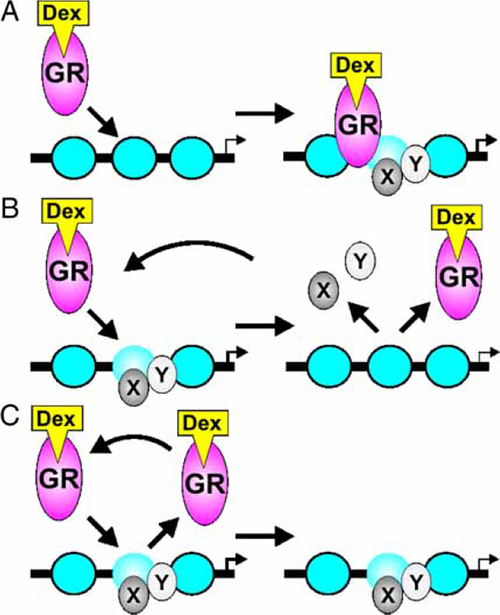
Models of glucocorticoid receptor dynamics at hormone response elements. (A) The classic model of receptor binding posits long-term residency of the receptor at the promoter with subsequent recruitment of factors. (B) Direct observation of receptor binding in living cells by Hager and colleagues (McNally et al. 2000) revealed rapid exchange of the receptor (hit-and-run). Most cofactors that have been examined (x, y) also exchange dynamically at sites of receptor binding. (C) Some coregulatory proteins may have longer residence times at selected sites. GR, glucocorticoid receptor; Dex, dexamethasone.
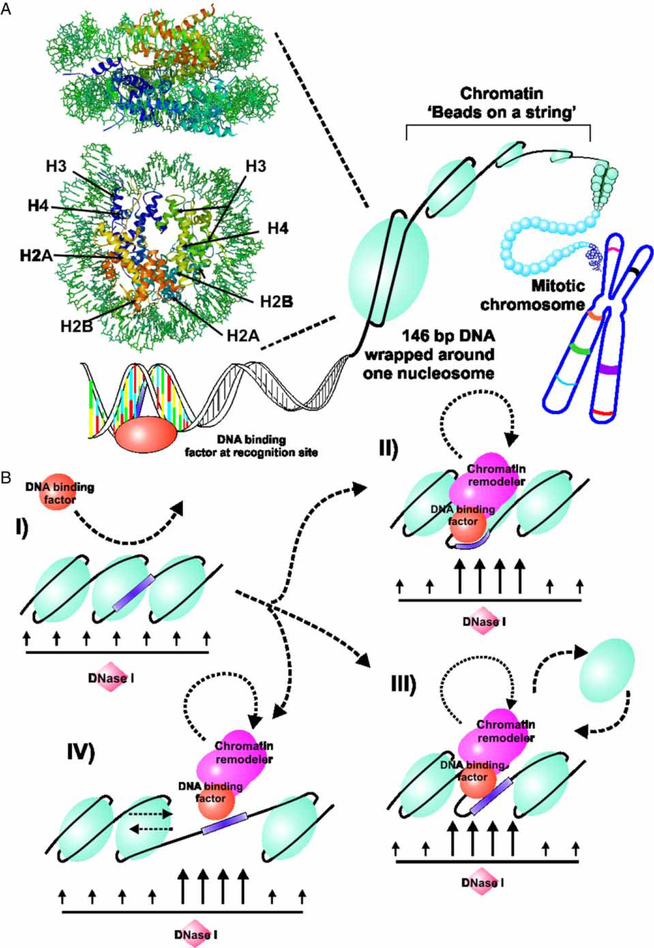
Interaction of transcription factors with chromatin. (A) DNA in the mammalian cell is organized in a hierarchical series of nucleoprotein structures collectively referred to as chromatin. The basic repeating unit in this structure is the nucleosome, with 146 bp of DNA wrapped on an octameric core of histones (H). The nucleosome is a flattened ellipsoid approximately 110Å on the large axis and 57Å thick. This structure is rendered here in RasMol from the coordinates published for the Xenopus laevis particle by Richmond and colleagues (Ong et al. 2007). Although transcription factors recognize specific sequences in DNA, access to these sites is severely constrained by packaging of the sequences in the nucleosome and higher order structures. (B) Eukaryotic cells have evolved complex systems to reorganize local nucleosome structures during gene regulation. These systems, referred to as remodeling enzymes, are recruited to specific regions by protein–protein interactions with transcription factors, and transiently “open” the nucleosome structure. These molecular reorganizations can be conveniently detected and mapped by the local increase in access to DNA by nucleolytic reagents, including DNaseI (Wu 1980), and chemicals such as methidiumpropyl-EDTA-Fe(II) (Cartwright and Elgin 1989). Multiple mechanisms are considered to be involved in nucleosome remodeling. A pioneer protein, such as GR, can sometimes recognize sites in non-remodeled chromatin (I), and initiate a cascade of binding events. These events can include the transient remodeling of core histone structure (II), the complete or partial eviction of histone components (III), or the “sliding” of nucleosomes to new translational positions on the DNA (IV). The mobility of transcription factors on DNA is now understood to be linked to these chromatin remodeling processes.
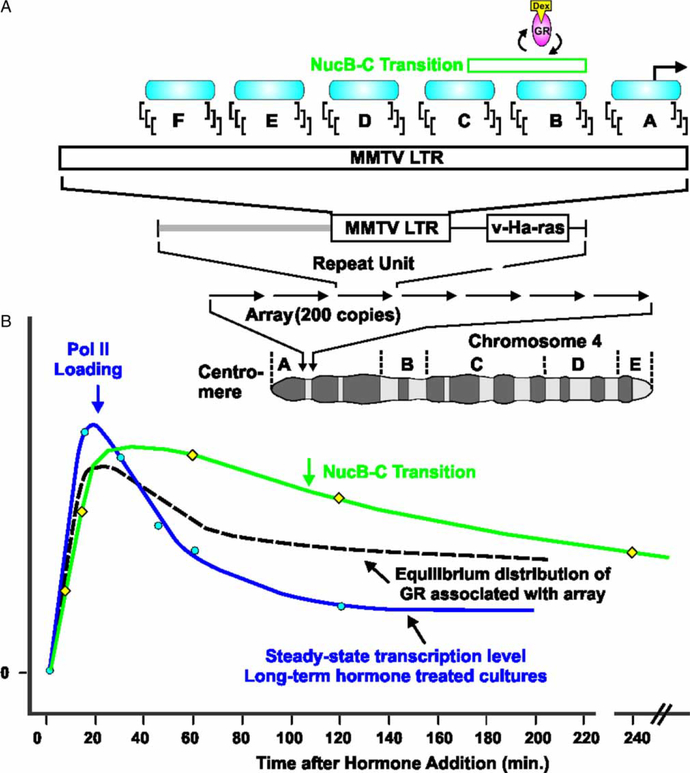
Glucocorticoid receptor induced transcriptional kinetics at a tandem array of GR responsive promoters. (A) The 3134 cell line contains the mouse mammary tumor virus-long terminal repeat (MMTV-LTR)-reporter array integrated at a unique site on chromosome four. Each repeat element (9 kb) includes the MMTV-LTR with 6 positioned nucleosome regions (NucA to NucF). (B) When examined by chromatin immunoprecipitation (ChIP), equilibrium loading of GR and RNA polymerase II (Pol II) at the MMTV promoter is rapidly induced, followed by a strong reduction in RNA polymerase II (Pol II) residency, and a lesser decrease in equilibrium loading of GR which persists for hours. DNaseI hypersensitivity is also rapidly induced, but follows a similar decay over the time period of observation. GR, glucocorticoid receptor; Dex, dexamethasone; v-Ha-ras, Harvey rat sarcoma viral oncogene homolog.
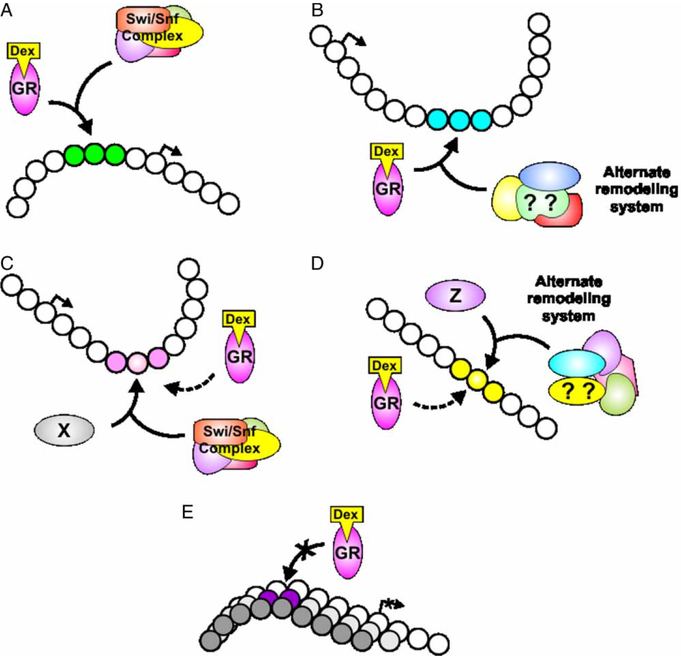
Glucocorticoid receptor binding throughout the genome is associated with localized chromatin remodeling. Four classes of remodeling events have been characterized (John et al. 2008b). GR either induces a de novo chromatin transition (A, B), or binds to a preexisting transition (pre-programmed)(C, D). The de novo transitions are either dependent on the Swi/Snf remodeling complex (A), or independent, requiring alternate remodeling complexes (B). GR also loads at sites of constitutively remodeled chromatin (C, D), which are maintained by other DNA binding proteins (X, Z). These sites are in turn either brahma-related gene 1 (Brg1)-dependent (C) or independent(D). Sites can also be available, or sequestered on a cell specific basis (E). The chromatin landscape thus presents a mechanism of cell and tissue-specific response to GR activation. GR, glucocorticoid receptor; Dex, dexamethasone.
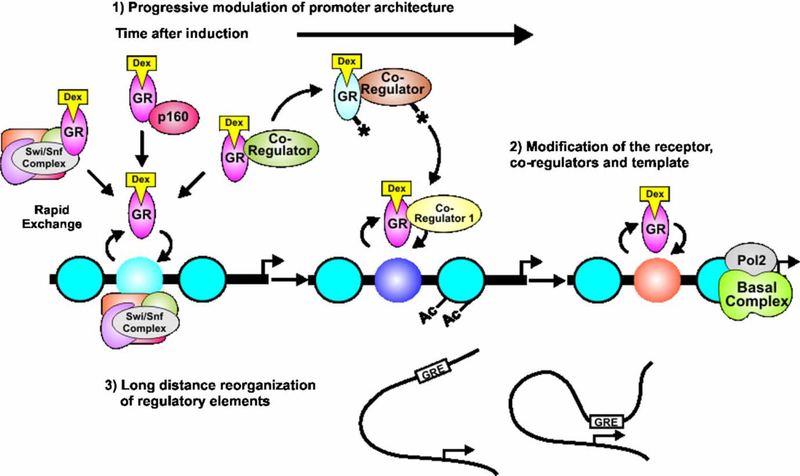
The promoter progression model proposes an integrative view of fast and slow dynamics of receptors and cofactors at the promoter. Receptors and cofactors exchange rapidly with the template at response elements, allowing the regulatory sites to constantly sample receptor/cofactor complexes present in the nucleus. Promoter activity can be modulated in a time-dependent manner by multiple mechanisms, including (1) progressive modification of promoter chromatin structure, and (2) post-translational modification of factors involved in transcription initiation. Alteration in promoter modification and structure may include long distance architectural transfiguration to facilitate transcriptional initiation (3). GR, glucocorticoid receptor; Dex, dexamethasone; Pol II, RNA polymerase II; GRE, glucocorticoid responsive element; Ac, acetylation; p160, Figure 4, oactivator family.
References
-
- Agresti A, Scaffidi P, Riva A, Caiolfa VR, Bianchi ME. 2005. GR and HMGB1 interact only within chromatin and influence each other’s residence time. Mol Cell 18:109–121. - PubMed
-
- Archer TK, Lee H-L, Cordingley MG, Mymryk JS, Fragoso G, Berard DS, Hager GL. 1994. Differential steroid hormone induction of transcription from the mouse mammary tumor virus promoter. Mol Endocrinol 8(5):568–576. - PubMed
-
- Assenmacher I, Barbanel G, Gaillet S, Givalois L, Ixart G, Malaval F, Mekaouche M, Siaud P, Szafarczyk A. 1995. Central regulation of ACTH release in stress. Ann NY Acad Sci 771: 41–54. - PubMed
Publication types
MeSH terms
Substances
Grants and funding
LinkOut - more resources
Full Text Sources
