. 2008 Dec 9;105(49):19544-9.
doi: 10.1073/pnas.0804604105. Epub 2008 Dec 3.

The nuclear corepressor, NCoR, regulates thyroid hormone action in vivo

Affiliations

The nuclear corepressor, NCoR, regulates thyroid hormone action in vivo

Inna Astapova et al. Proc Natl Acad Sci U S A. .

Abstract

The thyroid hormone receptor (TR) has been proposed to regulate expression of target genes in the absence of triiodothyronine (T(3)) through the recruitment of the corepressors, NCoR and SMRT. Thus, NCoR and SMRT may play an essential role in thyroid hormone action, although this has never been tested in vivo. To accomplish this, we developed mice that express in the liver a mutant NCoR protein (L-NCoRDeltaID) that cannot interact with the TR. L-NCoRDeltaID mice appear grossly normal, however, when made hypothyroid the repression of many positively regulated T(3)-target genes is abrogated, demonstrating that NCoR plays a specific and sufficient role in repression by TR in the absence of T(3). Remarkably, in the euthyroid state, expression of many T(3)-targets is also up-regulated in L-NCoRDeltaID mice, demonstrating that NCoR also determines the magnitude of the response to T(3) in euthyroid animals. Although positive T(3) targets were up-regulated in L-NCoRDeltaID mice in the hypo- and euthyroid state, there was little effect seen on negatively regulated T(3) target genes. Thus, NCoR is a specific regulator of T(3)-action in vivo and mediates repression by the unliganded TR in hypothyroidism. Furthermore, NCoR appears to play a key role in determining the tissue-specific responses to similar levels of circulating T(3). Interestingly, NCoR recruitment to LXR is also impaired in this model, leading to activation of LXR-target genes, further demonstrating that NCoR recruitment regulates multiple nuclear receptor signaling pathways.


Conflict of interest statement

The authors declare no conflict of interest.

Figures

Fig. 1.
Fig. 1.
Expression of the mutant NCoRΔID in L-NCoRΔID mice. (A) Schematic representation of the approach used to generate a mouse strain that expresses mutant NCoR lacking N3 and N2 RIDs in the liver (L-NCoRΔID). (B) Hepatic expression of NCoR mRNA in L-NCoRΔID and control mice as assessed by Q-PCR directed against the 5′ region of the mRNA. (C) Expression of NCoR mRNA in different tissues as assessed by Q-PCR directed against the 3′ region of the mRNA. mRNA levels are expressed as fold change compared with WT group. All values are expressed as mean± SEM. Significant differences compared with WT group: ***, P < 0.001. PGF-perigonadal fat pad. (D) Western blot analysis of NCoR in the liver in a variety of genotypes. RNA pol II is used as a loading control. (E) Co-IPs were performed on extracts from control and L-NCoRΔID livers by using 2 anti-TR antibodies (see SI Text). The protein complexes were resolved on NuPAGE Tris-acetate gel, and analyzed by Western blot using anti-NCoR antibody. The blots were scanned and quantified by using Image J software.
Fig. 2.
Fig. 2.
Microarray analysis of hepatic gene expression in euthyroid and hypothyroid lox/lox and L-NCoRΔID female mice (n = 3 per group). (A) Scatter plot representing genes that are differentially expressed in hypothyroid compared with euthyroid control animals. Genes that are expressed differently in hypothyroid L-NCoRΔID animals as compared with hypothyroid controls are shown in red. (B) Heat map showing expression levels of the genes that are down-regulated in the hypothyroid state and expressed differently in hypothyroid L-NCoRΔID and control animals. (C) Heat map showing expression levels of the genes that are up-regulated in the hypothyroid state and expressed differently in hypothyroid L-NCoRΔID and control animals. (D) Hierarchical clustering of the genes differentially expressed in euthyroid L-NCoRΔID mice compared with euthyroid lox/lox controls. All of the heat maps show color-coded expression levels (red, high expression; black, medium expression; and green, low expression). Each column represents data for 1 animal.
Fig. 3.
Fig. 3.
Changes in hepatic expression of TR target genes in L-NCoRΔID animals. (A) Expression of genes that are repressed in the hypothyroid state in control animals is derepressed in the livers of hypothyroid L-NCoRΔID animals. (B) Expression of positively regulated T3-target genes that are not significantly repressed in the hypothyroid state in control animals is activated in the livers of L-NCoRΔID mice in both the hypo and euthyroid state. (C) Expression of negatively regulated T3-target genes is not affected in L-NCoRΔID animals. n = 5–7 animals. mRNA levels are expressed as fold change compared with lox/lox chow group. All values are expressed as mean ± SEM. Significant differences compared with control mice on the same diet: *, P < 0.05; **, P < 0.01; ***, P < 0.001.
Fig. 4.
Fig. 4.
Hypothyroidism-associated hypercholesterolemia is not reversed in L-NCoRΔID mice. (A and B) Hepatic cyp7a1 (A) and hmgcr (B) mRNA levels are elevated in euthyroid and hypothyroid L-NCoRΔID animals. mRNA levels are expressed as fold change compared with controls. (C) Serum cholesterol is significantly increased by hypothyroidism in all groups of animals, while hepatic cholesterol content is not changed (D). n = 5–7 per group. All values are expressed as mean ± SEM. Significant differences compared with control mice on the same diet: *, P < 0.05; **, P < 0.01; ***, P < 0.001. Significant differences compared with the same genotype on chow: ###, P < 0.001.
Fig. 5.
Fig. 5.
NCoR modulates LXR signaling in the liver. (A) Co-IPs were performed on extracts from control and L-NCoRΔID livers by using an anti-LXR antibody that recognizes both LXR isoforms. The protein complexes were resolved on NuPAGE Tris-acetate gel, and analyzed by Western blot using anti-NCoR antibody. The blots were scanned and quantified by using Image J software. (B) mRNA expression levels of LXR target genes are elevated in the livers of L-NCoRΔID mice. mRNA levels are expressed as fold change compared with lox/lox chow controls. (C) Serum and liver triglyceride levels are not significantly increased in L-NCoRΔID animals. n = 5–7. All values are expressed as mean ± SEM. Significant differences compared with control mice on the same diet: *, P < 0.05; **, P < 0.01; ***, P < 0.001.
Fig. 6.
Fig. 6.
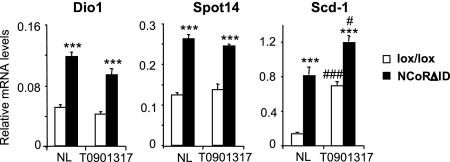
NCoR specifically regulates TR-target genes. mRNA levels of TR and LXR target genes were determined from primary hepatocytes isolated from control and L-NCoRΔID animals cultured in the presence of 1 μM LXR ligand T0901317 where indicated. Relative mRNA levels are shown. All values are expressed as mean ± SEM. Significant differences compared with controls on the same treatment: ***, P < 0.001. Significant differences compared with the same genotype with no treatment: #, P < 0.05; ###, P < 0.001.

References

    1. Chen JD, Evans RM. A transcriptional co-repressor that interacts with nuclear hormone receptors. Nature. 1995;377:454–457. - PubMed
    1. Horlein AJ, et al. Ligand-independent repression by the thyroid hormone receptor mediated by a nuclear receptor co-repressor. Nature. 1995;377:397–404. - PubMed
    1. Alland L, et al. Role for N-CoR and histone deacetylase in Sin3-mediated transcriptional repression. Nature. 1997;387:49–55. - PubMed
    1. Guenther MG, Barak O, Lazar MA. The SMRT and N-CoR corepressors are activating cofactors for histone deacetylase 3. Mol Cell Biol. 2001;21:6091–6101. - PMC - PubMed
    1. Heinzel T, et al. A complex containing N-CoR, mSin3 and histone deacetylase mediates transcriptional repression. Nature. 1997;387:43–48. - PubMed

Publication types

MeSH terms