Review
. 2008 Dec;72(4):728-64, Table of Contents.
doi: 10.1128/MMBR.00017-08.

Genes and molecules of lactobacilli supporting probiotic action

Affiliations
Review

Genes and molecules of lactobacilli supporting probiotic action

Sarah Lebeer et al. Microbiol Mol Biol Rev. 2008 Dec.

Abstract

Lactobacilli have been crucial for the production of fermented products for centuries. They are also members of the mutualistic microbiota present in the human gastrointestinal and urogenital tract. Recently, increasing attention has been given to their probiotic, health-promoting capacities. Many human intervention studies demonstrating health effects have been published. However, as not all studies resulted in positive outcomes, scientific interest arose regarding the precise mechanisms of action of probiotics. Many reported mechanistic studies have addressed mainly the host responses, with less attention being focused on the specificities of the bacterial partners, notwithstanding the completion of Lactobacillus genome sequencing projects, and increasing possibilities of genomics-based and dedicated mutant analyses. In this emerging and highly interdisciplinary field, microbiologists are facing the challenge of molecular characterization of probiotic traits. This review addresses the advances in the understanding of the probiotic-host interaction with a focus on the molecular microbiology of lactobacilli. Insight into the molecules and genes involved should contribute to a more judicious application of probiotic lactobacilli and to improved screening of novel potential probiotics.


Figures
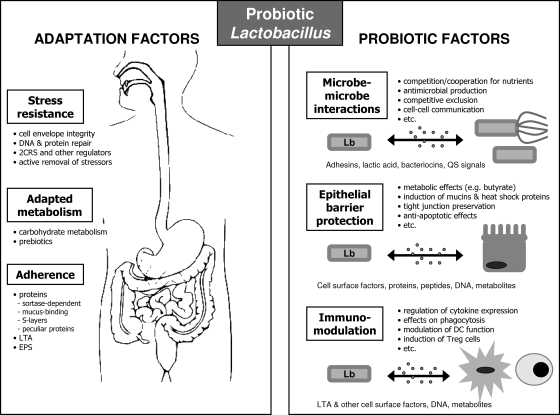
FIG. 1.
FIG. 1.
Mechanistic view of probiotic actions by lactobacilli. Molecular studies of probiotics with focus on lactobacilli (Lb) aim to identify factors that promote survival in, adaptation to, and colonization of the host (adaptation factors) and factors that directly contribute to health-promoting effects (probiotic factors). As probiotic lactobacilli are generally studied in their relation with the GIT, this niche is depicted. The health-promoting effects are thought to be mediated by three main mechanisms of probiotic actions, which include pathogen inhibition, restoration of the microbial balance, enhancement of epithelial barrier function, and immunomodulatory effects via interactions with immune cells such as DCs. The figure reflects the outline of this review.
FIG. 2.
FIG. 2.
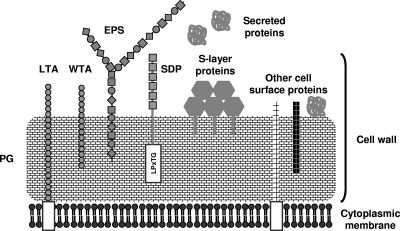
Cell surface architecture of lactobacilli. The cell wall of lactobacilli is composed of different macromolecules together determining the strain-specific properties that include adaptation to the changing host environment and interaction with host immune receptors and epithelial cells. A thick multilayered PG layer is decorated with teichoic acids (WTA and/or LTA), proteins, and EPSs (65). SDPs (24, 258) and S-layer proteins (9) are best studied in lactobacilli, but many other types of cell surface proteins and protein anchors exist. In contrast to coccoid bacteria, PG and WTA biosynthesis and protein secretion via the general secretion machinery appear to occur in helical patterns around the cell surface of rod-shaped bacteria such as B. subtilis (42, 59, 85, 219). Such a helical pattern of cell wall biosynthesis, although not yet documented, can also be postulated for Lactobacillus rods.
FIG. 3.
FIG. 3.
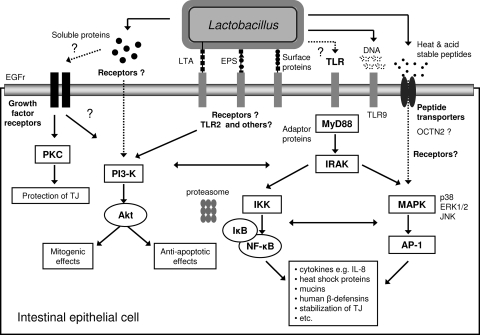
Modulation of epithelial barrier function by lactobacilli. Several in vitro studies have identified signaling pathways that are involved in the interaction between lactobacilli and epithelial cells. The MAPKs p38, ERK1/2, and JNK have an important function in the dynamic regulation of the cell cytoskeleton, tight junctions (TJ), and other effectors of epithelium barrier function, and these MAPKs are often influenced by lactobacilli (see, e.g., reference 205). Given the critical role of EGF signaling in many aspects of gastrointestinal physiology and epithelial repair, some beneficial effects of probiotics are also related to interference with this signaling (204, 282). Akt (or protein kinase B) plays a central role in promoting epithelial cell survival by lactobacilli by the inactivation of several proapoptotic pathways, including caspase 9 and caspase 3, and stimulation of cell proliferation by the activation of cell cycle regulators (see, e.g., reference 280). Akt is generally activated in a phosphatidylinositol 3-kinase (PI3-K)-dependent manner by, e.g., EGF receptor (EGFr) signaling or TLR signaling. Additionally, inhibition of the activation of the NF-κB pathway that plays a key role in inflammatory responses seems to be a primary target of lactobacilli by inhibiting the ubiquitination and proteasome degradation of IκB and thus preventing the nuclear translocation of the NF-κB transcription factor (see, e.g., reference 190). Clearly, a complex network of interacting signaling pathways can be influenced by lactobacilli. However, there is a general lack of knowledge of the Lactobacillus effector molecules and their corresponding host receptors mediating these effects (89, 116, 190, 198, 204, 205, 225, 248, 280) (double arrows indicate cross-signaling events; dotted lines indicate ligand-receptor interactions that are not yet well defined). PKC, protein kinase C.
FIG. 4.
FIG. 4.
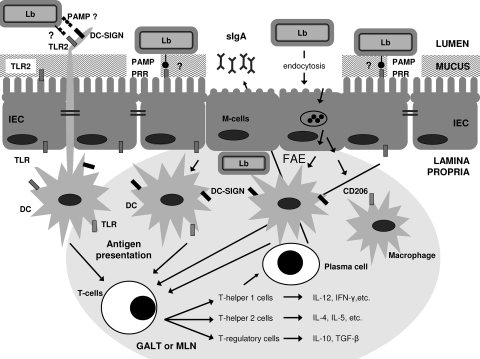
Interaction of lactobacilli with the GALT. Together with IECs, DCs and macrophages continuously sense the environment and coordinate defenses for the protection of mucosal tissues. DCs are the most important antigen-presenting cells of the mucosa. It has been demonstrated that immature DCs in the lamina propria can even extend their appendices between epithelial cells, like periscopes, into the intestinal lumen to take up bacteria (203). DCs are also involved in the sampling of antigens and bacteria, including lactobacilli that are transported through microfold epithelial cells (M-cells) to the dome region of the GALT. M cells are specialized epithelial cells for antigen sampling, which are located in the follicle-associated epithelium (FAE) overlying the GALT such as Peyer's patches (PP) in isolated lymphoid follicles and are individually present in the gut epithelium. Once released into the dome region, the antigens are captured by immature DCs, which become activated when they encounter microbial products through these different pathways. This triggers a switch in cytokine and chemokine production and an upregulation in costimulatory molecules. This activation is mediated by PRRs such as TLRs, DC-SIGN on DCs, and mannose receptor (CD206) on macrophages, and these PRRs recognize pathogen-associated molecular patterns (PAMP). Activation allows the DCs to migrate to the draining lymph nodes such as the mesenteric lymph nodes (MLN) or subepithelial dome of the GALT, were the DCs orchestrate the conversion of naïve T cells into a mature, balanced response of T-helper cells or regulatory T cells, depending on the microbial products which they have encountered (8). The DCs can also activate naïve plasma cells into becoming protective sIgA-producing B cells, especially in the Peyer's patches (155). Tolerance and homeostasis in the intestine are also maintained by specialized subsets of T lymphocytes, which can all be influenced by lactobacilli (Lb). T-helper 1 (Th1) responses are usually associated with inflammatory reactions, and Th2 cells are usually associated with allergic responses. Some cytokines are released by both cell types, e.g., IL-3 and TNF-α, whereas Th1 cells secrete cytokines such as gamma interferon (IFN-γ) and IL-12 and Th2 cells secrete IL-4 and IL-5, etc. Treg cells are essential in modulating immune responses and preventing overreaction and are thought to be a key target of probiotics. At least three different Treg cells have been identified: CD4+ CD25+ Treg cells, Tr1 cells mediating bystander suppressor function by secreting IL-10, and Th3 cells that produce TGF-β and are believed to play a role in oral tolerance (54).

References

    1. Adlerberth, I., S. Ahrne, M. L. Johansson, G. Molin, L. A. Hanson, and A. E. Wold. 1996. A mannose-specific adherence mechanism in Lactobacillus plantarum conferring binding to the human colonic cell line HT-29. Appl. Environ. Microbiol. 622244-2251. - PMC - PubMed
    1. Alakomi, H. L., E. Skytta, M. Saarela, T. Mattila-Sandholm, K. Latva-Kala, and I. M. Helander. 2000. Lactic acid permeabilizes gram-negative bacteria by disrupting the outer membrane. Appl. Environ. Microbiol. 662001-2005. - PMC - PubMed
    1. Altermann, E., B. L. Buck, R. Cano, and T. R. Klaenhammer. 2004. Identification and phenotypic characterization of the cell division protein CdpA. Gene 342189-197. - PubMed
    1. Altermann, E., W. M. Russell, M. A. Azcarate-Peril, R. Barrangou, B. L. Buck, O. McAuliffe, N. Souther, A. Dobson, T. Duong, M. Callanan, S. Lick, A. Hamrick, R. Cano, and T. R. Klaenhammer. 2005. Complete genome sequence of the probiotic lactic acid bacterium Lactobacillus acidophilus NCFM. Proc. Natl. Acad. Sci. USA 1023906-3912. - PMC - PubMed
    1. Antikainen, J., L. Anton, J. Sillanpaa, and T. K. Korhonen. 2002. Domains in the S-layer protein CbsA of Lactobacillus crispatus involved in adherence to collagens, laminin and lipoteichoic acids and in self-assembly. Mol. Microbiol. 46381-394. - PubMed

Publication types

LinkOut - more resources