


Malignancies in the rheumatoid arthritis abatacept clinical development programme: an epidemiological assessment
- PMID: 19054822
- PMCID: PMC2770103
- DOI: 10.1136/ard.2008.097527
Malignancies in the rheumatoid arthritis abatacept clinical development programme: an epidemiological assessment
Abstract
Objective: To provide context for the malignancy experience in the rheumatoid arthritis (RA) abatacept clinical development programme (CDP) by performing comparisons with similar RA patients and the general population.
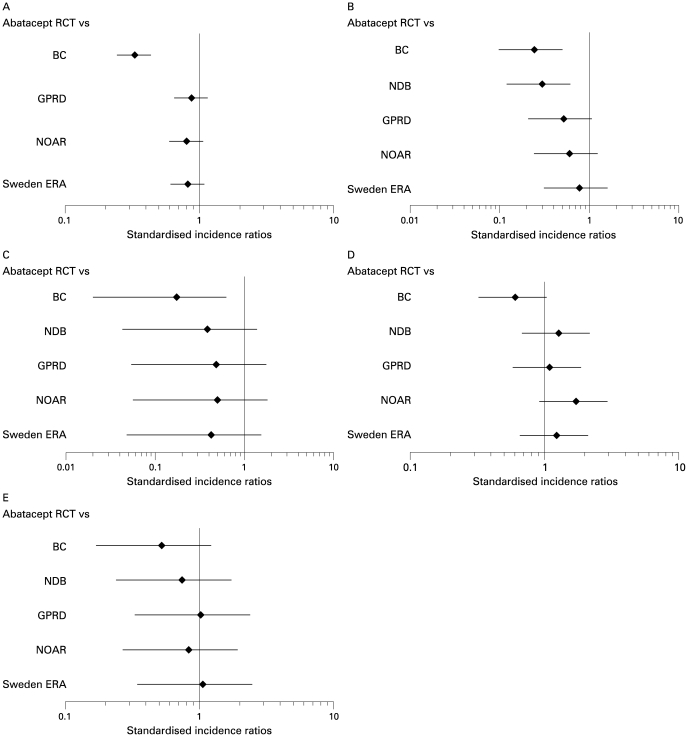
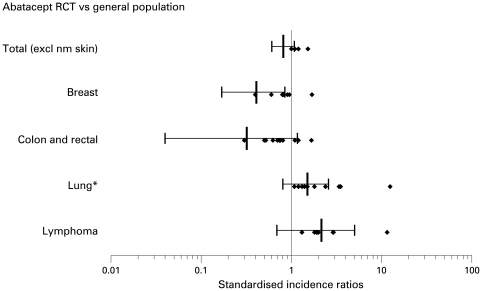
Methods: Malignancy outcomes included total malignancy (excluding non-melanoma skin cancer (NMSC)), breast, colorectal, lung cancers and lymphoma. Comparisons were made between the observed incidence in patients within the abatacept CDP and RA patients on disease-modifying antirheumatic drugs (DMARD) identified from five data sources: the population-based British Columbia RA Cohort, the Norfolk Arthritis Register, the National Data Bank for Rheumatic Diseases, the Sweden Early RA Register and the General Practice Research Database. Age and sex-adjusted incidence rates (IR) and standardised incidence ratios (SIR) were used to compare events in the abatacept trials with the RA DMARD cohorts and the general population.
Results: A total of 4134 RA patients treated with abatacept in seven trials and 41,529 DMARD-treated RA patients in the five observational cohorts was identified for study inclusion. In the abatacept-treated patients, the 51 malignancies (excluding NMSC), seven cases of breast, two cases of colorectal, 13 cases of lung cancer and five cases of lymphoma observed were not greater than the range of expected cases from the five RA cohorts. The SIR comparing RA patients with the general population were consistent with those reported in the literature.
Conclusions: The IR of total malignancy (excluding NMSC), breast, colorectal, lung cancers and lymphoma in the abatacept CDP were consistent with those in a comparable RA population. These data suggest no new safety signals with respect to malignancies, which will continue to be monitored.
Conflict of interest statement
Competing interests: Declared. TAS and KQ are current full-time employees of Bristol-Myers Squibb. ALS is currently a full-time employee of Bristol-Myers Squibb but her affiliation at the time the work was done was the School of Medicine, Duke University, Durham, NC, USA. JA reports having been an invited speaker at meetings sponsored by Schering-Plough and Abbott. JF reports having received research funding from Bristol-Myers Squibb. DL reports receiving research funding from Bristol-Myers Squibb to perform the analyses included in the manuscript and has participated in advisory meetings supported by Bristol-Myers Squibb. DL is supported by an investigator award from the Arthritis Society of Canada and is the Nancy and Peter Paul Saunders Scholar. FW reports having received research grants from Bristol-Myers Squibb, Centocor, Abbott and Amgen. MCH reports serving as a consultant to Amgen, Bristol-Myers Squibb and Roche. SS reports having served as an advisor and participating as a speaker in scientific meetings for AstraZeneca, Boehringer Ingelheim, GlaxoSmithKline, Pfizer and Sepracor. SS also reports receiving research funding from AstraZeneca and GlaxoSmithKline.
Figures
References
-
- Kremer JM, Westhovens R, Leon M, et al. Treatment of rheumatoid arthritis by selective inhibition of T-cell activation with fusion protein CTLA4Ig. N Engl J Med 2003;349:1907–15 - PubMed
-
- Kremer JM, Genant HK, Moreland LW, et al. Effects of abatacept in patients with methotrexate-resistant active rheumatoid arthritis: a randomized trial. Ann Intern Med 2006;144:865–76 - PubMed
-
- Genovese MC, Schiff M, Luggen M, et al. Efficacy and safety of the selective co-stimulation modulator abatacept following 2 years of treatment in patients with rheumatoid arthritis and an inadequate response to anti-TNF therapy. Ann Rheum Dis 2008;67:547–54 - PubMed
Publication types
MeSH terms
Substances
LinkOut - more resources
Full Text Sources
Medical
