


Relationship between recent short-acting beta-agonist use and subsequent asthma exacerbations
- PMID: 19055201
- PMCID: PMC2646829
- DOI: 10.1016/S1081-1206(10)60286-4
Relationship between recent short-acting beta-agonist use and subsequent asthma exacerbations
Abstract
Background: US national guidelines recommend assessing short-acting beta-agonist (SABA) medication use as a marker of asthma severity and control. However, the relationship between recent SABA use and asthma exacerbations is not currently known.
Objective: To evaluate the proximal relationship between the type and frequency of SABA use and asthma-related outcomes.
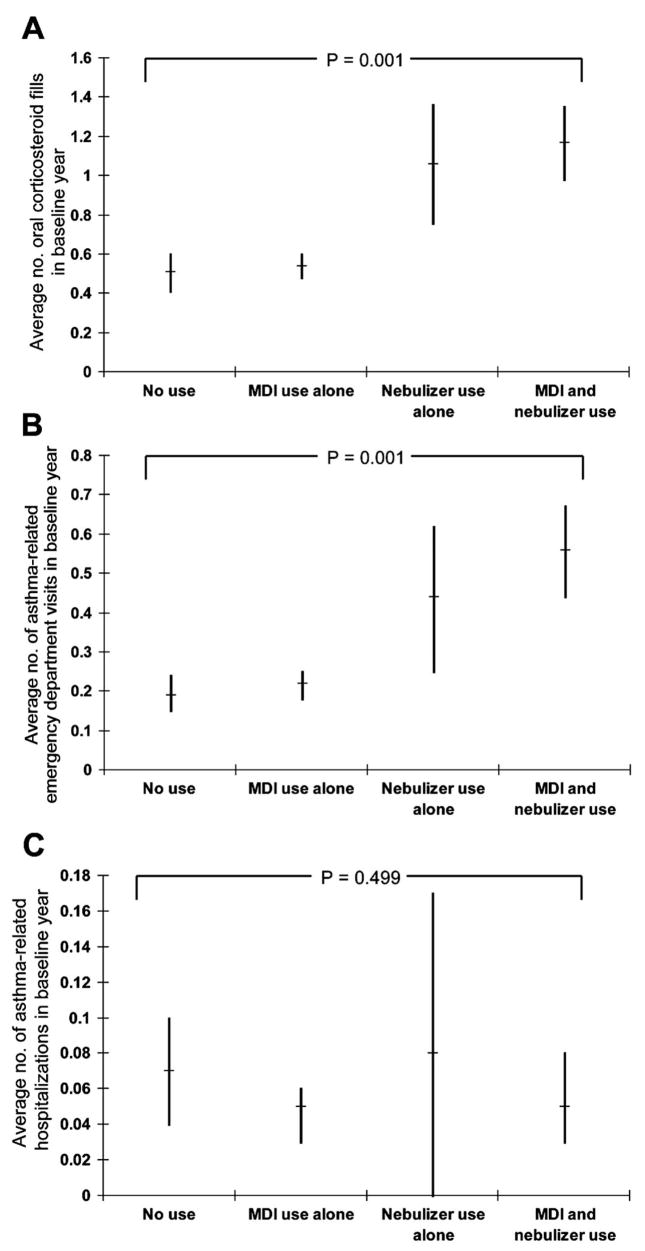
Methods: We evaluated SABA use among patients with asthma ages 5 to 56 years who were members of a large health maintenance organization in southeast Michigan. Frequency of use was estimated from pharmacy data assessing the timing and amount of SABA fills. Cox proportional hazards models were used to examine the prospective relationship between average daily SABA use for 3 months and outcomes associated with poor asthma control (ie, oral corticosteroids use, asthma-related emergency department visits, and asthma-related hospitalizations). We separately accounted for SABA metered-dose inhaler (MDI) and SABA nebulizer use.
Results: Of the 2,056 patients who met study criteria, 1,569 (76.3%) had used a SABA medication in their baseline year. After adjusting for potential confounders, SABA nebulizer use was associated with asthma-related emergency department visits (adjusted hazard ratio [aHR], 6.32; 95% confidence interval [CI], 2.38 to 16.80) and asthma-related hospitalizations (aHR, 21.62; 95% CI, 3.17 to 147.57). In contrast, frequency of SABA MDI use was not associated with these outcomes.
Conclusions: Frequency of SABA use during a 3-month period was associated with poor asthma outcomes. The relationship with poor asthma outcomes was strongest for SABA nebulizer use, suggesting that the type of SABA used is also of prognostic importance.
Trial registration: ClinicalTrials.gov NCT00459368.
Figures
References
-
- Braman SS. The global burden of asthma. Chest. 2006;130 (Suppl 1):4S–12S. - PubMed
-
- Mangan JM, Wittich AR, Gerald LB. The potential for reducing asthma disparities through improved family and social function and modified health behaviors. Chest. 2007;132 (Suppl 5):789S–801S. - PubMed
-
- Watson L, Kerstjens HA, Rabe KF, Kiri V, Visick GT, Postma DS. Obtaining optimal control in mild asthma: theory and practice. Fam Pract. 2005;22:305–310. - PubMed
-
- Suissa S, Blais L, Ernst P. Patterns of increasing beta-agonist use and the risk of fatal or near-fatal asthma. Eur Respir J. 1994;7:1602–1609. - PubMed
Publication types
MeSH terms
Substances
Associated data
Grants and funding
LinkOut - more resources
Full Text Sources
Medical
Molecular Biology Databases
Miscellaneous
