Review
. 2008:101:277-348.
doi: 10.1016/S0065-230X(08)00408-9.

The role of NKT cells in tumor immunity

Affiliations
Review

The role of NKT cells in tumor immunity

Masaki Terabe et al. Adv Cancer Res. 2008.

Abstract

NKT cells are a relatively newly recognized member of the immune community, with profound effects on the rest of the immune system despite their small numbers. They are true T cells with a T cell receptor (TCR), but unlike conventional T cells that detect peptide antigens presented by conventional major histocompatibility (MHC) molecules, NKT cells recognize lipid antigens presented by CD1d, a nonclassical MHC molecule. As members of both the innate and adaptive immune systems, they bridge the gap between these, and respond rapidly to set the tone for subsequent immune responses. They fill a unique niche in providing the immune system a cellular arm to recognize lipid antigens. They play both effector and regulatory roles in infectious and autoimmune diseases. Furthermore, subsets of NKT cells can play distinct and sometimes opposing roles. In cancer, type I NKT cells, defined by their invariant TCR using Valpha14Jalpha18 in mice and Valpha24Jalpha18 in humans, are mostly protective, by producing interferon-gamma to activate NK and CD8(+) T cells and by activating dendritic cells to make IL-12. In contrast, type II NKT cells, characterized by more diverse TCRs recognizing lipids presented by CD1d, primarily inhibit tumor immunity. Moreover, type I and type II NKT cells counter-regulate each other, forming a new immunoregulatory axis. Because NKT cells respond rapidly, the balance along this axis can greatly influence other immune responses that follow. Therefore, learning to manipulate the balance along the NKT regulatory axis may be critical to devising successful immunotherapies for cancer.


Figures
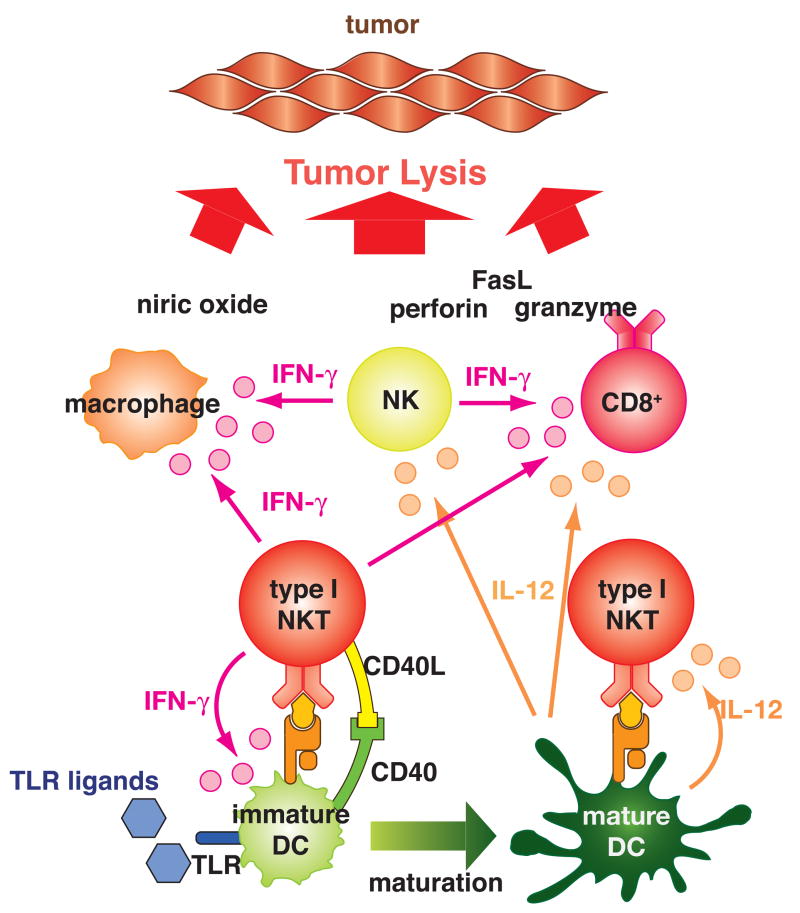
Fig. 1
Fig. 1
Type I NKT cells promote tumor immunity. When type I NKT cells are activated by α-GalCer or endogenous glycolipids (may be tumor derived) presented by CD1d on immature dendritic cells (DCs), they produce interferon-γ (IFN-γ). The type I NKT cells may also interact with the immature DCs through CD40-CD40L. This interaction and IFN-γ induce maturation of the DCs. The mature DCs produce IL-12, which augments IFN-γ and IL-2 production by type I NKT cells. IFN-γ and IL-2 from the type I NKT cells and IL-12 from the mature DCs activate NK cells, CD8+ T cells, and macrophages. Exogenous IL-12 may bypass the process of DC maturation induced by the activated type I NKT cells. Providing exogenous Toll-like receptor (TLR) ligands may strengthen the cytokine production. Cross-presentation of tumor antigens by antigen presenting cells to CD8+ T cells when activated by the type I NKT cells may enhance induction of tumor antigen-specific CD8+ T cells. These activated T cells lyse tumor cells by employing multiple effector mechanisms including perforin, granzyme, FasL, and nitric oxide.
Fig. 2
Fig. 2
Type II NKT cells suppress tumor immunity. When type II NKT cells (mostly CD4+) are activated by tumor-derived glycolipids presented by CD1d, they produce IL-13. Together with TNF-α in the microenvironment signaling through TNF-receptor (TNFR) and NF-κB, IL-13 signals through a type II IL-4 receptor (IL-4R), a heterodimer of an IL-4Rα and an IL-13Rα1, and STAT6 to induce expression of the IL-13Rα2 on a CD11b+Gr-1+ myeloid cell. The IL-13Rα2 binding to IL-13 transduces a signal through AP-1, which induces expression of TGF-β. TGF-β suppresses activation of tumor specific CD8+ T cells, which mediate regression of tumors. In some tumor settings, IL-13 may induce M2 macrophages that also suppress CD8+ T cells. Blockade of either IL-13 by an IL-13 inhibitor such as soluble IL-13Rα2, or TGF-β with anti-TGF-β antibodies, or TNF-α with a TNF-α antagonist can remove the suppression. Modified from (Terabe, et al., 2003a) with permission.
Fig. 3
Fig. 3
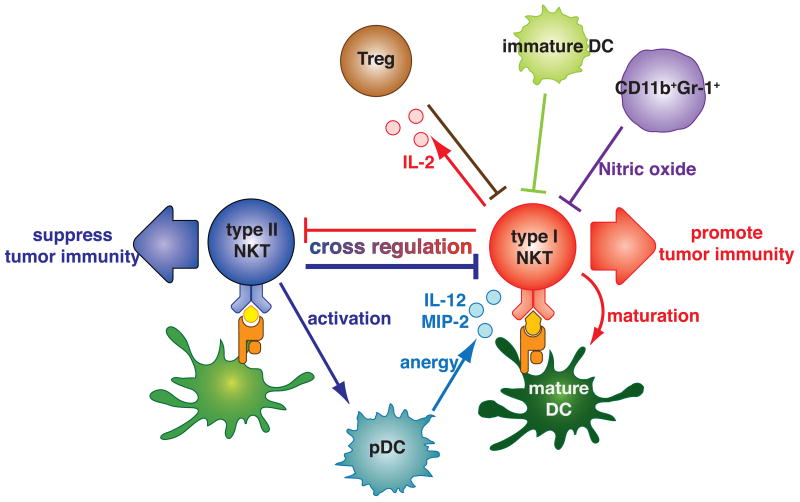
Cross-regulation of type I and type II NKT cells—a new immunoregulatory axis. Type I and type II NKT cells cross-regulate each other. Type II NKT cells suppress tumor immunity when they are activated (by recognizing sulfatide or another lipid presented by CD1d). In some settings, the type II NKT cells suppress type I NKT cells. It is reported that sulfatide activated type II NKT cells activate plasmacytoid DCs (pDC) to produce IL-12 and MIP-2, which recruit and lead to the anergy of type I NKT cells. Activated type I NKT cells induce DC maturation and promote tumor immunity. It is also possible that IL-2 production by activated type I NKT cells supports regulatory T cells, which can suppress type I NKT cells. Immature DCs and CD11b+Gr-1+ myeloid cells may also suppress type I NKT cells in some tumor settings. The cross-regulation between type I and type II NKT cells defines a new immunoregulatory axis like the Th1-Th2 axis. The balance along this axis may in part determine the outcome of tumor immunity. Manipulation of this balance may be critical for the successful immunotherapy of cancer.

References

    1. Agea E, Russano A, Bistoni O, Mannucci R, Nicoletti I, Corazzi L, Postle AD, De Libero G, Porcelli SA, Spinozzi F. Human CD1-restricted T cell recognition of lipids from pollens. J Exp Med. 2005;202:295–308. - PMC - PubMed
    1. Ahlers JD, Belyakov IM, Terabe M, Koka R, Donaldson DD, Thomas E, Berzofsky JA. A push-pull approach to maximize vaccine efficacy: abrogating suppression with an IL-13 inhibitor while augmenting help with GM-CSF and CD40L. Proc Natl Acad Sci U S A. 2002;99:13020–13025. - PMC - PubMed
    1. Akbari O, Faul JL, Hoyte EG, Berry GJ, Wahlstrom J, Kronenberg M, DeKruyff RH, Umetsu DT. CD4+ invariant T-cell-receptor+ natural killer T cells in bronchial asthma. N Engl J Med. 2006;354:1117–29. - PubMed
    1. Akbari O, Stock P, Meyer E, Kronenberg M, Sidobre S, Nakayama T, Taniguchi M, Grusby MJ, DeKruyff RH, Umetsu DT. Essential role of NKT cells producing IL-4 and IL-13 in the development of allergen-induced airway hyperreactivity. Nat Med. 2003;9:582–8. - PubMed
    1. Almand B, Clark JI, Nikitina E, van Beynen J, English NR, Knight SC, Carbone DP, Gabrilovich DI. Increased production of immature myeloid cells in cancer patients: a mechanism of immunosuppression in cancer. J Immunol. 2001;166:678–89. - PubMed

Publication types

Substances