. 2008 Dec 15;5(9):878-83.
doi: 10.1513/pats.200804-035QC.

Natural histories of chronic obstructive pulmonary disease

Affiliations

Natural histories of chronic obstructive pulmonary disease

Stephen I Rennard et al. Proc Am Thorac Soc. .

Abstract

Concepts relating to the natural history of chronic obstructive pulmonary disease (COPD) arise most importantly from the classic study of Fletcher and colleagues (The Natural History of Chronic Bronchitis and Emphysema, Oxford University Press, New York, 1976). This study, which evaluated working English men over 8 years, was used to construct a proposed life-long natural history. Although this is a classic study that has greatly advanced understanding of COPD, it has a number of limitations. Its duration is relatively short compared with the duration of COPD, so it is more cross-sectional than longitudinal. It was unable to distinguish among varied "natural histories." It assessed primarily the FEV(1), and the natural history of other features of COPD is largely undescribed. With advances in understanding the clinical features of COPD and with the development of evaluating new tools to assess patients with COPD, longitudinal studies evaluating COPD in novel ways and for longer durations are needed.


Figures
<b>Figure 1.</b>
Figure 1.
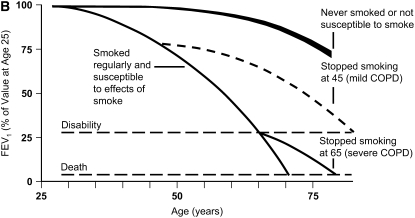
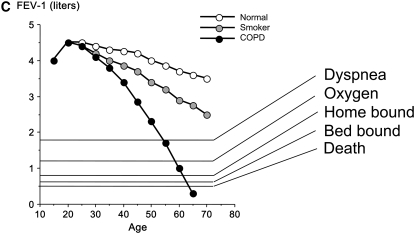
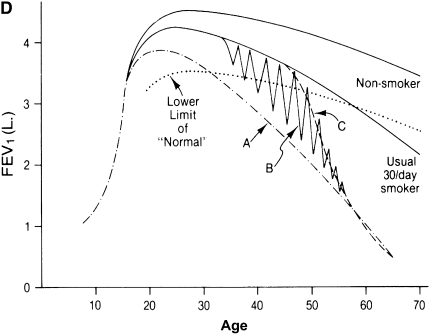
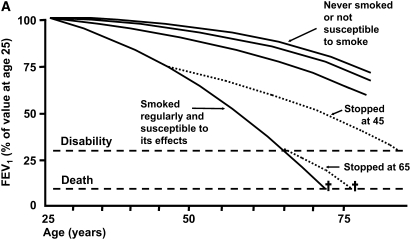
Natural history of chronic obstructive pulmonary disease (COPD). (A) Fletcher and Peto suggested a “natural history” for the airflow limitation in patients with COPD based on their 8-year study of working English men (3). Their exclusion of nonsmokers who develop COPD may have led to this group being relatively understudied. Reprinted by permission from Reference . (B) One of many derivative versions of the Fletcher-Peto curve, presented in the GOLD (Global Initiative for Chronic Obstructive Lung Disease) guidelines slide set, which has been rendered in black and white by the authors. Reprinted by permission from Reference . (C) A version prepared by the author using data from Reference . As airflow worsens, symptoms increase, but there is tremendous variability among individual patients in this regard. (D) Variable “natural histories” that can lead to severe COPD as described by Burrows (34). Although these may represent distinct pathophysiologic processes, by the time diagnosis is made, they may be impossible to distinguish using FEV1 since their natural histories will overlap. Reprinted by permission from Reference .
<b>Figure 1.</b>
Figure 1.
Natural history of chronic obstructive pulmonary disease (COPD). (A) Fletcher and Peto suggested a “natural history” for the airflow limitation in patients with COPD based on their 8-year study of working English men (3). Their exclusion of nonsmokers who develop COPD may have led to this group being relatively understudied. Reprinted by permission from Reference . (B) One of many derivative versions of the Fletcher-Peto curve, presented in the GOLD (Global Initiative for Chronic Obstructive Lung Disease) guidelines slide set, which has been rendered in black and white by the authors. Reprinted by permission from Reference . (C) A version prepared by the author using data from Reference . As airflow worsens, symptoms increase, but there is tremendous variability among individual patients in this regard. (D) Variable “natural histories” that can lead to severe COPD as described by Burrows (34). Although these may represent distinct pathophysiologic processes, by the time diagnosis is made, they may be impossible to distinguish using FEV1 since their natural histories will overlap. Reprinted by permission from Reference .
<b>Figure 1.</b>
Figure 1.
Natural history of chronic obstructive pulmonary disease (COPD). (A) Fletcher and Peto suggested a “natural history” for the airflow limitation in patients with COPD based on their 8-year study of working English men (3). Their exclusion of nonsmokers who develop COPD may have led to this group being relatively understudied. Reprinted by permission from Reference . (B) One of many derivative versions of the Fletcher-Peto curve, presented in the GOLD (Global Initiative for Chronic Obstructive Lung Disease) guidelines slide set, which has been rendered in black and white by the authors. Reprinted by permission from Reference . (C) A version prepared by the author using data from Reference . As airflow worsens, symptoms increase, but there is tremendous variability among individual patients in this regard. (D) Variable “natural histories” that can lead to severe COPD as described by Burrows (34). Although these may represent distinct pathophysiologic processes, by the time diagnosis is made, they may be impossible to distinguish using FEV1 since their natural histories will overlap. Reprinted by permission from Reference .
<b>Figure 1.</b>
Figure 1.
Natural history of chronic obstructive pulmonary disease (COPD). (A) Fletcher and Peto suggested a “natural history” for the airflow limitation in patients with COPD based on their 8-year study of working English men (3). Their exclusion of nonsmokers who develop COPD may have led to this group being relatively understudied. Reprinted by permission from Reference . (B) One of many derivative versions of the Fletcher-Peto curve, presented in the GOLD (Global Initiative for Chronic Obstructive Lung Disease) guidelines slide set, which has been rendered in black and white by the authors. Reprinted by permission from Reference . (C) A version prepared by the author using data from Reference . As airflow worsens, symptoms increase, but there is tremendous variability among individual patients in this regard. (D) Variable “natural histories” that can lead to severe COPD as described by Burrows (34). Although these may represent distinct pathophysiologic processes, by the time diagnosis is made, they may be impossible to distinguish using FEV1 since their natural histories will overlap. Reprinted by permission from Reference .
<b>Figure 2.</b>
Figure 2.
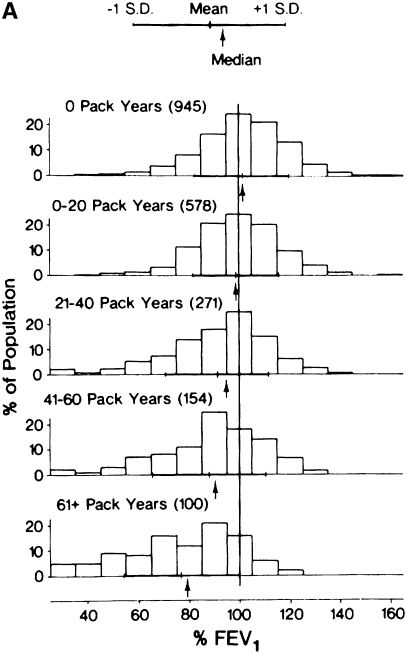
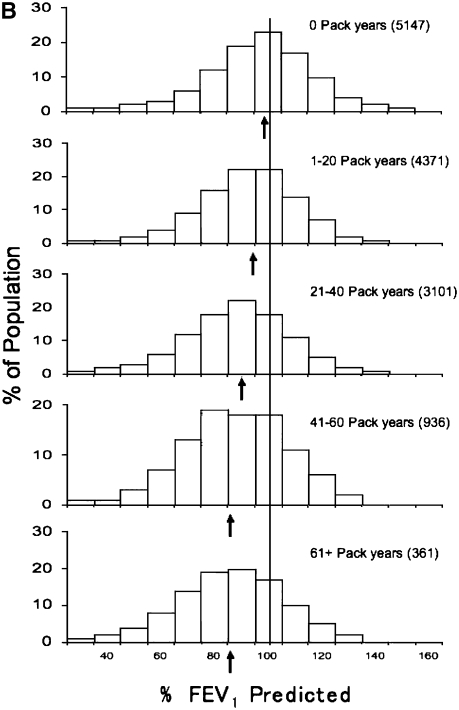
Distribution of FEV1 values in relationship to smoking history. Note that there is a reduction in FEV1 with increasing smoking history. For each smoking history, however, there is considerable heterogeneity in FEV1 response. Even among nonsmokers, there is a subset with severe lung function impairment. Note the striking similarity of the data presented by (A) Burrows (11) and that of the (B) Copenhagen City Study several decades later (10) Reprinted by permission from Reference . The time course for the progression of individuals with varying smoking histories is unknown and likely follows many “natural histories.”
<b>Figure 2.</b>
Figure 2.
Distribution of FEV1 values in relationship to smoking history. Note that there is a reduction in FEV1 with increasing smoking history. For each smoking history, however, there is considerable heterogeneity in FEV1 response. Even among nonsmokers, there is a subset with severe lung function impairment. Note the striking similarity of the data presented by (A) Burrows (11) and that of the (B) Copenhagen City Study several decades later (10) Reprinted by permission from Reference . The time course for the progression of individuals with varying smoking histories is unknown and likely follows many “natural histories.”
<b>Figure 3.</b>
Figure 3.
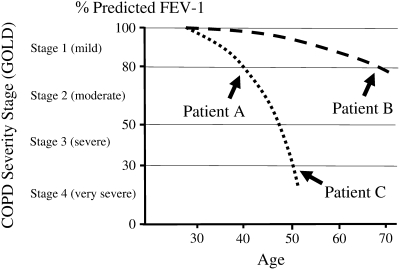
Severity stage and natural history of chronic obstructive pulmonary disease (COPD). Two theoretical natural histories are shown. Grouping by severity would pool a 40-year-old (patient A) with a rapidly progressive natural history (dotted line) and a 70-year-old (patient B) with a slowly progressive natural history (dashed line). Conversely, to group individuals of many ages with the rapidly progressive natural history (dotted line), individuals with differing severities (patients A and C) would need to be grouped. GOLD = Global Initiative for Chronic Obstructive Lung Disease.

References

    1. Global Initiative for Chronic Obstructive Lung Disease. Global strategy for diagnosis, management and prevention of COPD, 2006. [Internet]. (Accessed 29 Aug 2008) Bethesda (MD): NHLBI.
    1. Fletcher C, Peto R, Tinker C, Speizer F. The natural history of chronic bronchitis and emphysema. New York: Oxford University Press; 1976.
    1. Fletcher C, Peto R. The natural history of chronic airflow obstruction. BMJ 1977;1:1645–1648. - PMC - PubMed
    1. Benowitz NL, Jacob P III. Individual differences in nicotine kinetics and metabolism in humans. NIDA Res Monogr 1997;173:48–64. - PubMed
    1. Mazzone RW, Kornblau S. Size of pores of Kohn: influence of transpulmonary and vascular pressures. J Appl Physiol 1981;51:739–745. - PubMed

Publication types

MeSH terms

LinkOut - more resources