Right into the heart of microRNA-133a
- PMID: 19056878
- PMCID: PMC3959988
- DOI: 10.1101/gad.1753508
Right into the heart of microRNA-133a
Abstract
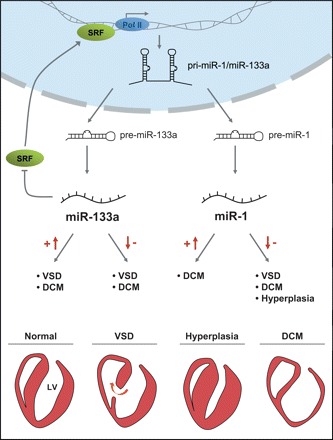
MicroRNAs play an essential role in diverse cellular processes, such as proliferation, differentiation, apoptosis, and stress response. Recent studies demonstrate that miRNAs are important for timing developmental decisions and fine-tuning cellular determination in vertebrate heart development. In an elegant set of experiments reported in this issue of Genes & Development, Liu et al. (3242-3254) demonstrate that miR-133a functions as an inhibitor of cardiomyocyte proliferation and a modifier of serum response factor (SRF)-dependent transcriptional signaling in the murine heart. Both targeted deletion and transgenic overexpression of miR-133a can result in the same cardiac phenotype, ventricular septal defect (VSD) and heart failure. The new data add another piece to the puzzle of regulatory networks that are implicated in cardiac disease. It will be interesting to see, if miR-133a is also involved in human heart diseases, especially VSD and dilated cardiomyopathy.
Figures
Comment on
-
microRNA-133a regulates cardiomyocyte proliferation and suppresses smooth muscle gene expression in the heart.Genes Dev. 2008 Dec 1;22(23):3242-54. doi: 10.1101/gad.1738708. Epub 2008 Nov 17. Genes Dev. 2008. PMID: 19015276 Free PMC article.
References
-
- Bartel D.P. MicroRNAs: Genomics, biogenesis, mechanism, and function. Cell. 2004;116:281–297. - PubMed
-
- Basson C.T., Cowley G.S., Solomon S.D., Weissman B., Poznanski A.K., Traill T.A., Seidman J.G., Seidman C.E. The clinical and genetic spectrum of the Holt-Oram syndrome (heart–hand syndrome) N. Engl. J. Med. 1994;330:885–891. - PubMed
-
- Berezikov E., Guryev V., de van Belt J., Wienholds E., Plasterk R.H., Cuppen E. Phylogenetic shadowing and computational identification of human microRNA genes. Cell. 2005;120:21–24. - PubMed
Publication types
MeSH terms
Substances
Grants and funding
LinkOut - more resources
Full Text Sources
Other Literature Sources
Medical
Miscellaneous