. 2009 Feb;106(2):378-84.
doi: 10.1152/japplphysiol.90883.2008. Epub 2008 Dec 4.

Muscle fatigue examined at different temperatures in experiments on intact mammalian (rat) muscle fibers

Affiliations

Muscle fatigue examined at different temperatures in experiments on intact mammalian (rat) muscle fibers

H Roots et al. J Appl Physiol (1985). 2009 Feb.

Abstract

In experiments on small bundles of intact fibers from a rat fast muscle, in vitro, we examined the decline in force in repeated tetanic contractions; the aim was to characterize the effect of shortening and of temperature on the initial phase of muscle fatigue. Short tetanic contractions were elicited at a control repetition rate of 1/60 s, and fatigue was induced by raising the rate to 1/5 s for 2-3 min, both in isometric mode (no shortening) and in shortening mode, in which each tetanic contraction included a ramp shortening at a standard velocity. In experiments at 20 degrees C (n = 12), the force decline during a fatigue run was 25% in the isometric mode but was significantly higher (35%) in the shortening mode. In experiments at different temperatures (10-30 degrees C, n = 11), the tetanic frequency and duration were adjusted as appropriate, and for shortening mode, the velocity was adjusted for maximum power output. In isometric mode, fatigue of force was significantly less at 30 degrees C ( approximately 20%) than at 10 degrees C ( approximately 30%); the power output (force x velocity) was >10x higher at 30 degrees C than at 10 degrees C, and power decline during a fatigue run was less at 30 degrees C ( approximately 20-30%) than at 10 degrees C ( approximately 50%). The finding that the extent of fatigue is increased with shortening contractions and is lower at higher temperatures is consistent with the view that force depression by inorganic phosphate, which accumulates within fibers during activity, may be a primary cause of initial muscle fatigue.


Figures
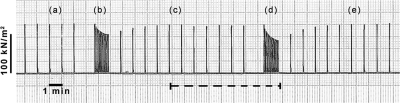
Fig. 1.
Fig. 1.
Fatigue protocol, with and without shortening. A chart recorder trace showing typical fatigue runs and recovery in an experiment at 20°C from one fiber bundle, with isometric and ramp shortening contractions. In isometric mode, contractions at 1/60 s (a) do not cause tension to fall; when changed to 1/5 s contraction rate (b) isometric tension falls toward a steady level. After ∼1.5 min, contraction rate is returned to 1/60 s and isometric tension gradually recovers to within 95% of its original value (c). Once recovered, a shortening ramp is introduced to each tetanic contraction; no fatigue occurs at 1/60 s but when the rate is increased to 1/5 s (d) isometric tension declines. The horizontal dashed line indicates the period of shortening mode, where ramp shortening was introduced to each contraction (see Fig. 2). After the second period of fatigue, contraction rate was returned to 1/60 s and tension recovered once more (e). Note that the extent of tension decline during the fatigue run is greater with shortening contractions than with isometric contractions (compare d with b).
Fig. 2.
Fig. 2.
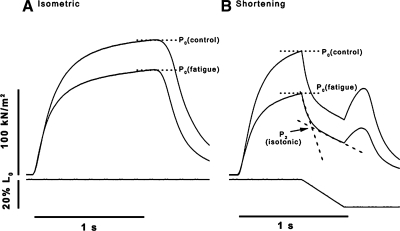
Sample records of contractions before (control) and after fatigue. Tension responses (top traces) and length changes (bottom traces) from a preparation taken at time 0, the 1st contraction (P0 control), and at the 20th contraction (P0 fatigue) during a fatigue run at 1/5 s, at 20°C. A: 2 superimposed tension traces of isometric contractions (without ramp shortening). B: contractions with a ramp shortening of 20% optimal fiber length (L0), 0.5 L0/s, applied during tetanic tension plateau. Note that tension fatigue is greater in B, in the shortening mode. The tension response to a ramp shortening (B) is similar to that characterized in a previous study [Roots et al. (38)]; an initial rapid drop in tension is followed by a gradual transition phase (P2); P2 tension was estimated from the point of intersection between the lines fitted, as shown, and taken as tension during shortening for calculating power.
Fig. 3.
Fig. 3.
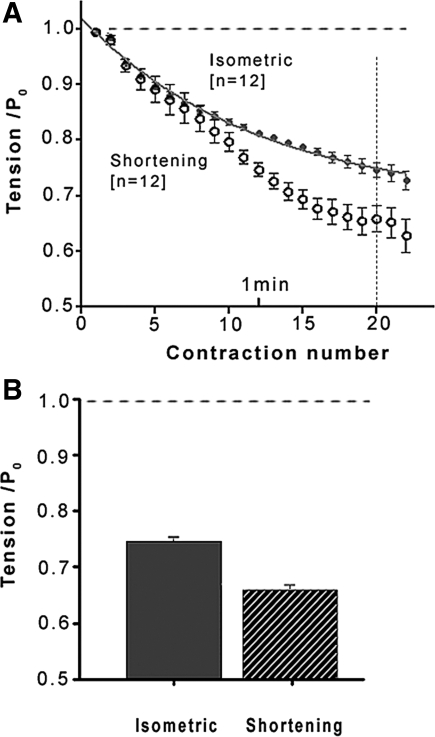
Fatigue in isometric mode and shortening mode. A: pooled mean (±SE) tension data during a fatigue run, solid symbols in isometric mode and open symbols in shortening mode, from 12 fiber bundles. Tensions are normalized to control P0 (horizontal dashed line). A single-exponential curve fitted to the isometric mode data indicates that fatigue would reach a steady value of 0.71 ± 0.015 P0; it is 0.49 ± 0.06 P0 in shortening mode (curve not shown). B: mean (±SE) tension of the 20th contraction during a fatigue run in isometric mode (filled column) and in shortening mode (striped); the tensions were 0.75 ± 0.012 P0 in isometric and 0.65 ± 0.025 P0 with shortening; the difference is significant (paired t-test, P < 0.01).
Fig. 4.
Fig. 4.
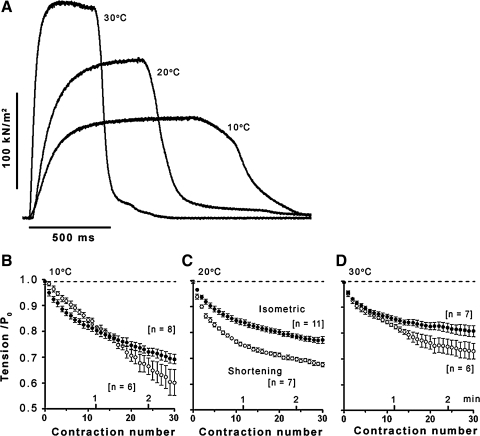
Fatigue at different temperatures. A: sample traces from one preparation illustrating the tetanic contractions used in fatigue experiments: note that contractions are faster and the tension is increased at high temperatures, as in previous studies [Coupland and Ranatunga (8)]. Tetanic durations (and frequency) were accordingly adjusted as shown (see methods). B–D: pooled data (11 preparations; n for each temperature is given) for tension decline during a fatigue run (at 1/5 s) at 10 (B), 20 (C), and 30°C (D); presentation is similar to Fig. 3A. Filled symbols, data in isometric mode: fatigue decreases from B (10°C) to D (30°C). A single-exponential curve fitted to each data set (as in Fig. 3A) gave steady fatigued tension levels of 0.63 ± 0.03 P0 for 10°C, 0.75 ± 0.01 P0 for 20°C, and 0.81 ± 0.01 P0 for 30°C; their time constants of approach to steady level were ∼100, ∼55, and ∼40 s, respectively. Open symbols, data in shortening mode; at each temperature, fatigue is higher in shortening mode, but the time course for 10°C shows complexity (see text).
Fig. 5.
Fig. 5.
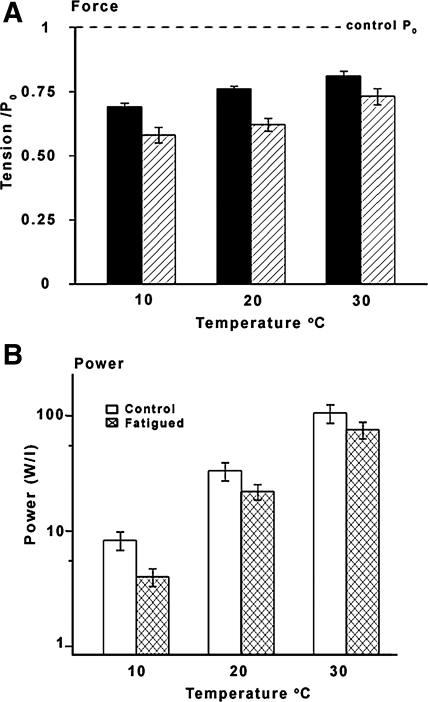
Summary data for fatigue at different temperature. A: mean (±SE) data for isometric tension of the 30th contraction (as a ratio of control P0; dashed line) at different temperatures (n as in Fig. 4) in isometric mode (filled columns) and in shortening mode (hatched columns). Extent of fatigue is less at higher temperatures and at each temperature shortening mode causes more fatigue than isometric. Statistically significant differences (t-test; P < 0.05) are found for fatigue data in isometric mode between 10 and 20°C and 10 and 30°C and between isometric vs. shortening data at 20 and 10°C. B: mechanical power, calculated as P2 tension (see Fig. 2) in kN/m2 multiplied by shortening velocity in L0/s, is plotted in units of watts/liter (W/l) on a logarithmic ordinate. The histograms show the mean (±SE; n = 6, 7) absolute power for prefatigue control (open columns) and for 30th fatiguing contraction (cross-hatched columns) at different temperatures. Note that the power output shows >10-fold increase from 10°C (∼8 W/l) to 30°C (∼105 W/l) and the differences between temperatures are significant (P < 0.05); also, the power at each temperature is significantly reduced (paired t-test, P < 0.05) after fatigue. The fatigue of power is greater at 10°C (∼50%) than at 20 and 30°C (70–75%).

Comment in

  • Fatigue in working muscles.
    Allen DG. Allen DG. J Appl Physiol (1985). 2009 Feb;106(2):358-9. doi: 10.1152/japplphysiol.91599.2008. Epub 2008 Dec 18. J Appl Physiol (1985). 2009. PMID: 19095748 No abstract available.

References

    1. Allen DG, Lamb GD, Westerblad H. Skeletal muscle fatigue: cellular mechanisms. Physiol Rev 88: 287–332, 2008. - PubMed
    1. Allen DG, Lee JA, Westerblad H. Intracellular calcium and tension during fatigue in isolated single muscle fibres from Xenopus laevis. J Physiol 415: 433–458, 1989. - PMC - PubMed
    1. Cady EB, Jones DA, Lynn J, Newham DJ. Changes in force and intracellular metabolites during fatigue of human skeletal muscle. J Physiol 418: 311–325, 1989. - PMC - PubMed
    1. Chin ER, Allen DG. The contribution of pH-dependent mechanisms to fatigue at different intensities in mammalian single muscle fibres. J Physiol 512: 831–840, 1998. - PMC - PubMed
    1. Cooke R, Franks K, Luiciani GB, Pate E. The inhibition of rabbit skeletal muscle contraction by hydrogen ions and phosphate. J Physiol 398: 77–97, 1988. - PMC - PubMed

Publication types

LinkOut - more resources