. 2008 Dec;4(12):e1000231.
doi: 10.1371/journal.ppat.1000231. Epub 2008 Dec 5.

APOBEC3G inhibits elongation of HIV-1 reverse transcripts

Affiliations

APOBEC3G inhibits elongation of HIV-1 reverse transcripts

Kate N Bishop et al. PLoS Pathog. 2008 Dec.

Abstract

APOBEC3G (A3G) is a host cytidine deaminase that, in the absence of Vif, restricts HIV-1 replication and reduces the amount of viral DNA that accumulates in cells. Initial studies determined that A3G induces extensive mutation of nascent HIV-1 cDNA during reverse transcription. It has been proposed that this triggers the degradation of the viral DNA, but there is now mounting evidence that this mechanism may not be correct. Here, we use a natural endogenous reverse transcriptase assay to show that, in cell-free virus particles, A3G is able to inhibit HIV-1 cDNA accumulation not only in the absence of hypermutation but also without the apparent need for any target cell factors. We find that although reverse transcription initiates in the presence of A3G, elongation of the cDNA product is impeded. These data support the model that A3G reduces HIV-1 cDNA levels by inhibiting synthesis rather than by inducing degradation.


Conflict of interest statement

The authors have declared that no competing interests exist.

Figures

Figure 1
Figure 1. A3G inhibits HIV-1 cDNA accumulation regardless of target cell type.
Equivalent amounts of HIV-1/Δvif produced from 293T cells in the presence or absence of human A3G were used to infect SupT1, CEM-SS, CEM, or PBMC target cells. Total DNA was harvested at the indicated times after infection, and the relative amounts of early reverse transcription products (strong stop) were measured using quantitative PCR analysis. Levels of cDNA are shown as percentages of the peak accumulation detected in the control (no APOBEC) reaction. Representative data from at least two independent experiments with each cell type are shown.
Figure 2
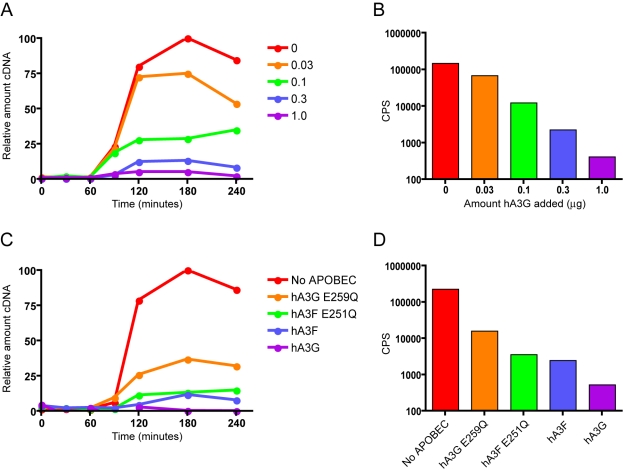
Figure 2. A3G inhibits HIV-1 cDNA accumulation in the absence of target cells and hypermutation.
(A) HIV-1/Δvif viruses were generated from 293T transfected with a fixed amount of proviral plasmid (3 µg) and increasing amounts of A3G plasmid (from 0 to 1 µg). Viruses were subjected to natural endogenous reverse transcription reactions, and DNA was harvested at the indicated times after the addition of dNTPs. The relative amounts of early reverse transcription products (strong stop) were measured using quantitative PCR analysis and are represented as in Figure 1. (B) The virus preparations described in (A) were used in parallel to challenge TZM β-gal indicator cells, and productive infection was measured after 24 h as the induction of β-galactosidase activity, monitored using a chemiluminescent substrate. Infectivity is reported as counts per sec. (C) HIV-1/Δvif viruses were produced from 293T cells in the presence of either control vector, wild-type (WT) A3G, WT A3F, or A3G/A3F variants with the catalytic glutamic acid residue altered to a glutamine. Viruses were subjected to natural endogenous reverse transcription reactions, and DNA was harvested at the indicated times after the addition of dNTPs. The relative amounts of early reverse transcription products (strong stop) were measured using quantitative PCR analysis. (D) The virus preparations described in (C) were used in parallel to challenge TZM β-gal indicator cells, and viral infectivity was measured as in (B). All experiments were performed with at least two independent sets of viruses, representative results are shown.
Figure 3
Figure 3. Endogenous A3G has the same effect on early cDNA accumulation as equivalent amounts of A3G expressed in 293T cells.
(A) Immunoblot analysis of A3G expression in uninfected CEM cells, CEM cells infected with either WT HIV-1 or HIV-1/Δvif, or 293T cells transfected with a fixed amount of HIV-1/Δvif proviral plasmid (3 µg) and increasing amounts of A3G plasmid (0, 0.03, 0.1, 0.3 or 1 µg). Below the blot, the graph shows the quantity of A3G expressed relative to HSP90. (B) Viral incorporation of A3G was measured by immunoblot analysis of purified virions harvested from the cells in (A). Below the blot, the graph shows the quantity of A3G incorporated relative to HIV-1 CA-p24. (C) WT HIV-1 or HIV-1/Δvif were passaged through CEM cells and used in natural endogenous reverse transcription reactions. DNA was harvested at the indicated times after the addition of dNTPs, and the relative amounts of early reverse transcription products (strong stop) were measured using quantitative PCR analysis. (D) The virus preparations from CEM cells described in (C) were used in parallel to challenge TZM β-gal indicator cells, and productive infection was measured as the induction of β-galactosidase activity, monitored using a chemiluminescent substrate. Infectivity is reported as counts per sec.
Figure 4
Figure 4. A3G does not affect initiation of reverse transcription.
(A) Equivalent amounts of HIV-1/Δvif produced from 293T cells in the presence or absence of human A3G were incubated with biotinylated-dCTP during modified natural endogenous reverse transcription reactions. Samples were taken at 2, 30, or 120 min after the addition of biotinylated-dCTP, and at 120 min for the control reaction with no dNTPs. Reverse transcription initiation was assessed by measuring both the amount of biotinylated primer tRNAlys3 that bound to a streptavidin-coated 384-well qPCR plate and the total amount of tRNAlys3 purified from each reaction. The ratio of biotinylated tRNAlys3 to total tRNAlys3 is plotted on the y-axis. Error bars show the standard deviation of four independent viral preparations. (B) The same virus preparations described in (A) were used in parallel to challenge TZM β-gal indicator cells, and productive infection was measured as the induction of β-galactosidase activity, monitored using a chemiluminescent substrate. Infectivity is reported as counts per sec.
Figure 5
Figure 5. A3G inhibits the accumulation of longer reverse transcription products more than shorter ones.
(A) Schematic to show how the length of the reverse transcript was measured for each primer/probe set. The exact positions of the primers and probe are not depicted. (B) Natural endogenous reverse transcription reactions were performed for 2 h with HIV-1/Δvif produced in the presence or absence of A3G. Quantitative PCR was carried out with different primer/probe sets to measure the amount of viral cDNA of the various lengths indicated. The amount of cDNA in virions with A3G is plotted as a percentage of that in virions without A3G. Data from Figure 4 are included to show the relative amount of reverse transcripts of 1 base in length. Each point represents an independent pair of viral preparations. Lines indicate the mean value.

References

    1. Sheehy AM, Gaddis NC, Choi JD, Malim MH. Isolation of a human gene that inhibits HIV-1 infection and is suppressed by the viral Vif protein. Nature. 2002;418:646–650. - PubMed
    1. Chiu YL, Greene WC. The APOBEC3 cytidine deaminases: an innate defensive network opposing exogenous retroviruses and endogenous retroelements. Annu Rev Immunol. 2008;26:317–353. - PubMed
    1. Holmes RK, Malim MH, Bishop KN. APOBEC-mediated viral restriction: not simply editing? Trends Biochem Sci. 2007;32:118–128. - PubMed
    1. Malim MH, Emerman M. HIV-1 accessory proteins—Ensuring viral survival in a hostile environment. Cell Host Microbe. 2008;3:388–398. - PubMed
    1. Sheehy AM, Gaddis NC, Malim MH. The antiretroviral enzyme APOBEC3G is degraded by the proteasome in response to HIV-1 Vif. Nat Med. 2003;9:1404–1407. - PubMed

Publication types

Substances