. 2009 Feb;125(1):95-103.
doi: 10.1007/s00439-008-0599-0. Epub 2008 Dec 5.

Sonic hedgehog mutations identified in holoprosencephaly patients can act in a dominant negative manner

Affiliations

Sonic hedgehog mutations identified in holoprosencephaly patients can act in a dominant negative manner

Samer Singh et al. Hum Genet. 2009 Feb.

Abstract

Sonic hedgehog (SHH) plays an important instructional role in vertebrate development, as exemplified by the numerous developmental disorders that occur when the SHH pathway is disrupted. Mutations in the SHH gene are the most common cause of sporadic and inherited holoprosencephaly (HPE), a developmental disorder that is characterized by defective prosencephalon development. SHH HPE mutations provide a unique opportunity to better understand SHH biogenesis and signaling, and to decipher its role in the development of HPE. Here, we analyzed a panel of SHH HPE missense mutations that encode changes in the amino-terminal active domain of SHH. Our results show that SHH HPE mutations affect SHH biogenesis and signaling at multiple steps, which broadly results in low levels of protein expression, defective processing of SHH into its active form and protein with reduced activity. Additionally, we found that some inactive SHH proteins were able to modulate the activity of wt SHH in a dominant negative manner, both in vitro and in vivo. These findings show for the first time the susceptibility of SHH driven developmental processes to perturbations by low-activity forms of SHH. In conclusion, we demonstrate that SHH mutations found in HPE patients affect distinct steps of SHH biogenesis to attenuate SHH activity to different levels, and suggest that these variable levels of SHH activity might contribute to some of the phenotypic variation found in HPE patients.


Figures
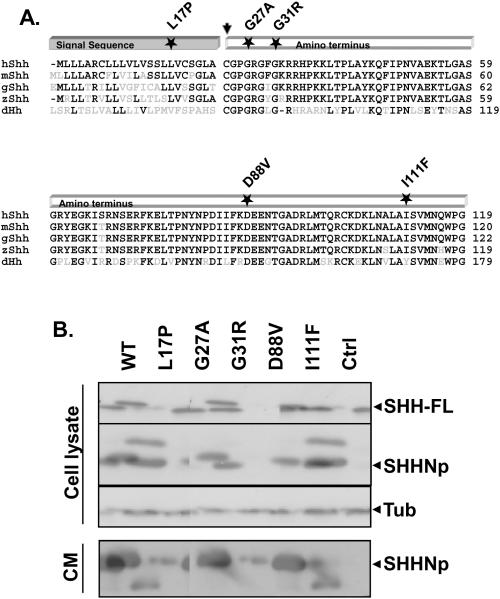
Figure 1
Figure 1. SHHHPE mutations affect its expression, processing and activity
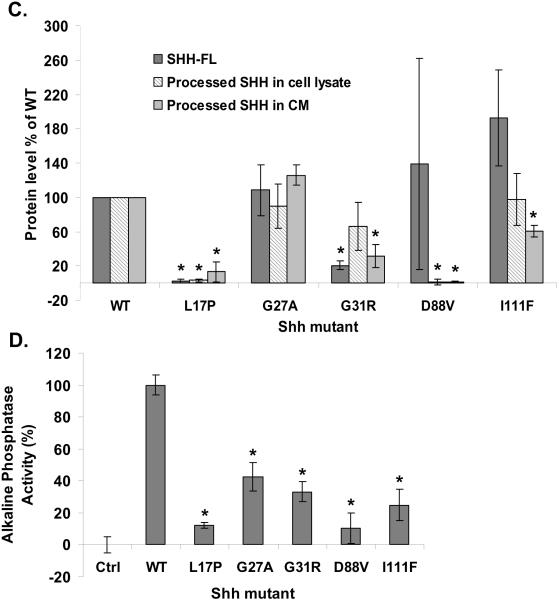
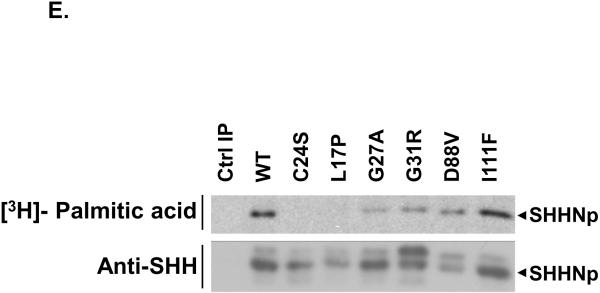
The amino-terminus of SHH is highly conserved across phyla, as shown by the multiple sequence alignment of human SHH (hSHH) with homologs found in Mus musculus (mSHH), Gallus gallus (gSHH), Danio rerio (zSHH) and Drosophila melanogaster (dHh) (A). The residues identical to that of hSHH are in black while others are in grey. For simplicity, only the signal-peptide and amino-terminal signaling domain (SHHN) are shown. The position of amino acid residues altered in SHH as a result of missense mutations in SHH, which were investigated in this paper, are marked by a star. The arrow indicates the palmitoylation site in the signaling domain after removal of the signal peptide. Bosc cells expressing wt SHH (WT), SHH-L17P (L17P), SHH-G27A (G27A), SHH-G31R (G31R), SHH-D88V (D88V), SHH-I111F (I111F) or a control (Ctrl) vector, were analyzed for the expression of SHH by immunoblotting cell lysate (top panel) for full-length SHH (SHH-FL), processed SHH (SHHNp) and tubulin (B) or conditioned medium (CM) (bottom panel) for SHHNp. Note: SHH-G31R is prone to proteolysis in the conditioned medium and the higher molecular weight species of SHH-G31R in the cell lysate migrates in a manner similar to SHHN (data not shown), which is not cholesterol modified. The immunoblots were analayzed using ImageJ software to quantify the level of different forms of SHH for indicated mutants in both cell lysate and CM (C). The protein levels are presented as the mean of three independent experiments and error bars represent ±S.D. The values for the processed form of SHH included both higher molecular weight and lower molecular weight immuno-reactive bands wherever present. The level of the different forms of SHH mutants generally differed from that of wt SHH (P values < 0.05 are indicated by *). Note: The level of SHH-FL form of SHH-D88V mutant was quite variable in different experiments for some unknown reason, as indicated by large S.D. error bar. Conditioned medium from cells expressing the indicated mutant was assayed for its ability to induce alkaline phosphatase activity in C3H10T ½ cells (D). Activity assays were done in triplicate and the error bars represent ±S.D. The activity of all the mutants was significantly different than wt SHH (P values < 0.05 are indicated by *). The palmitate modification of the indicated SHH mutants was estimated by immunoprecipitating SHH from the lysate of HEK 293T cells growing in medium supplemented with [9,10-3H] palmitic acid (E). The mutant SHH-C24S which lacked the palmitate acceptor amino acid acted as a negative control for palmitate labeling and the control immunoprecipitation (Ctrl IP) served as a control for nonspecific immunoprecipitation in this experiment. Note: Mutations near palmitate modification site affected modification more severely.
Figure 1
Figure 1. SHHHPE mutations affect its expression, processing and activity
The amino-terminus of SHH is highly conserved across phyla, as shown by the multiple sequence alignment of human SHH (hSHH) with homologs found in Mus musculus (mSHH), Gallus gallus (gSHH), Danio rerio (zSHH) and Drosophila melanogaster (dHh) (A). The residues identical to that of hSHH are in black while others are in grey. For simplicity, only the signal-peptide and amino-terminal signaling domain (SHHN) are shown. The position of amino acid residues altered in SHH as a result of missense mutations in SHH, which were investigated in this paper, are marked by a star. The arrow indicates the palmitoylation site in the signaling domain after removal of the signal peptide. Bosc cells expressing wt SHH (WT), SHH-L17P (L17P), SHH-G27A (G27A), SHH-G31R (G31R), SHH-D88V (D88V), SHH-I111F (I111F) or a control (Ctrl) vector, were analyzed for the expression of SHH by immunoblotting cell lysate (top panel) for full-length SHH (SHH-FL), processed SHH (SHHNp) and tubulin (B) or conditioned medium (CM) (bottom panel) for SHHNp. Note: SHH-G31R is prone to proteolysis in the conditioned medium and the higher molecular weight species of SHH-G31R in the cell lysate migrates in a manner similar to SHHN (data not shown), which is not cholesterol modified. The immunoblots were analayzed using ImageJ software to quantify the level of different forms of SHH for indicated mutants in both cell lysate and CM (C). The protein levels are presented as the mean of three independent experiments and error bars represent ±S.D. The values for the processed form of SHH included both higher molecular weight and lower molecular weight immuno-reactive bands wherever present. The level of the different forms of SHH mutants generally differed from that of wt SHH (P values < 0.05 are indicated by *). Note: The level of SHH-FL form of SHH-D88V mutant was quite variable in different experiments for some unknown reason, as indicated by large S.D. error bar. Conditioned medium from cells expressing the indicated mutant was assayed for its ability to induce alkaline phosphatase activity in C3H10T ½ cells (D). Activity assays were done in triplicate and the error bars represent ±S.D. The activity of all the mutants was significantly different than wt SHH (P values < 0.05 are indicated by *). The palmitate modification of the indicated SHH mutants was estimated by immunoprecipitating SHH from the lysate of HEK 293T cells growing in medium supplemented with [9,10-3H] palmitic acid (E). The mutant SHH-C24S which lacked the palmitate acceptor amino acid acted as a negative control for palmitate labeling and the control immunoprecipitation (Ctrl IP) served as a control for nonspecific immunoprecipitation in this experiment. Note: Mutations near palmitate modification site affected modification more severely.
Figure 1
Figure 1. SHHHPE mutations affect its expression, processing and activity
The amino-terminus of SHH is highly conserved across phyla, as shown by the multiple sequence alignment of human SHH (hSHH) with homologs found in Mus musculus (mSHH), Gallus gallus (gSHH), Danio rerio (zSHH) and Drosophila melanogaster (dHh) (A). The residues identical to that of hSHH are in black while others are in grey. For simplicity, only the signal-peptide and amino-terminal signaling domain (SHHN) are shown. The position of amino acid residues altered in SHH as a result of missense mutations in SHH, which were investigated in this paper, are marked by a star. The arrow indicates the palmitoylation site in the signaling domain after removal of the signal peptide. Bosc cells expressing wt SHH (WT), SHH-L17P (L17P), SHH-G27A (G27A), SHH-G31R (G31R), SHH-D88V (D88V), SHH-I111F (I111F) or a control (Ctrl) vector, were analyzed for the expression of SHH by immunoblotting cell lysate (top panel) for full-length SHH (SHH-FL), processed SHH (SHHNp) and tubulin (B) or conditioned medium (CM) (bottom panel) for SHHNp. Note: SHH-G31R is prone to proteolysis in the conditioned medium and the higher molecular weight species of SHH-G31R in the cell lysate migrates in a manner similar to SHHN (data not shown), which is not cholesterol modified. The immunoblots were analayzed using ImageJ software to quantify the level of different forms of SHH for indicated mutants in both cell lysate and CM (C). The protein levels are presented as the mean of three independent experiments and error bars represent ±S.D. The values for the processed form of SHH included both higher molecular weight and lower molecular weight immuno-reactive bands wherever present. The level of the different forms of SHH mutants generally differed from that of wt SHH (P values < 0.05 are indicated by *). Note: The level of SHH-FL form of SHH-D88V mutant was quite variable in different experiments for some unknown reason, as indicated by large S.D. error bar. Conditioned medium from cells expressing the indicated mutant was assayed for its ability to induce alkaline phosphatase activity in C3H10T ½ cells (D). Activity assays were done in triplicate and the error bars represent ±S.D. The activity of all the mutants was significantly different than wt SHH (P values < 0.05 are indicated by *). The palmitate modification of the indicated SHH mutants was estimated by immunoprecipitating SHH from the lysate of HEK 293T cells growing in medium supplemented with [9,10-3H] palmitic acid (E). The mutant SHH-C24S which lacked the palmitate acceptor amino acid acted as a negative control for palmitate labeling and the control immunoprecipitation (Ctrl IP) served as a control for nonspecific immunoprecipitation in this experiment. Note: Mutations near palmitate modification site affected modification more severely.
Figure 2
Figure 2. SHH-G27A and SHH-G31R have attenuated activityin vivo
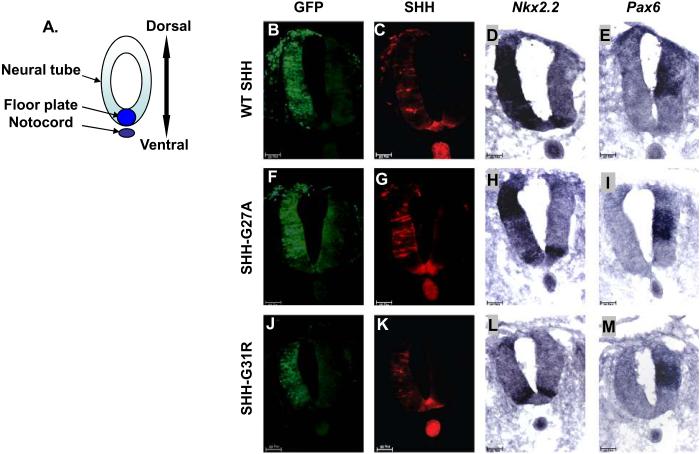
Panel (A) shows a schematic representation of the neural tube and notochord. (B-M) The activity of wt SHH, SHH-G27A and SHHG31R was determined by electroporating plasmids expressing them, along with a GFP expressing plasmid, on one side of the chick embryonic neural tube. Induction of Nkx2.2 expression and repression of Pax6 expression (dark blue) was then determined by in situ hybridization, while SHH expression was determined using anti-SHH antibodies (red). GFP expression served as an electroporation control in these experiments (light green). Electroporation of SHH-G27A (n=37) and SHH-G31R (n=27) induced Nkx2.2 expression at a lower level than wt SHH (n=52) (compare panel H, L and D to the amount of SHH expressed in panel G, K and C, respectively), but were comparable in their ability to repress Pax6 expression (wt SHH, n=45; SHH-G27A, n=29; SHH-G31R, n=22), whose repression is considered an indicator of low-level SHH activity (panel I, M and E).
Figure 3
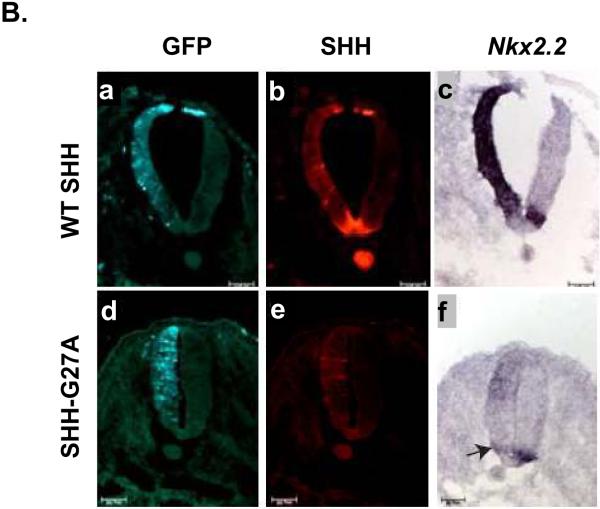
Figure 3. SHH-G27A dominantly inhibits endogenous SHH activity
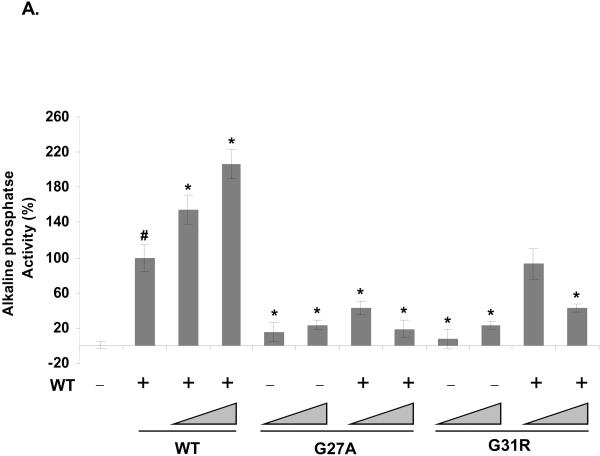
The ability of SHH mutants SHH-G27A and SHH-G31R to affect wt SHH activity was evaluated by testing conditioned medium from Bosc cells expressing wt SHH (WT), SHH-G27A (G27A) and SHH-G31R (G31R) alone or in combination with wt SHH, at different molar ratios (1x:1x and 5x:1x respectively), for its ability to induce alkaline phosphatase activity in C3H10T½ cells (A). In this experiment, 1x corresponded to 80 ng of variant DNA and a total of 500 ng of DNA (equalized using vector DNA) was transfected into Bosc cells plated in 60 mm plates. Activity assays were done in triplicate and the error bars represent ±S.D. Both SHHG27A and SHH-G31R attenuated wt SHH activity (1x wt SHH, indicated by #) in a dose dependent manner. The activity of these mutants alone or when expressed in combination with wt SHH was significantly different from 1x wt SHH as were higher doses of wt SHH (P values < 0.05 are indicated by *). SHH-G27A also attenuated endogenous SHH activity in vivo (B). The ability of SHH-G27A to attenuate endogenous SHH in the chick neural tube was assessed by electroporating a SHH-G27A expressing plasmid (n=16), along with a GFP expressing plasmid, on one side of the chick embryonic neural tube. SHH expression was determined using anti-SHH antibodies (red). Induction of Nkx2.2 expression (dark blue) was determined by in situ hybridization. GFP expression (light-green) served as an electroporation control in these experiments. SHH-G27A attenuated the induction of Nkx2.2 expression by endogenous SHH (arrow in panel f) validating our in vitro observation that some SHH mutants can act in a dominant negative manner. Under these conditions, endogenous SHH activity was attenuated 50% (8 out of 16) of the time embryos were electroporated with SHH-G27A expressing plasmid (see Table 1).
Figure 3
Figure 3. SHH-G27A dominantly inhibits endogenous SHH activity
The ability of SHH mutants SHH-G27A and SHH-G31R to affect wt SHH activity was evaluated by testing conditioned medium from Bosc cells expressing wt SHH (WT), SHH-G27A (G27A) and SHH-G31R (G31R) alone or in combination with wt SHH, at different molar ratios (1x:1x and 5x:1x respectively), for its ability to induce alkaline phosphatase activity in C3H10T½ cells (A). In this experiment, 1x corresponded to 80 ng of variant DNA and a total of 500 ng of DNA (equalized using vector DNA) was transfected into Bosc cells plated in 60 mm plates. Activity assays were done in triplicate and the error bars represent ±S.D. Both SHHG27A and SHH-G31R attenuated wt SHH activity (1x wt SHH, indicated by #) in a dose dependent manner. The activity of these mutants alone or when expressed in combination with wt SHH was significantly different from 1x wt SHH as were higher doses of wt SHH (P values < 0.05 are indicated by *). SHH-G27A also attenuated endogenous SHH activity in vivo (B). The ability of SHH-G27A to attenuate endogenous SHH in the chick neural tube was assessed by electroporating a SHH-G27A expressing plasmid (n=16), along with a GFP expressing plasmid, on one side of the chick embryonic neural tube. SHH expression was determined using anti-SHH antibodies (red). Induction of Nkx2.2 expression (dark blue) was determined by in situ hybridization. GFP expression (light-green) served as an electroporation control in these experiments. SHH-G27A attenuated the induction of Nkx2.2 expression by endogenous SHH (arrow in panel f) validating our in vitro observation that some SHH mutants can act in a dominant negative manner. Under these conditions, endogenous SHH activity was attenuated 50% (8 out of 16) of the time embryos were electroporated with SHH-G27A expressing plasmid (see Table 1).

References

    1. Belloni E, Muenke M, Roessler E, Traverso G, Siegel-Bartelt J, Frumkin A, Mitchell HF, Donis-Keller H, Helms C, Hing AV, Heng HH, Koop B, Martindale D, Rommens JM, Tsui LC, Scherer SW. Identification of Sonic hedgehog as a candidate gene responsible for holoprosencephaly. Nat Genet. 1996;14:353–6. - PubMed
    1. Bourikas D, Pekarik V, Baeriswyl T, Grunditz A, Sadhu R, Nardo M, Stoeckli ET. Sonic hedgehog guides commissural axons along the longitudinal axis of the spinal cord. Nat Neurosci. 2005;8:297–304. - PubMed
    1. Briscoe J, Ericson J. The specification of neuronal identity by graded Sonic Hedgehog signalling. Semin Cell Dev Biol. 1999;10:353–62. - PubMed
    1. Bumcrot DA, Takada R, McMahon AP. Proteolytic processing yields two secreted forms of sonic hedgehog. Mol Cell Biol. 1995;15:2294–303. - PMC - PubMed
    1. Burke R, Nellen D, Bellotto M, Hafen E, Senti KA, Dickson BJ, Basler K. Dispatched, a novel sterol-sensing domain protein dedicated to the release of cholesterol-modified hedgehog from signaling cells. Cell. 1999;99:803–15. - PubMed

Publication types

LinkOut - more resources