. 2008 Dec;152(6):265-72.
doi: 10.1016/j.trsl.2008.10.004. Epub 2008 Oct 31.

Epidermal growth factor receptor (EGFR) regulates mechanical ventilation-induced lung injury in mice

Affiliations

Epidermal growth factor receptor (EGFR) regulates mechanical ventilation-induced lung injury in mice

Alexis Bierman et al. Transl Res. 2008 Dec.

Abstract

Mechanical ventilation (MV) is used as therapy to support critically ill patients; however, the mechanisms by which MV induces lung injury and inflammation remain unclear. Epidermal growth factor receptor (EGFR)-mediated signaling plays a key role in various physiologic and pathologic processes, which include those modulated by mechanical and shear forces, in various cell types. We hypothesized that EGFR-activated signaling plays a key role in ventilator-induced lung injury and inflammation (VILI). To test this hypothesis, we assessed lung vascular and alveolar permeability as well as inflammation, which are cardinal features of VILI, in mice treated with the EGFR inhibitor AG1478. Inhibition of EGFR activity greatly diminished MV-induced lung alveolar permeability and neutrophil accumulation in the bronchoalveolar lavage (BAL) fluid, as compared with vehicle-treated controls. Similarly, AG1478 inhibition diminished lung vascular leak (as assessed by Evans blue extravasation), but it did not affect interstitial neutrophil accumulation. Inhibition of the EGFR pathway also blocked expression of genes induced by MV. However, intratracheal instillation of EGF alone failed to induce lung injury. Collectively, our findings suggest that EGFR-activated signaling is necessary but not sufficient to produce acute lung injury in mice.


Figures
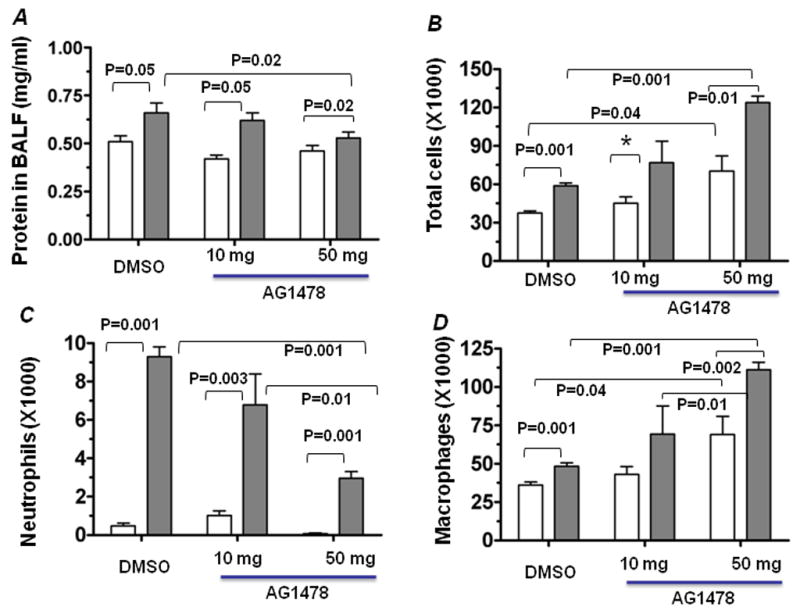
Figure 1
Figure 1. Effect of EGFR inhibition on MV induced lung injury and inflammatory responses
Mice were pretreated for 30 min with AG1478 (10 mg or 50/mg per kg body weight) or DMSO and then randomly assigned to SpV (open bars) or MV (filled bars) groups. Mice were subjected to MV or breathed spontaneously (SpV) for 2 h, and BAL fluid was obtained and protein was quantified as detailed in Methods. (A) The effect of AG1478 on MV induced lung alveolar permeability. The number of cells (B), neutrophils (C), and total macrophages (D) in the BAL fluid collected from mice was counted by differential staining with Diff Quick’s. Values represent means ± SE (n = 3 for SpV group and n=5 for MV group) and the respective P values are displayed. (E) EGFR activation by MV. Mice were exposed to SpV or MV for 30 min supplemented with either DMSO or AG1478. The right lobe from each animal was separately homogenized in MAP kinase lysis buffer and immunoblotted using antibodies specific for the phosphorylated form of EGFR. The native form of EGFR was used as loading control. Lanes 2 and 3 represent lung samples from two different mice treated with DMSO and then subjected to MV, whereas lanes 5 and 6 represent that of AG1478-treated MV group. Lanes 1 and 2 represent lung samples isolated from SpV mice pre-treated with DMSO and AG1478, respectively.
Figure 1
Figure 1. Effect of EGFR inhibition on MV induced lung injury and inflammatory responses
Mice were pretreated for 30 min with AG1478 (10 mg or 50/mg per kg body weight) or DMSO and then randomly assigned to SpV (open bars) or MV (filled bars) groups. Mice were subjected to MV or breathed spontaneously (SpV) for 2 h, and BAL fluid was obtained and protein was quantified as detailed in Methods. (A) The effect of AG1478 on MV induced lung alveolar permeability. The number of cells (B), neutrophils (C), and total macrophages (D) in the BAL fluid collected from mice was counted by differential staining with Diff Quick’s. Values represent means ± SE (n = 3 for SpV group and n=5 for MV group) and the respective P values are displayed. (E) EGFR activation by MV. Mice were exposed to SpV or MV for 30 min supplemented with either DMSO or AG1478. The right lobe from each animal was separately homogenized in MAP kinase lysis buffer and immunoblotted using antibodies specific for the phosphorylated form of EGFR. The native form of EGFR was used as loading control. Lanes 2 and 3 represent lung samples from two different mice treated with DMSO and then subjected to MV, whereas lanes 5 and 6 represent that of AG1478-treated MV group. Lanes 1 and 2 represent lung samples isolated from SpV mice pre-treated with DMSO and AG1478, respectively.
Figure 2
Figure 2. Effect of AG1478 on MV-induced pulmonary neutrophil infiltration
(A) H& E staining of lung tissues (magnification 400×). Arrows indicate the position of positive antibody staining for the presence of neutrophils. (B) Assessment of MV-induced neutrophil infiltration in lung parenchyma of mice supplemented with vehicle or AG1478 was performed using anti-neutrophil antibody as detailed in “Methods”. (C) Quantification of neutrophils present in the alveolar space. Digital images of tissue sections stained with anti-neutrophil antibody were obtained and neutrophils were quantified as detailed elsewhere . Data represent means ± SE of an average of at least 15 high-power fields for each experimental group (n =4). P values are shown for respective experimental groups.
Figure 3
Figure 3. Effects of exogenous A1478 on MV-induced vascular leak
Mice were treated for 30 min with AG1478 (50 mg/kg b.w) or DMSO prior to MV exposure, and randomly assigned to MV or SpV. Mice were injected with Evans blue dye intraperitoneally 1 h prior to the end of MV exposure. Lungs were flushed and vascular leakage was assessed by the extravasation of Evans blue into lung parenchyma as detailed in Methods. Data are presented as means ± SE. The following number of mice was used in each experimental group include: N=5 for DMSO-SpV; N=9 for DMSO-MV; N=5 for AG1478-SpV, and N=7 for AG1478-MV. P values for respective groups are indicated.
Figure 4
Figure 4. Effects of EGFR inhibition on MV-induced gene expression
Total RNA was isolated from the left lobe of each mice treated with the AG1478 inhibitor or vehicle and subjected to SpV (n=3) or MV (n=3) for 2 h. cDNA was prepared separately for each RNA sample and real-time RT-PCR was performed using Taqman assays specific for mouse Areg, Atf3, Cxcl2, and Egr1 genes. GAPDH was used as an internal control. Data are presented as means ± SE. P values for respective each experimental groups are shown.
Figure 5
Figure 5. Effects of exogenous EGF on lung injury and inflammatory response
Mice were briefly anesthetized and EGF was instilled intratracheally at two different doses of 20 ng or 100 ng (n=4/each group). Saline (50 μl) instillation was used as vehicle control group (n=5). After 2 h of EGF or vehicle administration, BAL fluid was collected for cell count and protein estimation. Total protein (A) and cells (B), and neutrophils (C) and macrophages (D) in the BAL fluid were quantified as detailed in Fig. 1.

Comment in

References

    1. Matthay MA, Zimmerman GA. Acute lung injury and the acute respiratory distress syndrome: four decades of inquiry into pathogenesis and rational management. Am J Respir Cell Mol Biol. 2005;33:319–327. - PMC - PubMed
    1. Waters CM. Reactive oxygen species in mechanotransduction. Am J Physiol Lung Cell Mol Physiol. 2004;287:L484–485. - PubMed
    1. Reddy SP, Hassoun PM, Brower R. Redox imbalance and ventilator-induced lung injury. Antioxid Redox Signal. 2007;9:2003–2012. - PubMed
    1. Belperio JA, Keane MP, Lynch JP, 3rd, Strieter RM. The role of cytokines during the pathogenesis of ventilator-associated and ventilator-induced lung injury. Semin Respir Crit Care Med. 2006;27:350–364. - PubMed
    1. Fischer OM, Hart S, Gschwind A, Ullrich A. EGFR signal transactivation in cancer cells. Biochem Soc Trans. 2003;31:1203–1208. - PubMed

Publication types

MeSH terms
