


Evolution of Drosophila ribosomal protein gene core promoters
- PMID: 19059316
- PMCID: PMC3232064
- DOI: 10.1016/j.gene.2008.10.025
Evolution of Drosophila ribosomal protein gene core promoters
Abstract
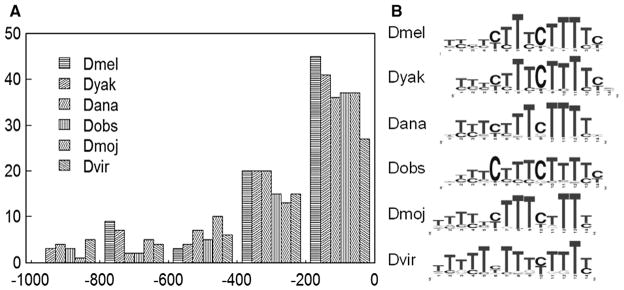
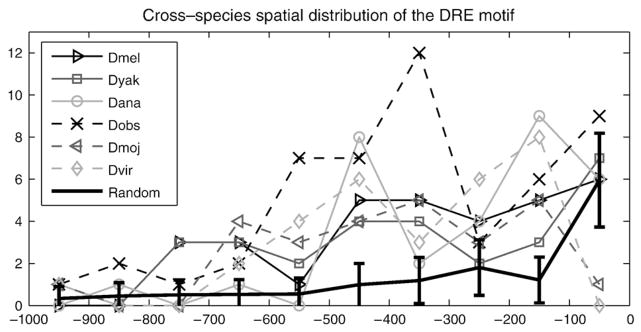
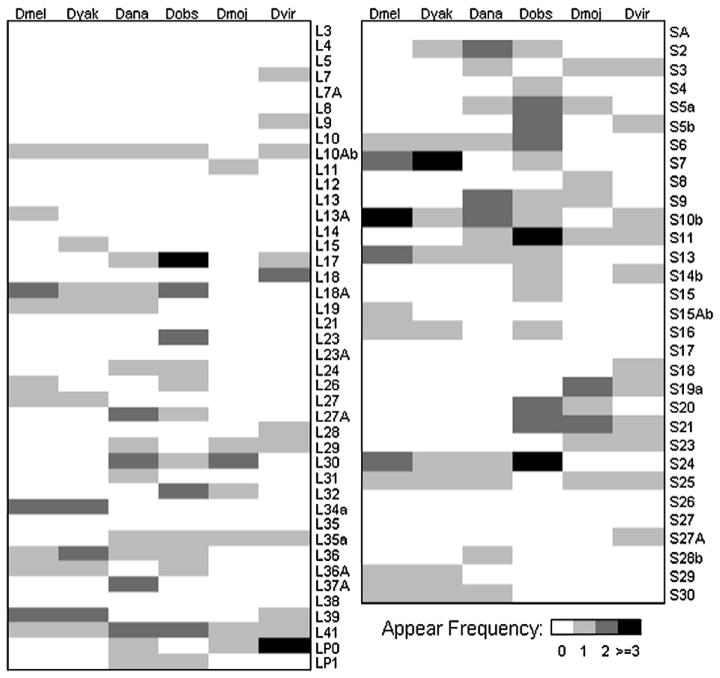
The coordinated expression of ribosomal protein genes (RPGs) has been well documented in many species. Previous analyses of RPG promoters focus only on Fungi and mammals. Recognizing this gap and using a comparative genomics approach, we utilize a motif-finding algorithm that incorporates cross-species conservation to identify several significant motifs in Drosophila RPG promoters. As a result, significant differences of the enriched motifs in RPG promoter are found among Drosophila, Fungi, and mammals, demonstrating the evolutionary dynamics of the ribosomal gene regulatory network. We also report a motif present in similar numbers of RPGs among Drosophila species which does not appear to be conserved at the individual RPG gene level. A module-wise stabilizing selection theory is proposed to explain this observation. Overall, our results provide significant insight into the fast-evolving nature of transcriptional regulation in the RPG module.
Figures

References
-
- Arnheim N. Concerted evolution of multigene families. In: Nei M, Koehn R, editors. Evolution of Genes and Proteins. MA, Sunderland: 1983. pp. 38–61.
-
- Bailey TL, Elkan C. Fitting a mixture model by expectation maximization to discover motifs in biopolymers. Proc Int Conf Intell Syst Mol Biol. 1994;2:28–36. - PubMed
-
- Hariharan N, Kelley DE, Perry RP. Equipotent mouse ribosomal protein promoters have a similar architecture that includes internal sequence elements. Genes Dev. 1989;3:1789–1800. - PubMed
Publication types
MeSH terms
Substances
Grants and funding
LinkOut - more resources
Full Text Sources
Molecular Biology Databases
Miscellaneous
