


Development of perceptual expertise in emotion recognition
- PMID: 19059585
- PMCID: PMC2673797
- DOI: 10.1016/j.cognition.2008.10.010
Development of perceptual expertise in emotion recognition
Abstract
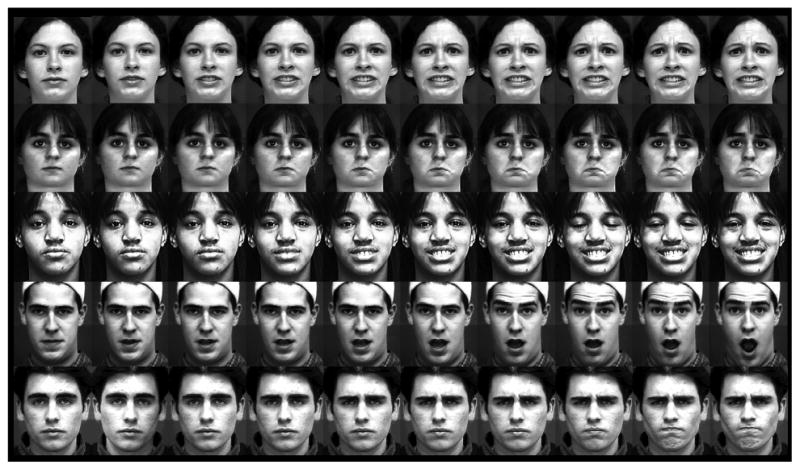
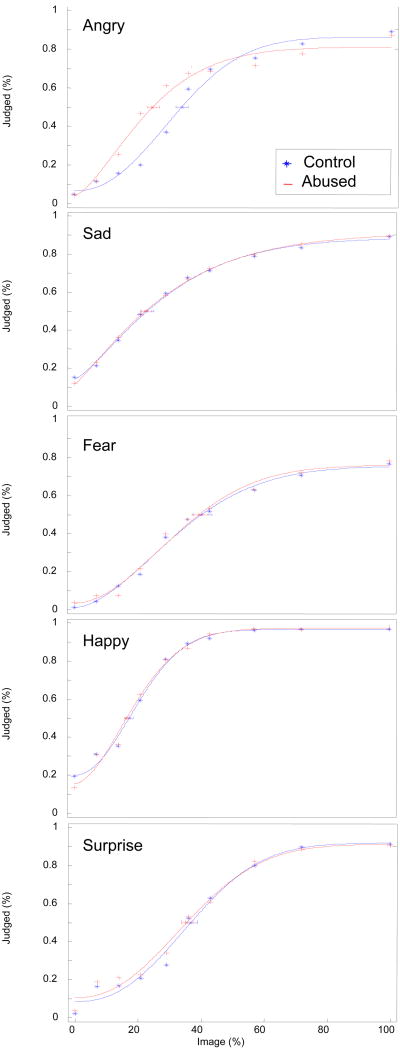
How do children's early social experiences influence their perception of emotion-specific information communicated by the face? To examine this question, we tested a group of abused children who had been exposed to extremely high levels of parental anger expression and physical threat. Children were presented with arrays of stimuli that depicted the unfolding of facial expressions, from neutrality to peak emotions. The abused children accurately recognized anger early in the formation of the facial expression, when few physiological cues were available. The speed of children's recognition was associated with the degree of anger/hostility reported by the child's parent. These data highlight the ways in which perceptual learning can shape the timing of emotion perception.
Figures
References
-
- Bornstein MH, Arterberry ME. Recognition, discrimination and categorization of smiling by 5-month-old infants. Developmental Science. 2003;6:585–599.
-
- Carey S, Diamond R. Are faces perceived as configurations more by adults than by children? Visual Cognition. 1994;1:253–174.
-
- Diamond R, Carey S. Why faces are and are not special: An effect of expertise. Journal of Experimental Psychology: General. 1986;115:107–117. - PubMed
-
- Dolan RJ, Fink GR, Rolls E, Booth M, Holmes A, Frackowiak RSJ, Friston KJ. How the brain learns to see objects and faces in an impoverished context. Nature. 1997;389:596–599. - PubMed
-
- Ekman P. The directed facial action technique. In: Coan JA, Allen JB, editors. The handbook of emotion elicitation and assessment, Oxford University Press Series in Affective Science. New York, NY: Oxford University; In press.
MeSH terms
Grants and funding
LinkOut - more resources
Full Text Sources
