Racial, ethnic, and socioeconomic differences in the incidence of obesity related to childbirth
- PMID: 19059856
- PMCID: PMC2622775
- DOI: 10.2105/AJPH.2007.132373
Racial, ethnic, and socioeconomic differences in the incidence of obesity related to childbirth
Abstract
Objectives: We investigated the relationship between childbirth and 5-year incidence of obesity.
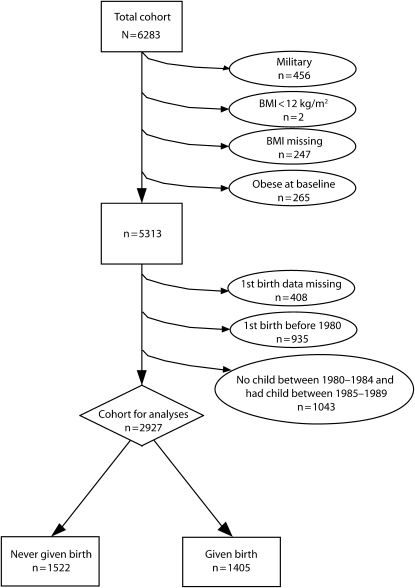
Methods: We performed a prospective analysis of data on 2923 nonobese, nonpregnant women aged 14 to 22 years from the 1979 National Longitudinal Survey of Youth Cohort, which was followed from 1980 to 1990. We used multivariable logistic regression analyses to determine the adjusted relative risk of obesity for mothers 5 years after childbirth compared with women who did not have children.
Results: The 5-year incidence of obesity was 11.3 per 100 parous women, compared with 4.5 per 100 nulliparous women (relative risk [RR] = 3.5; 95% confidence interval [CI] = 2.4, 4.9; P < .001). The 5-year incidence of obesity was 8.6 for primiparous women (RR = 2.8; 95% CI = 1.5, 5.0) and 12.2 for multiparous women (RR = 3.8; 95% CI = 2.6, 5.6). Among parous women, White women had the lowest obesity incidence (9.1 per 100 vs 15.1 per 100 for African Americans and 12.5 per 100 for Hispanics).
Conclusions: Parous women have a higher incidence of obesity than do nulliparous women, and minority women have a higher incidence of parity-related obesity than do White women. Thus, efforts to reduce obesity should target postpartum women and minority women who give birth.
Figures
References
-
- Flegal KM, Carroll MD, Ogden CL, Johnson CL. Prevalence and trends in obesity among US adults, 1999–2000. JAMA 2002;288:1723–1727 - PubMed
-
- Mokdad AH, Ford ES, Bowman BA, et al. Prevalence of obesity, diabetes, and obesity-related health risk factors, 2001. JAMA 2003;289:76–79 - PubMed
-
- The Surgeon General's Call to Action to Prevent and Decrease Overweight and Obesity. Washington, DC: Public Health Service; 2001
-
- Linne Y, Barkeling B, Rossner S. Long-term weight development after pregnancy. Obes Rev 2002;3:75–83 - PubMed
-
- Olson CM, Strawderman MS, Hinton PS, Pearson TA. Gestational weight gain and postpartum behaviors associated with weight change from early pregnancy to 1 year postpartum. Int J Obes Relat Metab Disord 2003;27:117–127 - PubMed
Publication types
MeSH terms
Grants and funding
LinkOut - more resources
Full Text Sources
Medical