


Urinary metabolites of di(2-ethylhexyl) phthalate are associated with decreased steroid hormone levels in adult men
- PMID: 19059903
- PMCID: PMC2772199
- DOI: 10.2164/jandrol.108.006403
Urinary metabolites of di(2-ethylhexyl) phthalate are associated with decreased steroid hormone levels in adult men
Abstract
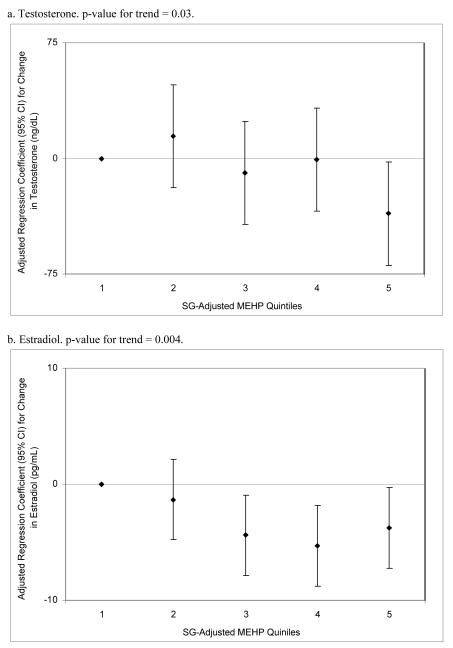
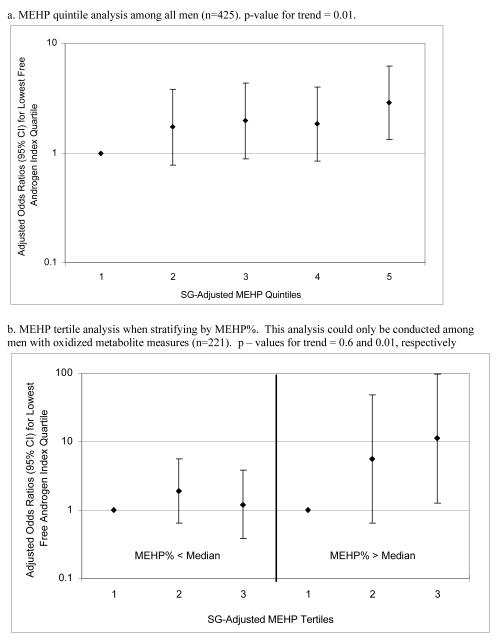
Experimental animal studies have demonstrated that exposure to some phthalates may be associated with altered endocrine function and adverse effects on male reproductive development and function, but human studies are limited. In the present study, urine and serum samples were collected from 425 men recruited through a US infertility clinic. Urinary concentrations of mono(2-ethylhexyl) phthalate (MEHP), the hydrolytic metabolite of di(2-ethylhexyl) phthalate (DEHP), and other phthalate monoester metabolites were measured, along with serum levels of testosterone, estradiol, sex hormone-binding globulin (SHBG), follicle-stimulating hormone, luteinizing hormone, inhibin B, and prolactin. Two oxidized urinary metabolites of DEHP were also measured in urine from 221 of the men. In multiple regression models adjusted for potential confounders, MEHP was inversely associated with testosterone, estradiol, and free androgen index (FAI). An interquartile range increase in MEHP was associated with 3.7% (95% confidence interval [CI], -6.8% to -0.5%) and 6.8% (95% CI, -11.2% to -2.4%) declines in testosterone and estradiol, respectively, relative to the population median hormone levels. There was limited evidence for effect modification of the inverse association between MEHP and FAI by the proportion of DEHP metabolites in the urine measured as MEHP (MEHP%), which is considered a phenotypic marker of less efficient metabolism of DEHP to its oxidized metabolites. Finally, the ratio of testosterone to estradiol was positively associated with MEHP (P = .07) and MEHP% (P = .007), suggesting potential relationships with aromatase suppression. In conclusion, these results suggest that urinary metabolites of DEHP are inversely associated with circulating steroid hormone levels in adult men. However, additional research is needed to confirm these findings.
Figures
References
-
- Andersson AM, Jensen TK, Juul A, Petersen JH, Jorgensen T, Skakkebaek NE. Secular decline in male testosterone and sex hormone binding globulin serum levels in Danish population surveys. J Clin Endocrinol Metab. 2007;92(12):4696–705. - PubMed
-
- Andrade AJ, Grande SW, Talsness CE, Grote K, Chahoud I. A dose-response study following in utero and lactational exposure to di-(2-ethylhexyl)-phthalate (DEHP): non-monotonic dose-response and low dose effects on rat brain aromatase activity. Toxicology. 2006;227(3):185–92. - PubMed
-
- ATSDR . Toxicological Profile for Diethyl phthalate (DEP) Agency for Toxic Substances and Disease Registry; Atlanta, GA: 1995. - PubMed
-
- ATSDR . Toxicological Profile for Di-n-butyl phthalate (DBP) Agency for Toxic Substances and Disease Registry; Atlanta, GA: 2001. - PubMed
-
- ATSDR . Toxicological Profile for Di(2-ethylhexyl)phthalate (DEHP) Agency for Toxic Substances and Disease Registry; Atlanta, GA: 2002. - PubMed
Publication types
MeSH terms
Substances
Grants and funding
LinkOut - more resources
Full Text Sources
Medical
Miscellaneous
