Review
. 2009 Feb;37(3):721-30.
doi: 10.1093/nar/gkn994. Epub 2008 Dec 5.

Topoisomerase II: a fitted mechanism for the chromatin landscape

Affiliations
Review

Topoisomerase II: a fitted mechanism for the chromatin landscape

Joaquim Roca. Nucleic Acids Res. 2009 Feb.

Abstract

The mechanism by which type-2A topoisomerases transport one DNA duplex through a transient double-strand break produced in another exhibits fascinating traits. One of them is the fine coupling between inter-domainal movements and ATP usage; another is their preference to transport DNA in particular directions. These capabilities have been inferred from in vitro studies but we ignore their significance inside the cell, where DNA configurations markedly differ from those of DNA in free solution. The eukaryotic type-2A enzyme, topoisomerase II, is the second most abundant chromatin protein after histones and its biological roles include the decatenation of newly replicated DNA and the relaxation of polymerase-driven supercoils. Yet, topoisomerase II is also implicated in other cellular processes such as chromatin folding and gene expression, in which the topological transformations catalysed by the enzyme are uncertain. Here, some capabilities of topoisomerase II that might be relevant to infer the enzyme performance in the context of chromatin architecture are discussed. Some aspects addressed are the importance of the DNA rejoining step to ensure genome stability, the regulation of the enzyme activity and of its putative structural role, and the selectively of DNA transport in the chromatin milieu.


Figures
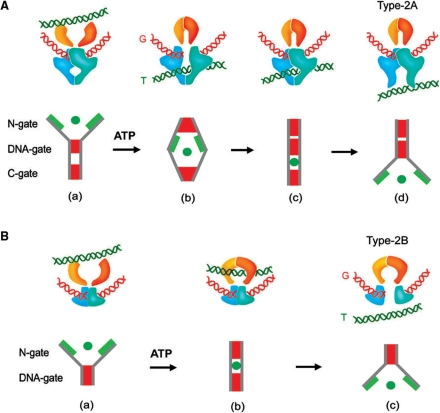
Figure 1.
Figure 1.
Mechanical couplings for gate opening and closure in type-2 topoisomerases. (A) In type-2A enzymes (bacterial gyrase, topoisomerase IV, topoisomerase II), the N-gate, DNA gate and C-gate appear to be mechanically coupled with a double-lock rule, such that a given gate can open only if the other two are closed. This coordination minimizes the risk of the two enzyme halves from coming apart while gating the DNA. (a) When the entrance N-gate is open, DNA might be cleaved but the DNA gate is not able to widen. (b) Upon ATP binding and closure of the N-gate, a captured T-segment cannot be held in the inter-domainal region between the N-gate and DNA gate. The T-segment quickly crosses the DNA-gate and reaches the central cavity of the enzyme. (c) The gated DNA is then rejoined. (d) The consequent entrapment of the T-segment enforces its exit by a transient opening of the C-gate. (B) In type-2B enzymes (topoisomerase VI) there is no C-gate. Dimer stability depends on the coordination between the N-gate and DNA gate. (a) When the entrance N-gate is open (no ATP bound) the DNA gate is locked. (b) Upon ATP binding and closure of the N-gate, a captured T-segment is held in the central cavity of the enzyme prior to the aperture of the DNA gate. (c) The captured T-segment crosses then the DNA-gate and exits the complex.
Figure 2.
Figure 2.
Topoisomerase II might discern whether or not a DNA domain is suitable for successful rejoining by bending the G-segment before the gating step. (a) Proper bending of the interacting duplex will be possible as long as the stretching tension along the DNA does not exceed a threshold value (τo). This threshold is determined by the tension (τp) that the enzyme is able to counteract to close the DNA gate. (b) The active deformation of DNA, coupled to ATP binding and hydrolysis, could operate then as a checkpoint to unlock the DNA-gate, as well as a gain of elastic energy to be delivered in the rejoining step.
Figure 3.
Figure 3.
Gate padlocks can regulate topoisomerase activity and clamp interacting DNA. Analogously to bisdioxopiperazines, such as ICRF-193 that inhibit topoisomerase II activity, closure of the N-gate of topoisomerase II upon ATP binding can be stabilized also by some cellular factor. (A) Such gate padlocks could operate as inhibitors of enzyme binding to chromosomal DNA. (B) If DNA is already bound to the topoisomerase, an N-gate padlock would produce a high salt resistant complex, which might serve to regulate the enzyme activity or operate as a structural element for DNA organization. (C) Padlocks for the C-gate could also exist. If both the N-gate and the C-gate were stabilized in the closed conformation, the topoisomerase could clamp two DNA duplexes, the G-segment and passed T-segment.
Figure 4.
Figure 4.
Juxtaposition of DNA segments enforced by chromatin architecture. (A) Nucleosomes accommodate to positive helical tension (+) by adopting a meta-stable conformation in which H2A–H2B dimers and the H3–H4 tetramer reorganize and shape a right-handed path for DNA. The entry and exit DNA segments of this nucleosomal conformation might configure an ideal positive DNA crossing to be targeted by topoisomerase II. DNA transport would relax the helical tension and revert the chiral transition of the nucleosome. This scenery might explain why topoisomerase II relaxes helical tension in nucleosome arrays as efficiently as in naked DNA. (B) In absence of DNA helical tension, DNA juxtaposition could be tailored by neighbouring DNA–protein interactions. DNA transport would then result in supercoiling (or knotting). The reaction would be analogous to that of DNA gyrase. The only difference is that protein–DNA interactions enforcing the juxtaposition of a T-segment are established outside rather than inside the topoisomerase–DNA complex.

References

    1. Wang JC. Moving one DNA double helix through another by a type II DNA topoisomerase: the story of a simple molecular machine. Q. Rev. Biophys. 1998;31:107–144. - PubMed
    1. Champoux JJ. DNA topoisomerases: structure, function, and mechanism. Annu. Rev. Biochem. 2001;70:369–413. - PubMed
    1. Corbett KD, Berger JM. Structure, molecular mechanisms, and evolutionary relationships in DNA topoisomerases. Annu. Rev. Biophys. Biomol. Struct. 2004;33:95–118. - PubMed
    1. Schoeffler AJ, Berger JM. DNA topoisomerases: harnessing and constraining energy to govern chromosome topology. Q. Rev. Biophys. 2008;41:41–101. - PubMed

    1. Schultz P, Olland S, Oudet P, Hancock R. Structure and conformational changes of DNA topoisomerase II visualized by electron microscopy. Proc. Natl Acad. Sci. USA. 1996;93:5936–5940. - PMC - PubMed