. 2009 Feb;46(2):201-12.
doi: 10.1016/j.yjmcc.2008.10.025. Epub 2008 Nov 11.

PGC-1alpha and ERRalpha target gene downregulation is a signature of the failing human heart

Affiliations

PGC-1alpha and ERRalpha target gene downregulation is a signature of the failing human heart

Smita Sihag et al. J Mol Cell Cardiol. 2009 Feb.

Abstract

Heart failure is a cause of significant morbidity and mortality in developed nations, and results from a complex interplay between genetic and environmental factors. To discover gene regulatory networks underlying heart failure, we analyzed DNA microarray data based on left ventricular free-wall myocardium from 59 failing (32 ischemic cardiomyopathy, 27 idiopathic dilated cardiomyopathy) and 33 non-failing explanted human hearts from the Cardiogenomics Consortium. In particular, we sought to investigate cardiac gene expression changes at the level of individual genes, as well as biological pathways which contain groups of functionally related genes. Utilizing a combination of computational techniques, including Comparative Marker Selection and Gene Set Enrichment Analysis, we identified a subset of downstream gene targets of the master mitochondrial transcriptional regulator, peroxisome proliferator-activated receptor gamma coactivator-1alpha (PGC-1alpha), whose expression is collectively decreased in failing human hearts. We also observed decreased expression of the key PGC-1alpha regulatory partner, estrogen-related receptor alpha (ERRalpha), as well as ERRalpha target genes which may participate in the downregulation of mitochondrial metabolic capacity. Gene expression of the antiapoptotic Raf-1/extracellular signal-regulated kinase (ERK) pathway was decreased in failing hearts. Alterations in PGC-1alpha and ERRalpha target gene sets were significantly correlated with an important clinical parameter of disease severity - left ventricular ejection fraction, and were predictive of failing vs. non-failing phenotypes. Overall, our results implicate PGC-1alpha and ERRalpha in the pathophysiology of human heart failure, and define dynamic target gene sets sharing known interrelated regulatory mechanisms capable of contributing to the mitochondrial dysfunction characteristic of this disease process.


Figures
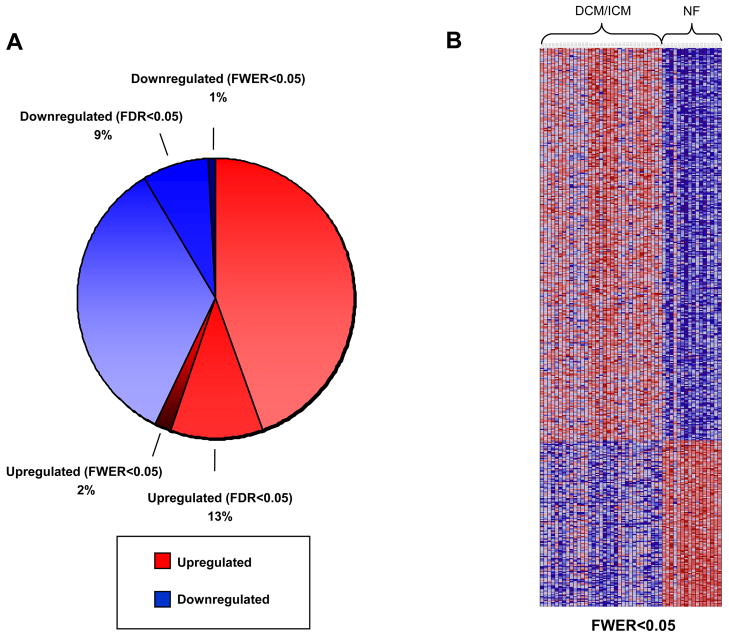
Fig. 1
Fig. 1
Results of comparative marker selection analysis in DCM/ICM vs. NF groups. Red indicates increased expression, while blue indicates decreased expression relative to the non-failing population mean. (A) The pie chart conveys the percentage of genes up and downregulated of 17,419 total genes. Those genes that are upregulated at FWER<0.05 are a subset of those upregulated at FDR<0.05, which are in turn a subset of all upregulated genes; the same applies to downregulated genes. (B) Heatmap of genes significantly up and downregulated at FWER<0.05.
Fig. 2
Fig. 2
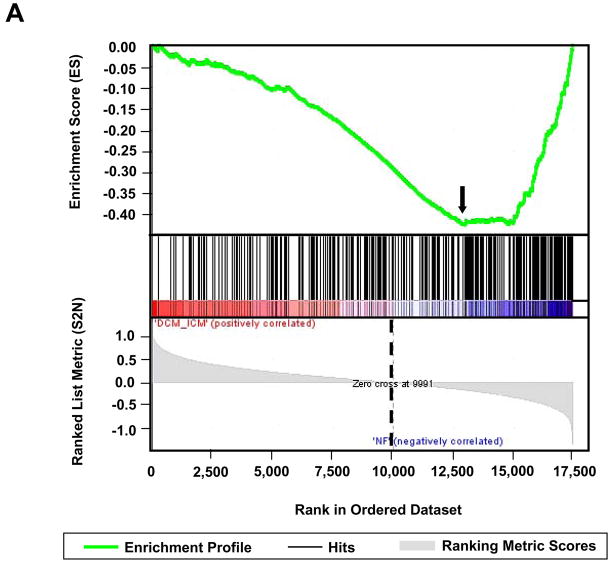
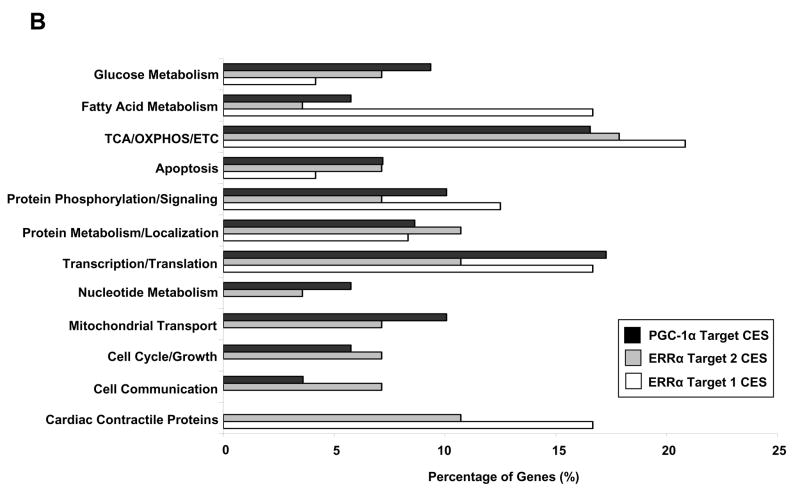
Characterization of PGC-1α, ERRα target1, and ERRα target 2 core enrichment sets defined by the DCM/ICM vs. NF comparison. (A) Upper plot depicts the enrichment profile in green of the ‘PGC-1α targets’ pathway by Gene Set Enrichment Analysis (GSEA). The arrow denotes the point of maximal deviation of the Enrichment Score (ES) from the baseline, which is determined by genes of the ‘Core Enrichment Set’ (CES). Lower plot shows all 17,419 genes rank-ordered according to the signal-to-noise metric, with the dotted line demarcating genes that are positively (red) and negatively (blue) correlated with heart failure. (B) Comparative functional distributions using GO Biological Process terms of the 158 genes of the PGC-1α target CES, the 24 genes of the ERRα target 1 CES, and the 38 genes of the ERRα target 2 CES.
Fig. 2
Fig. 2
Characterization of PGC-1α, ERRα target1, and ERRα target 2 core enrichment sets defined by the DCM/ICM vs. NF comparison. (A) Upper plot depicts the enrichment profile in green of the ‘PGC-1α targets’ pathway by Gene Set Enrichment Analysis (GSEA). The arrow denotes the point of maximal deviation of the Enrichment Score (ES) from the baseline, which is determined by genes of the ‘Core Enrichment Set’ (CES). Lower plot shows all 17,419 genes rank-ordered according to the signal-to-noise metric, with the dotted line demarcating genes that are positively (red) and negatively (blue) correlated with heart failure. (B) Comparative functional distributions using GO Biological Process terms of the 158 genes of the PGC-1α target CES, the 24 genes of the ERRα target 1 CES, and the 38 genes of the ERRα target 2 CES.
Fig. 3
Fig. 3
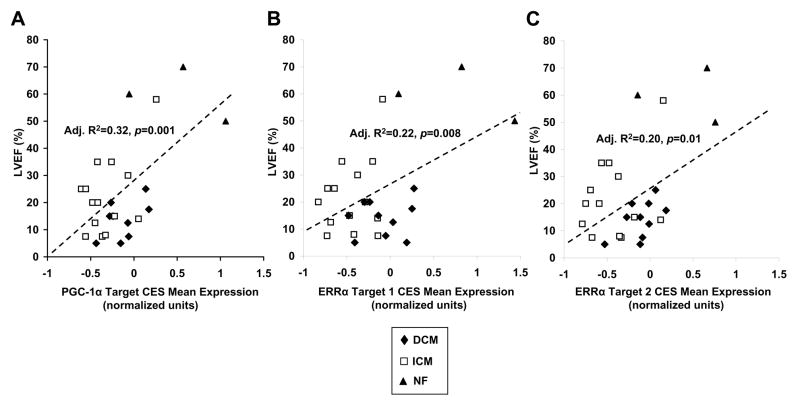
PGC-1α target, ERRα target 1, and ERRα target 2 core enrichment set (CES) mean expression correlate with severity of heart failure. Linear regression was used to model the relationship between left ventricular ejection fraction (LVEF), a marker of disease severity, with normalized, mean expression levels of genes in the PGC-1α target CES(A), ERRα target 1 CES (B), and ERRα target 2 CES (C). The Adjusted R2 and p-value of each model is shown.
Fig. 4
Fig. 4
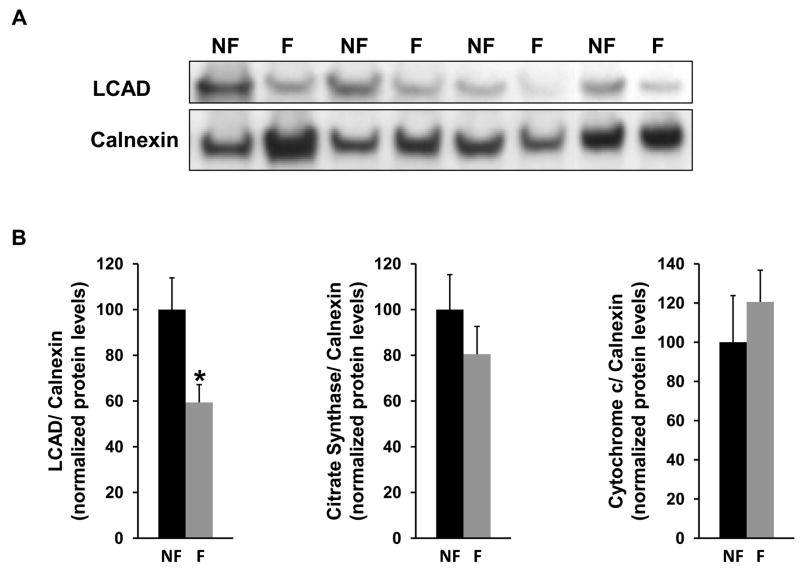
Protein levels of PGC-1α target genes in left ventricular tissue obtained from failing and nonfailing hearts. (A) Representative western blot panel depicts levels of the PGC-1α target gene long-chain acyl-CoA dehydrogenase (LCAD) and calnexin (used as a loading control) in nonfailing (NF) versus failing (F) hearts. Failing heart tissue was obtained from the left ventricle of patients with idiopathic dilated cardiomyopathy. Patients with failing and nonfailing hearts were age and gender-matched. (B) Bar graphs depict western blot protein levels of three PGC-1α target genes (LCAD, citrate synthase, and cytochrome c) normalized to the level of calnexin in nonfailing (NF) versus failing (F) left ventricles (n=8). * significantly different (p<0.05) compared to nonfailing hearts.
Fig. 5
Fig. 5
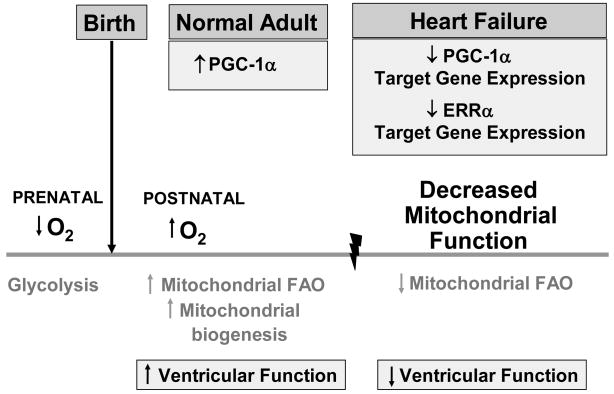
A role for altered PGC-1α and ERRα target gene expression in energy metabolic substrate switches in the developing and failing heart. In the setting of dietary and physiologic cues, developmentally programmed gene regulatory events facilitate the postnatal “switch” in myocardial fuel preference from glucose as the predominant source for ATP production to fatty acids metabolized via the mitochondrial fatty acid oxidation (FAO) pathway in the adult heart. Coordinate with this increased mitochondrial FAO is mitochondrial biogenesis promoted by PGC-1α, and associated enhanced left ventricular function. With heart failure, cardiac mitochondrial function declines with changes reminiscent of fetal metabolic re-programming, concomitant with decline in PGC-1α and ERRα target gene expression.

References

    1. Lloyd-Jones DM, Larson MG, Leip EP, Beiser A, D’Agostino RB, Kannel WB, et al. Lifetime risk for developing congestive heart failure: The Framingham heart study. Circulation. 2002;106:3068–72. - PubMed
    1. Nanni L, Romualdi C, Maseri A, Lanfranchi G. Differential gene expresion profiling in genetic and multifactorial cardiovascular diseases. J Mol Cell Cardiol. 2006;41:934–48. - PubMed
    1. Sharma UC, Pokharel S, Evelo CTA, Maessen JG. A systematic review of large scale and heterogeneous gene array data in heart failure. J Mol Cell Cardiol. 2005;38:425. - PubMed
    1. Steenman M, Chen Y-W, Le Cunff M, Lamirault G, Varró A, Hoffman E, et al. Transcriptomal analysis of failing and nonfailing human hearts. Physiol Genomics. 2003;12:97–112. - PubMed
    1. Kääb S, Barth AS, Margerie D, Dugas M, Gebauer M, Zwermann L, et al. Global gene expression in human myocardium-oligonucleotide microarray analysis of regional diversity and transcriptional regulation in heart failure. Journal of Molecular Medicine. 2004;82:308–16. - PubMed

Publication types

MeSH terms

Substances