


Identification of xenoestrogens in food additives by an integrated in silico and in vitro approach
- PMID: 19063592
- PMCID: PMC2758355
- DOI: 10.1021/tx800048m
Identification of xenoestrogens in food additives by an integrated in silico and in vitro approach
Abstract
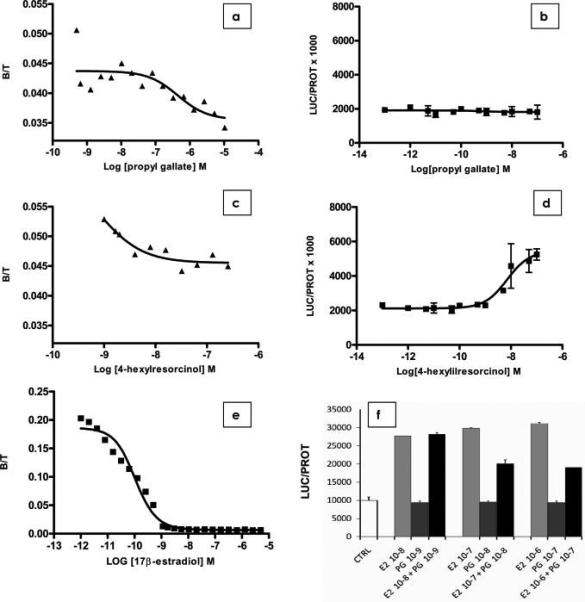
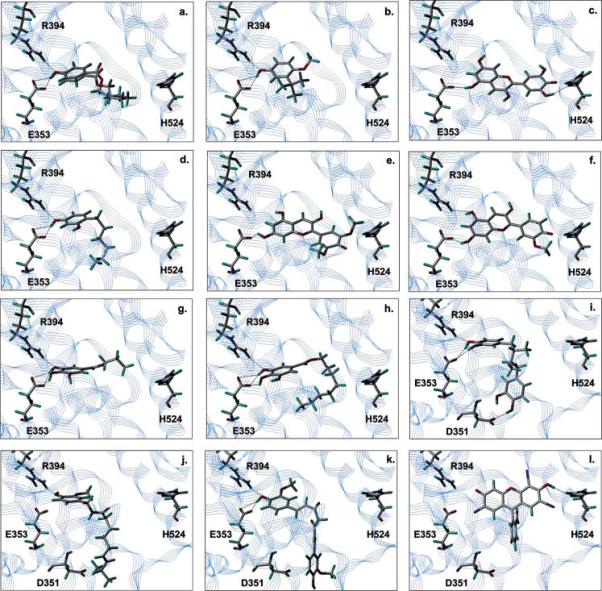
In the search for xenoestrogens within food additives, we have analyzed the Joint FAO-WHO expert committee database, containing 1500 compounds, using an integrated in silico and in vitro approach. This analysis identified 31 potential estrogen receptor alpha ligands that were reduced to 13 upon applying a stringent filter based on ligand volume and binding mode. Among the 13 potential xenoestrogens, four were already known to exhibit an estrogenic activity, and the other nine were assayed in vitro, determining the binding affinity to the receptor and biological effects. Propyl gallate was found to act as an antagonist, and 4-hexylresorcinol was found to act as a potent transactivator; both ligands were active at nanomolar concentrations, as predicted by the in silico analysis. Some caution should be issued for the use of propyl gallate and 4-hexylresorcinol as food additives.
Figures
References
-
- Dahlman-Wright K, Cavailles V, Fuqua SA, Jordan VC, Katzenellenbogen JA, Korach KS, Maggi A, Muramatsu M, Parker MG, Gustafsson JA. International Union of Pharmacology. LXIV. Estrogen receptors. Pharmacol. Rev. 2006;58:773–781. - PubMed
-
- Pozzi S, Benedusi V, Maggi A, Vegeto E. Estrogen action in neuroprotection and brain inflammation. Ann. N. Y. Acad. Sci. 2006;1089:302–323. - PubMed
-
- Gustafsson JA. Estrogen receptor beta—A new dimension in estrogen mechanism of action. J. Endocrinol. 1999;163:379–383. - PubMed
-
- Osborne CK, Zhao H, Fuqua SA. Selective estrogen receptor modulators: Structure, function, and clinical use. J. Clin. Oncol. 2000;18:3172–3186. - PubMed
-
- Heldring N, Pike A, Andersson S, Matthews J, Cheng G, Hartman J, Tujague M, Strom A, Treuter E, Warner M, Gustafsson JA. Estrogen receptors: How do they signal and what are their targets. Physiol. Rev. 2007;87:905–931. - PubMed
Publication types
MeSH terms
Substances
Grants and funding
LinkOut - more resources
Full Text Sources
Other Literature Sources
