


Success rates and immunologic responses of autogenic, allogenic, and xenogenic treatments to repair articular cartilage defects
- PMID: 19063664
- PMCID: PMC2760376
- DOI: 10.1089/ten.teb.2008.0189
Success rates and immunologic responses of autogenic, allogenic, and xenogenic treatments to repair articular cartilage defects
Abstract
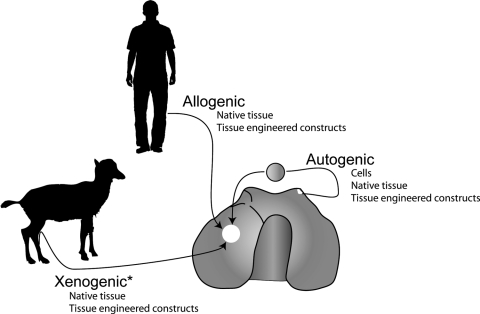
This review examines current approaches available for articular cartilage repair, not only in terms of their regeneration potential, but also as a function of immunologic response. Autogenic repair techniques, including osteochondral plug transplantation, chondrocyte implantation, and microfracture, are the most widely accepted clinical treatment options due to the lack of immunogenic reactions, but only moderate graft success rates have been reported. Although suspended allogenic chondrocytes are shown to evoke an immune response upon implantation, allogenic osteochondral plugs and tissue-engineered grafts using allogenic chondrocytes exhibit a tolerable immunogenic response. Additionally, these repair techniques produce neotissue with success rates approaching those of currently available autogenic repair techniques, while simultaneously obviating their major hindrance of donor tissue scarcity. To date, limited research has been performed with xenogenic tissue, although several studies demonstrate the potential for its long-term success. This article focuses on the various treatment options for cartilage repair and their associated success rates and immunologic responses.
Figures
References
-
- Buckwalter J.A. Articular cartilage injuries. Clin Orthop Relat Res. 2002;21:402. - PubMed
-
- Mauck R.L. Nicoll S.B. Seyhan S.L. Ateshian G.A. Hung C.T. Synergistic action of growth factors and dynamic loading for articular cartilage tissue engineering. Tissue Eng. 2003;9:597. - PubMed
-
- Ramallal M. Maneiro E. Lopez E. Fuentes-Boquete I. Lopez-Armada M.J. Fernandez-Sueiro J.L. Galdo F. de Toro F.J. Blanco F.J. Xeno-implantation of pig chondrocytes into rabbit to treat localized articular cartilage defects: an animal model. Wound Repair Regen. 2004;12:337. - PubMed
-
- Mankin H.J. The response of articular cartilage to mechanical injury. J Bone Joint Surg Am. 1982;64:460. - PubMed
-
- Hunziker E.B. Articular cartilage repair: are the intrinsic biological constraints undermining this process insuperable? Osteoarthritis Cartilage. 1999;7:15. - PubMed
Publication types
MeSH terms
Grants and funding
LinkOut - more resources
Full Text Sources
Other Literature Sources
Medical
