Prevalence of sulfonamide resistance genes in bacterial isolates from manured agricultural soils and pig slurry in the United Kingdom
- PMID: 19064898
- PMCID: PMC2630619
- DOI: 10.1128/AAC.00652-07
Prevalence of sulfonamide resistance genes in bacterial isolates from manured agricultural soils and pig slurry in the United Kingdom
Abstract
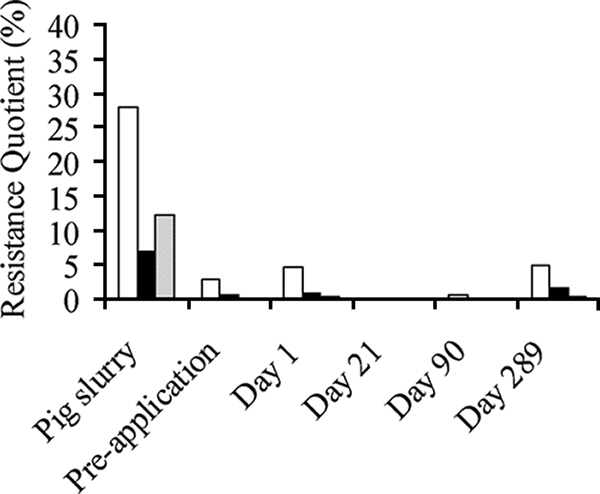
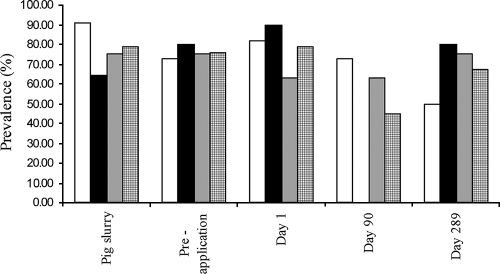
The prevalences of three sulfonamide resistance genes, sul1, sul2, and sul3 and sulfachloropyridazine (SCP) resistance were determined in bacteria isolated from manured agricultural clay soils and slurry samples in the United Kingdom over a 2-year period. Slurry from tylosin-fed pigs amended with SCP and oxytetracycline was used for manuring. Isolates positive for sul genes were further screened for the presence of class 1 and 2 integrons. Phenotypic resistance to SCP was significantly higher in isolates from pig slurry and postapplication soil than in those from preapplication soil. Of 531 isolates, 23% carried sul1, 18% sul2, and 9% sul3 only. Two percent of isolates contained all three sul genes. Class 1 and class 2 integrons were identified in 5% and 11.7%, respectively, of sul-positive isolates. In previous reports, sul1 was linked to class 1 integrons, but in this study only 8% of sul1-positive isolates carried the intI1 gene. Sulfonamide-resistant pathogens, including Shigella flexneri, Aerococcus spp., and Acinetobacter baumannii, were identified in slurry-amended soil and soil leachate, suggesting a potential environmental reservoir. Sulfonamide resistance in Psychrobacter, Enterococcus, and Bacillus spp. is reported for the first time, and this study also provides the first description of the genotypes sul1, sul2, and sul3 outside the Enterobacteriaceae and in the soil environment.
Figures
References
-
- Altschul, S. F., W. Gish, W. Miller, E. W. Myers, and D. J. Lipman. 1990. Basic local alignment search tool. J. Mol. Biol. 215:403-410. - PubMed
-
- Bennett, P. M. 1999. Integrons and gene cassettes: a genetic construction kit for bacteria. J. Antimicrob. Chemother. 43:1-4. - PubMed
-
- Binh, C. T., H. Heuer, M. Kaupenjohann, and K. Smalla. 2008. Piggery manure used for soil fertilization is a reservoir for transferable antibiotic resistance plasmids. FEMS Microbiol. Ecol. 66:25-37. - PubMed
-
- Böerlin, P., S. Eugster, F. Gaschen, R. Straub, and P. Schawalder. 2001. Transmission of opportunistic pathogens in a veterinary teaching hospital. Vet. Microbiol. 82:347-359. - PubMed
Publication types
MeSH terms
Substances
LinkOut - more resources
Full Text Sources
Medical
Miscellaneous