. 2009 Jan 6;106(1):340-5.
doi: 10.1073/pnas.0810957105. Epub 2008 Dec 8.

The absence of reward induces inequity aversion in dogs

Affiliations

The absence of reward induces inequity aversion in dogs

Friederike Range et al. Proc Natl Acad Sci U S A. .

Abstract

One crucial element for the evolution of cooperation may be the sensitivity to others' efforts and payoffs compared with one's own costs and gains. Inequity aversion is thought to be the driving force behind unselfish motivated punishment in humans constituting a powerful device for the enforcement of cooperation. Recent research indicates that non-human primates refuse to participate in cooperative problem-solving tasks if they witness a conspecific obtaining a more attractive reward for the same effort. However, little is known about non-primate species, although inequity aversion may also be expected in other cooperative species. Here, we investigated whether domestic dogs show sensitivity toward the inequity of rewards received for giving the paw to an experimenter on command in pairs of dogs. We found differences in dogs tested without food reward in the presence of a rewarded partner compared with both a baseline condition (both partners rewarded) and an asocial control situation (no reward, no partner), indicating that the presence of a rewarded partner matters. Furthermore, we showed that it was not the presence of the second dog but the fact that the partner received the food that was responsible for the change in the subjects' behavior. In contrast to primate studies, dogs did not react to differences in the quality of food or effort. Our results suggest that species other than primates show at least a primitive version of inequity aversion, which may be a precursor of a more sophisticated sensitivity to efforts and payoffs of joint interactions.


Conflict of interest statement

The authors declare no conflict of interest.

Figures
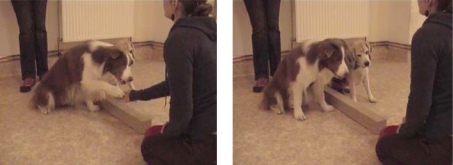
Fig. 1.
Fig. 1.
Photos of the experimental setup. The experimenter avoided eye contact with the dogs. The owner was standing behind the dogs.
Fig. 2.
Fig. 2.
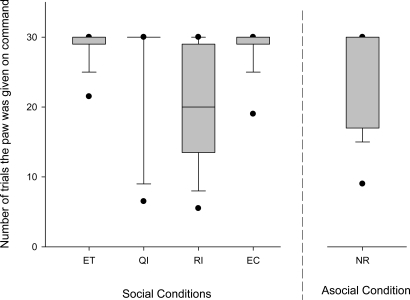
Box plots show the number of trials in which the subject gave the paw to the experimenter in the 4 different test conditions and the nonsocial control condition without reward. Shaded boxes represent the interquartile range, bars within shaded boxes are median values, and whiskers indicate the 5th and 95th percentiles. ET, equity test, where both animals receive a low-value reward; QI, quality inequity test, where the partner initially performed for a high-value reward followed by the subject asked to perform for a low-value reward; RI, reward inequity test, where the partner initially performed for a low-value reward followed by the subject performing but receiving no reward; EC, effort control, where the partner was initially handed a low-value reward without having to perform for it, after which the subject had to perform to receive the low-value reward; NR, asocial control, where the animal was tested alone and received no reward.
Fig. 3.
Fig. 3.
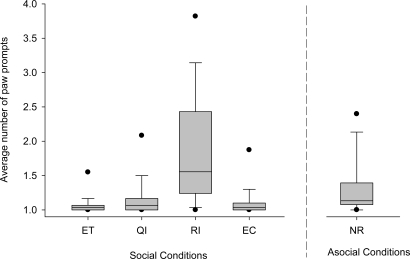
Box plots show the average number of times per trial the experimenter had to ask the subject to give the paw in the 4 different test conditions and the nonsocial control condition without reward (NR). Shaded boxes represent the interquartile range, bars within shaded boxes are median values, and whiskers indicate the 5th and 95th percentiles. Abbreviations are as in the Fig. 2 legend.
Fig. 4.
Fig. 4.
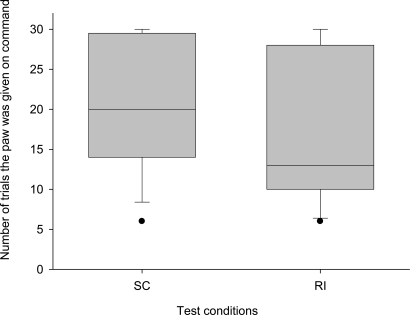
Box plots show the number of trials the subject gave the paw to the experimenter in the 2 test conditions of experiment 2 (RI and SC). Shaded boxes represent the interquartile range, bars within shaded boxes are median values, and whiskers indicate the 5th and 95th percentiles.
Fig. 5.
Fig. 5.
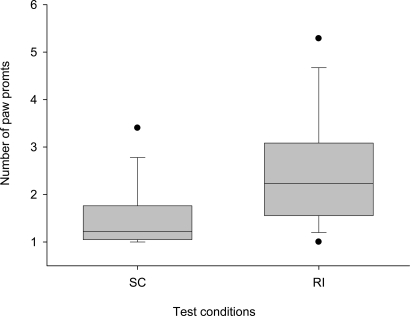
Box plots show the average number of times per trial the experimenter had to ask the subject to give the paw in the 2 experimental conditions (RI and SC). Shaded boxes represent the interquartile range, bars within shaded boxes are median values, and whiskers indicate the 5th and 95th percentiles.

References

    1. Fehr E, Schmidt KM. A theory of fairness, competition, and cooperation. Q J Econ. 1999;114:817–868.
    1. Fehr E, Fischbacher U. Social norms and human cooperation. Trends Cognit Sci. 2004;8:185–190. - PubMed
    1. Wynne CDL. Fair refusal by capuchin monkeys. Nature. 2004;428:140. - PubMed
    1. Brosnan SF, de Waal FBM. Monkeys reject unequal pay. Nature. 2003;425:297–299. - PubMed
    1. Brosnan SF, Schiff HC, Waal FBM. Tolerance for inequity may increase with social closeness in chimpanzees. Proc R Soc London Ser B. 2004;1560:253–258. - PMC - PubMed

Publication types

LinkOut - more resources