


Productivity costs of cancer mortality in the United States: 2000-2020
- PMID: 19066273
- PMCID: PMC2720777
- DOI: 10.1093/jnci/djn384
Productivity costs of cancer mortality in the United States: 2000-2020
Abstract
Background: A model that predicts the economic benefit of reduced cancer mortality provides critical information for allocating scarce resources to the interventions with the greatest benefits.
Methods: We developed models using the human capital approach, which relies on earnings as a measure of productivity, to estimate the value of productivity lost as a result of cancer mortality. The base model aggregated age- and sex-specific data from four primary sources: 1) the US Bureau of the Census, 2) US death certificate data for 1999-2003, 3) cohort life tables from the Berkeley Mortality Database for 1900-2000, and 4) the Bureau of Labor Statistics Current Population Survey. In a model that included costs of caregiving and household work, data from the National Human Activity Pattern Survey and the Caregiving in the U.S. study were used. Sensitivity analyses were performed using six types of cancer assuming a 1% decline in cancer mortality rates. The values of forgone earnings for employed individuals and imputed forgone earnings for informal caregiving were then estimated for the years 2000-2020.
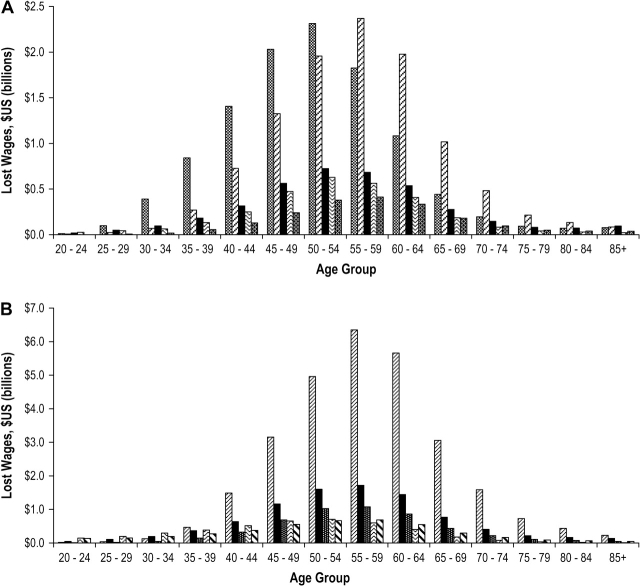
Results: The annual productivity cost from cancer mortality in the base model was approximately $115.8 billion in 2000; the projected value was $147.6 billion for 2020. Death from lung cancer accounted for more than 27% of productivity costs. A 1% annual reduction in lung, colorectal, breast, leukemia, pancreatic, and brain cancer mortality lowered productivity costs by $814 million per year. Including imputed earnings lost due to caregiving and household activity increased the base model total productivity cost to $232.4 billion in 2000 and to $308 billion in 2020.
Conclusions: Investments in programs that target the cancers with high incidence and/or cancers that occur in younger, working-age individuals are likely to yield the greatest reductions in productivity losses to society.
Figures



Comment in
-
How should we value lives lost to cancer?J Natl Cancer Inst. 2008 Dec 17;100(24):1742-3. doi: 10.1093/jnci/djn434. Epub 2008 Dec 9. J Natl Cancer Inst. 2008. PMID: 19066279 No abstract available.
References
-
- National Center for Health Statistics. Deaths—Leading Causes. http://www.cdc.gov/nchs/fastats/lcod.htm. Accessed August 2, 2007.
-
- Bradley C, Neumark D, Luo Z, Schenk M. Employment and cancer: findings from a longitudinal study of breast and prostate cancer survivors. Cancer Invest. 2007;25(1):47–54. - PubMed
-
- Edwards B, Brown M, Wingo P, et al. Annual report to the nation on the status of cancer, 1975–2002, featuring population-based trends in cancer treatment. J Natl Cancer Inst. 2005;97(19):1407–1427. - PubMed
-
- Hodgson T, Meiners M. Cost-of-illness methodology: a guide to current practices and procedures. Milbank Q. 1982;60(3):429–462. - PubMed
-
- Cooper B, Rice D. The economic cost of illness revisited. Soc Secur Bull. 1976;39(2):21–36. - PubMed
