


Importance of sociodemographic and morbidity aspects in measuring health-related quality of life: performances of three tools: comparison of three questionnaire scores
- PMID: 19067006
- PMCID: PMC2730444
- DOI: 10.1007/s10198-008-0139-9
Importance of sociodemographic and morbidity aspects in measuring health-related quality of life: performances of three tools: comparison of three questionnaire scores
Abstract
Background: Since health-related quality of life (HRQL) measures are numerous, comparisons have been suggested.
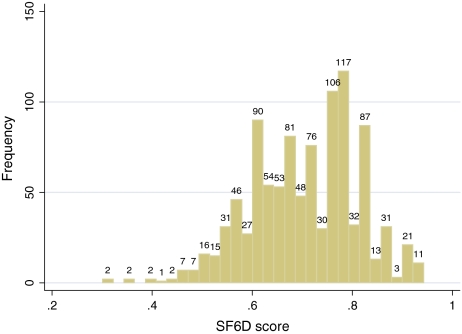
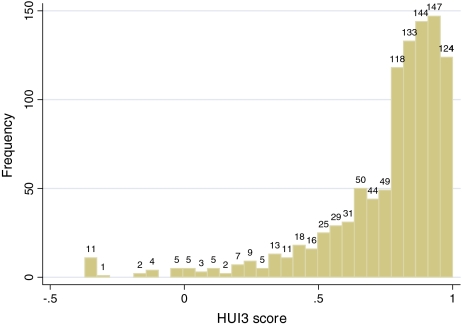
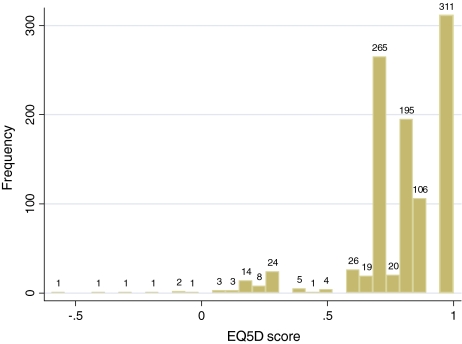
Aim: To compare three HRQL measures: SF6D, HUI3 and EQ5D.
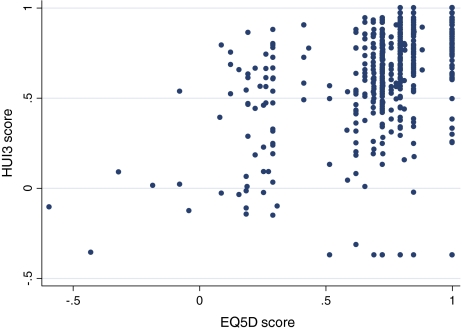
Methods: Three questionnaires (SF36, HUI3, EQ5D) were administered to 1,011 patients attending 16 general practices in two Italian cities. Information about patients' gender, age, education, marital status, smoking, body mass index (BMI) and chronic diseases (hypertension, diabetes, cardiovascular and musculoskeletal diseases) were also collected. Questionnaires scores were calculated using the appropriate algorithms; in particular SF6D scores were obtained from SF36 items. Agreement and correlation between questionnaires scores were investigated using Bland and Altman method and Spearman coefficient. The influence of socio-demographic and morbidity indicators on scores was analysed using the nonparametric quantile regression.
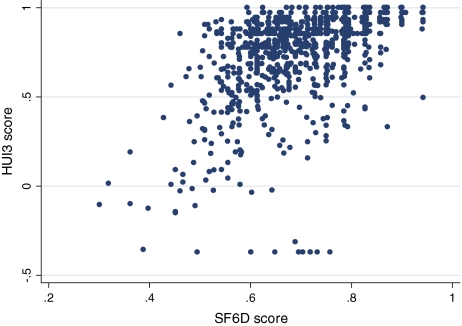
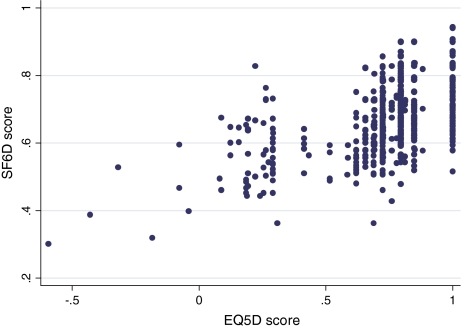
Results: The Spearman coefficient was about 0.6 for all questionnaires. The 95% limits of agreement of the scores were approximately from -0.5 to 0.3 except for SF6D and EQ5D when they were from -0.4 to 0.2. The measures were influenced by socio-demographic and clinical variables in a similar way, especially SF6D (the index obtained from SF36) and EQ5D, which appeared to be influenced by the same pattern of factors, including gender, chronic diseases, smoking and BMI.
Conclusions: Overall, the agreement between questionnaires scores was quite low, whilst the correlation level was good. Questionnaire scores were influenced by socio-demographic and clinical variables in a similar way, especially SF6D and EQ5D. Therefore, the descriptive capacity of SF6D and EQ5D was found to be similar.
Figures
References
Publication types
MeSH terms
LinkOut - more resources
Full Text Sources
