Kin discrimination increases with genetic distance in a social amoeba
- PMID: 19067487
- PMCID: PMC2586364
- DOI: 10.1371/journal.pbio.0060287
Kin discrimination increases with genetic distance in a social amoeba
Abstract
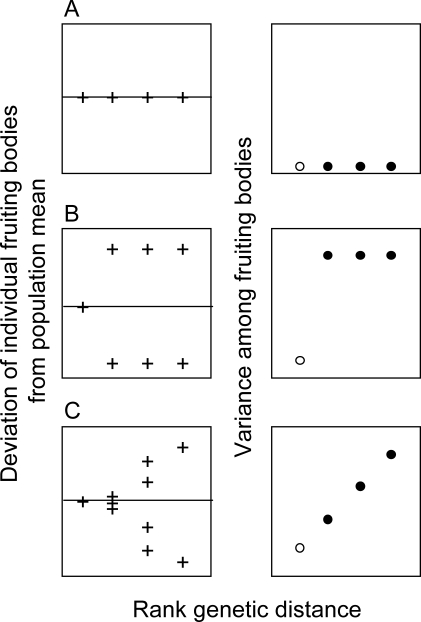
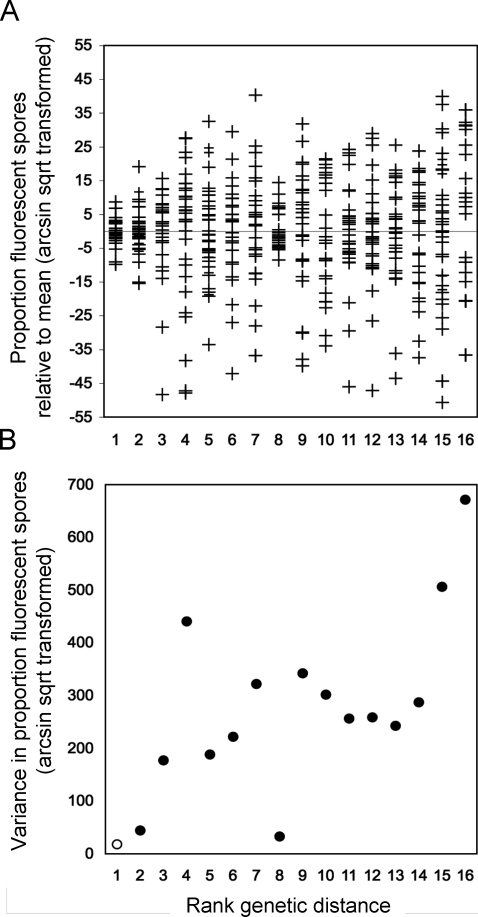
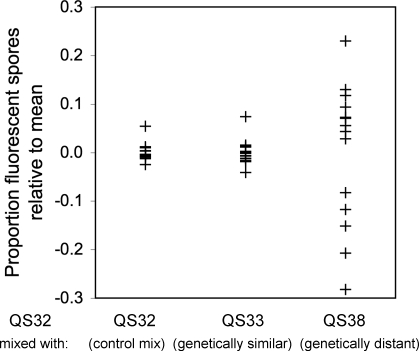
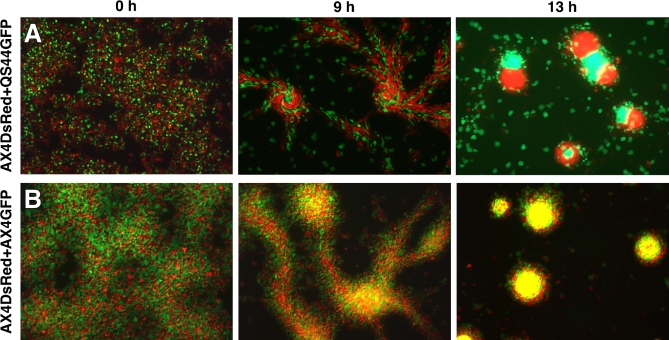
In the social amoeba Dictyostelium discoideum, thousands of cells aggregate upon starvation to form a multicellular fruiting body, and approximately 20% of them die to form a stalk that benefits the others. The aggregative nature of multicellular development makes the cells vulnerable to exploitation by cheaters, and the potential for cheating is indeed high. Cells might avoid being victimized if they can discriminate among individuals and avoid those that are genetically different. We tested how widely social amoebae cooperate by mixing isolates from different localities that cover most of their natural range. We show here that different isolates partially exclude one another during aggregation, and there is a positive relationship between the extent of this exclusion and the genetic distance between strains. Our findings demonstrate that D. discoideum cells co-aggregate more with genetically similar than dissimilar individuals, suggesting the existence of a mechanism that discerns the degree of genetic similarity between individuals in this social microorganism.
Conflict of interest statement
Figures
Comment in
-
A social amoeba discriminates in favor of kin.PLoS Biol. 2008 Nov;6(11):e290. doi: 10.1371/journal.pbio.0060290. Epub 2008 Nov 25. PLoS Biol. 2008. PMID: 20076697 Free PMC article. No abstract available.
References
-
- Hamilton WD. The genetical evolution of social behaviour. I, II. J Theor Biol. 1964;7:1–52. - PubMed
-
- West SA, Griffin AS, Gardner A, Diggle SP. Social evolution theory for microorganisms. Nat Rev Microbiol. 2006;4:597–607. - PubMed
-
- Crespi BJ. The evolution of social behavior in microorganisms. Trends Ecol Evol. 2001;16:178–183. - PubMed
-
- West SA, Diggle SP, Buckling A, Gardner A, Griffin AS. The social lives of microbes. Annu Rev Ecol Evol Syst. 2007;38:53–77.
-
- Ackermann M, Chao L. Evolution of cooperation: two for one. Curr Biol. 2004;14:R73–R74. - PubMed
Publication types
MeSH terms
Grants and funding
LinkOut - more resources
Full Text Sources
Other Literature Sources