


Strategy and mechanism for the prevention of hepatocellular carcinoma: phosphorylated retinoid X receptor alpha is a critical target for hepatocellular carcinoma chemoprevention
- PMID: 19068086
- PMCID: PMC11159360
- DOI: 10.1111/j.1349-7006.2008.01045.x
Strategy and mechanism for the prevention of hepatocellular carcinoma: phosphorylated retinoid X receptor alpha is a critical target for hepatocellular carcinoma chemoprevention
Abstract
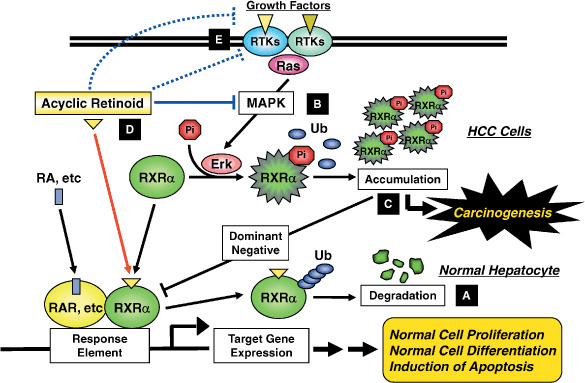
Hepatocellular carcinoma (HCC) is a major health care problem worldwide. The prognosis of patients with HCC is poor because even in the early stages when surgical treatment might be expected to be curative, the incidence of recurrence in patients with underlying cirrhosis is very high due to multicentric carcinogenesis. Therefore, strategies to prevent recurrence and second primary HCC are required to improve the prognosis. One of the most practical approaches to prevent the multicentric development of HCC is 'clonal deletion' therapy, which is defined as the removal of latent (i.e. invisible) (pre)malignant clones from the liver in a hypercarcinogenic state. Retinoids, a group of structural and functional analogs of vitamin A, exert their biological function primarily through two distinct nuclear receptors, retinoic acid receptors and retinoid X receptors (RXR), and abnormalities in the expression and function of these receptors are highly associated with the development of various cancers, including HCC. In particular, a malfunction of RXRalpha due to phosphorylation by the Ras-mitogen-activated protein kinase signaling pathway is profoundly associated with the development of HCC and thus may be a critical target for HCC chemoprevention. Acyclic retinoid, which has been clinically shown to reduce the incidence of a post-therapeutic recurrence of HCC, can inhibit Ras activity and phosphorylation of the extracellular signal-regulated kinase and RXRalpha proteins. In conclusion, the inhibition of RXRalpha phosphorylation and the restoration of its physiological function as a master regulator for nuclear receptors may be a potentially effective strategy for HCC chemoprevention and clonal deletion. Acyclic retinoid, which targets phosphorylated RXRalpha, may thus play a critical role in preventing the development of multicentric HCC.
Figures


References
-
- El‐Serag HB, Rudolph KL. Hepatocellular carcinoma: epidemiology and molecular carcinogenesis. Gastroenterology 2007; 132: 2557–76. - PubMed
-
- Parikh S, Hyman D. Hepatocellular cancer: a guide for the internist. Am J Med 2007; 120: 194–202. - PubMed
-
- Kumada T, Nakano S, Takeda I et al . Patterns of recurrence after initial treatment in patients with small hepatocellular carcinoma. Hepatology 1997; 25: 87–92. - PubMed
-
- Koda M, Murawaki Y, Mitsuda A et al . Predictive factors for intrahepatic recurrence after percutaneous ethanol injection therapy for small hepatocellular carcinoma. Cancer 2000; 88: 529–37. - PubMed
-
- Tsukuma H, Hiyama T, Tanaka S et al . Risk factors for hepatocellular carcinoma among patients with chronic liver disease. N Engl J Med 1993; 328: 1797–801. - PubMed
Publication types
MeSH terms
Substances
LinkOut - more resources
Full Text Sources
Medical
