. 2009 Aug;19(8):1905-14.
doi: 10.1093/cercor/bhn217. Epub 2008 Dec 9.

Grasping ideas with the motor system: semantic somatotopy in idiom comprehension

Affiliations

Grasping ideas with the motor system: semantic somatotopy in idiom comprehension

Véronique Boulenger et al. Cereb Cortex. 2009 Aug.

Abstract

Single words and sentences referring to bodily actions activate the motor cortex. However, this semantic grounding of concrete language does not address the critical question whether the sensory-motor system contributes to the processing of abstract meaning and thought. We examined functional magnetic resonance imaging activation to idioms and literal sentences including arm- and leg-related action words. A common left fronto-temporal network was engaged in sentence reading, with idioms yielding relatively stronger activity in (pre)frontal and middle temporal cortex. Crucially, somatotopic activation along the motor strip, in central and precentral cortex, was elicited by idiomatic and literal sentences, reflecting the body part reference of the words embedded in the sentences. Semantic somatotopy was most pronounced after sentence ending, thus reflecting sentence-level processing rather than that of single words. These results indicate that semantic representations grounded in the sensory-motor system play a role in the composition of sentence-level meaning, even in the case of idioms.


Figures
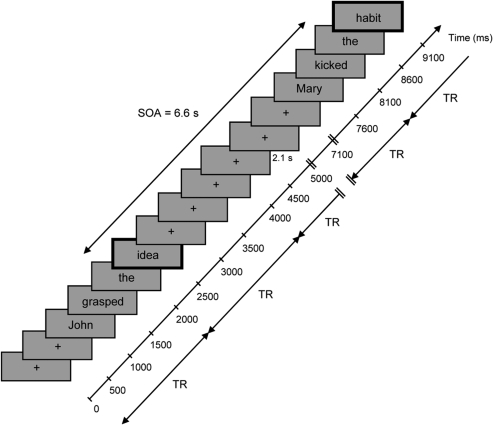
Figure 1.
Figure 1.
Design of the experiment. Each trial was composed of 10 displays/screens, here represented by gray boxes, where the consecutive stimuli—fixation cross “+” and words making sentences—appeared each for 500 ms. Two examples of arm- and leg-action–related sentences are given. SOA between 2 consecutive critical words (indicated in bold) was 6.6 s. A fixed delay of 2.1 s, where a fixation cross remained on the screen, was inserted between 2 consecutive trials, so that the ISI varied between 2.6 and 5.1 s. The oblique axis on the right illustrates the temporal sequence of the trials and gives the onset of the corresponding stimulus (in milliseconds). TR of the EPI sequence is also represented (TR = 2 s).
Figure 2.
Figure 2.
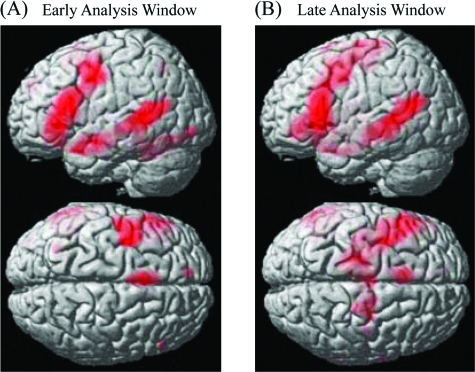
Cortical activation during silent reading of all sentences (idiomatic and literal) relative to the baseline (hash-mark strings) in the (a) early and (b) late analysis windows (P < 0.001, uncorrected). Results are rendered on a standard brain surface. Top panel: lateral view of the brain, Bottom panel: top view. Note the greater activation of precentral areas in the late window.
Figure 3.
Figure 3.
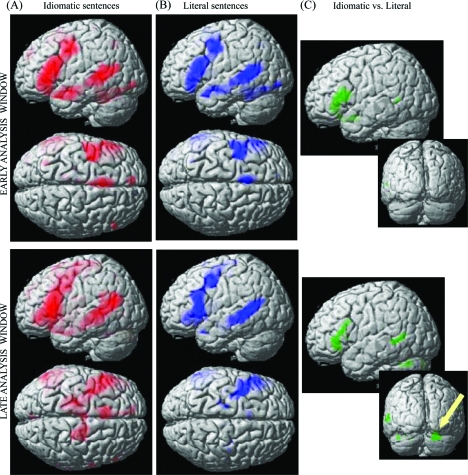
Cortical activation during silent reading of (a) idioms and (b) literal sentences (P < 0.001, uncorrected), compared with the baseline (hash-marks strings), in the early (top panel) and late analysis windows (bottom panel). Results are rendered on a standard brain surface. Specific activations for the direct contrast between idioms and literal sentences are reported for both windows in (c). The inset in (c) highlights the specific activation observed in the right cerebellum for idioms, compared with literal sentences, in the late window (bottom panel).
Figure 4.
Figure 4.
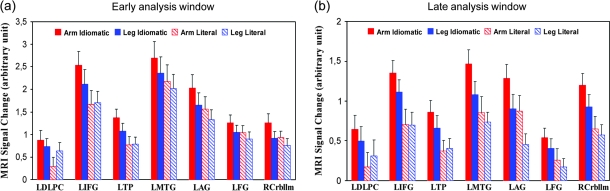
Mean parameter estimates (in arbitrary units) for the 7 ROIs in the 4 experimental conditions (arm idiomatic, leg idiomatic, arm literal, and leg literal sentences) in the (a) early and (b) late analysis windows. Error bars are reported. LDLPC, left DLPC; LIFG, left IFG; LTP, left TP; LMTG, left MTG; LAG, left AG; LFG, left FG; RCrbllm, right cerebellum.
Figure 5.
Figure 5.
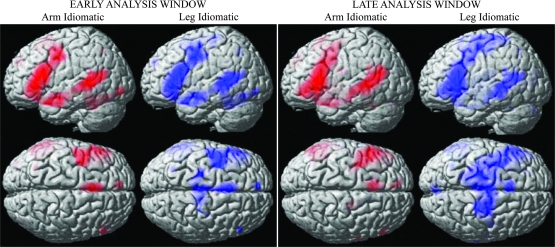
Somatotopic activation for idioms including arm- (in red) and leg-related action words (in blue), compared with the baseline (hash-mark strings), in the early (left panel) and late analysis windows (right panel; P < 0.001, uncorrected). Results are rendered on a standard brain surface.
Figure 6.
Figure 6.
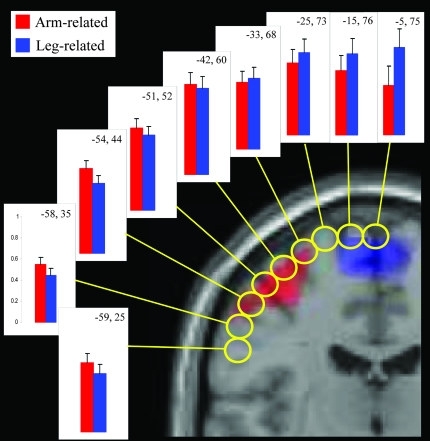
Semantic somatotopy for literal and idiomatic sentences along the motor strip in the late analysis window. Bar graphs show mean parameter estimates (in arbitrary units) for the 9 ROIs aligned along the central sulcus and the precentral gyrus that are reported for sentences including arm- (in red) and leg-related action words (in blue). For each graph, the /x/ and /z/ coordinates are indicated at the top right (x, z). The locations of the ROIs are reported (yellow circles) on a coronal slice of the brain. Somatotopic activations elicited during finger (in red) and foot movements (in blue) during the localizer experiment are also shown.

References

    1. Ackermann H. Cerebellar contributions to speech production and speech perception: psycholinguistic and neurobiological perspectives. Trends Neurosci. 2008;31(6):265–272. - PubMed
    1. Aziz-Zadeh L, Wilson SM, Rizzolatti G, Iacoboni M. Congruent embodied representations for visually presented actions and linguistic phrases describing actions. Curr Biol. 2006;16:1818–1823. - PubMed
    1. Bak TH, Yancopoulou D, Nestor PJ, Xuereb JH, Spillantini MG, Pulvermüller F, Hodges JR. Clinical, imaging and pathological correlates of a hereditary deficit in verb and action processing. Brain. 2006;129(2):321–332. - PubMed
    1. Barber HA, Kutas M. Interplay between computational models and cognitive electrophysiology in visual word recognition. Brain Res Rev. 2006;53(1):98–123. - PubMed
    1. Barsalou LW. Perceptual symbol systems. Behav Brain Sci. 1999;22(4):577–609. - PubMed

Publication types