


Systemic administration of diarylpropionitrile (DPN) or phytoestrogens does not affect anxiety-related behaviors in gonadally intact male rats
- PMID: 19071129
- PMCID: PMC2654784
- DOI: 10.1016/j.yhbeh.2008.11.004
Systemic administration of diarylpropionitrile (DPN) or phytoestrogens does not affect anxiety-related behaviors in gonadally intact male rats
Abstract
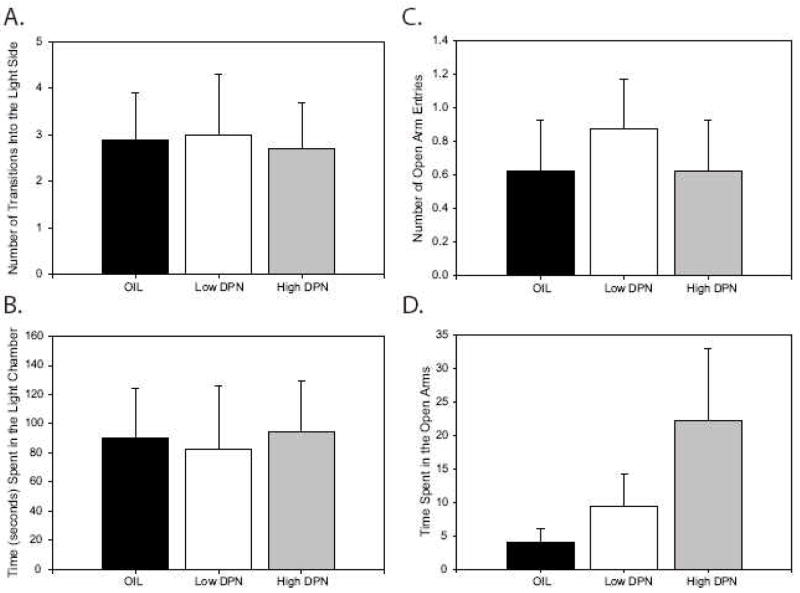
The development of highly selective agonists for the two major subforms of the estrogen receptor (ERalpha and ERbeta) has produced new experimental methodologies for delineating the distinct functional role each plays in neurobehavioral biology. It has also been suggested that these compounds might have the potential to treat estrogen influenced behavioral disorders, such as anxiety and depression. Prior work has established that the ERbeta agonist, diarylpropionitrile (DPN) is anxiolytic in gonadectomized animals of both sexes, but whether or not this effect persists in gonadally intact individuals is unknown. Isoflavone phytoestrogens, also potent but less selective ERbeta agonists, have also been shown to influence anxiety in multiple species and are becoming more readily available to humans as health supplements. Here we determined the effects of 0.5, 1 or 2 mg/kg DPN, 1 mg/kg of the ERalpha agonist propyl-pyrazole-triol (PPT), 3 or 20 mg/kg of the isoflavone equol (EQ) and 3 or 20 mg/kg of the isoflavone polyphenol resveratrol (RES) on anxiety behavior in the gonadally intact male rat using the light/dark box and the elevated plus maze. We first determined that DPN can be successfully administered either orally or by subcutaneous injection, although plasma DPN levels are significantly lower if given orally. Once injected, plasma levels peak rapidly and then decline to baseline levels within 3 h of administration. For the behavioral studies, all compounds were injected and the animals were tested within 3 h of treatment. None of the compounds, at any of the doses, significantly altered anxiety-related behavior. Plasma testosterone levels were also not significantly altered suggesting that these compounds do not interfere with endogenous androgen levels. The results suggest that the efficacy of ERbeta agonists may depend on gonadal status. Therefore the therapeutic potential of ERbeta selective agonists to treat mood disorders may be limited.
Figures



References
-
- Baur JA, Pearson KJ, Price NL, Jamieson HA, Lerin C, Kalra A, Prabhu VV, Allard JS, Lopez-Lluch G, Lewis K, Pistell PJ, Poosala S, Becker KG, Boss O, Gwinn D, Wang M, Ramaswamy S, Fishbein KW, Spencer RG, Lakatta EG, Le Couteur D, Shaw RJ, Navas P, Puigserver P, Ingram DK, de Cabo R, Sinclair DA. Resveratrol improves health and survival of mice on a high-calorie diet. Nature. 2006;444:337–42. - PMC - PubMed
-
- Bitran D, Kellogg CK, Hilvers RJ. Treatment with an anabolic-androgenic steroid affects anxiety-related behavior and alters the sensitivity of cortical GABAA receptors in the rat. Horm Behav. 1993;27:568–83. - PubMed
-
- Blaustein JD, Dudley SD, Gray JM, Roy EJ, Wade GN. Long-term retention of estradiol by brain cell nuclei and female rat sexual behavior. Brain Res. 1979;173:355–9. - PubMed
-
- Boettger-Tong H, Murthy L, Chiappetta C, Kirkland JL, Goodwin B, Adlercreutz H, Stancel GM, Mäkelä S. A case of a laboratory animal feed with high estrogenic activity and its impact on in vivo responses to exogenously administered estrogens. Environmental Health Perspectives. 1998;106:369–373. - PMC - PubMed
