


Speed versus accuracy in decision-making ants: expediting politics and policy implementation
- PMID: 19073483
- PMCID: PMC2689711
- DOI: 10.1098/rstb.2008.0224
Speed versus accuracy in decision-making ants: expediting politics and policy implementation
Abstract
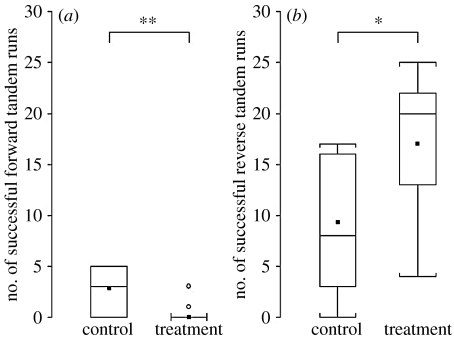
Compromises between speed and accuracy are seemingly inevitable in decision-making when accuracy depends on time-consuming information gathering. In collective decision-making, such compromises are especially likely because information is shared to determine corporate policy. This political process will also take time. Speed-accuracy trade-offs occur among house-hunting rock ants, Temnothorax albipennis. A key aspect of their decision-making is quorum sensing in a potential new nest. Finding a sufficient number of nest-mates, i.e. a quorum threshold (QT), in a potential nest site indicates that many ants find it suitable. Quorum sensing collates information. However, the QT is also used as a switch, from recruitment of nest-mates to their new home by slow tandem running, to recruitment by carrying, which is three times faster. Although tandem running is slow, it effectively enables one successful ant to lead and teach another the route between the nests. Tandem running creates positive feedback; more and more ants are shown the way, as tandem followers become, in turn, tandem leaders. The resulting corps of trained ants can then quickly carry their nest-mates; but carried ants do not learn the route. Therefore, the QT seems to set both the amount of information gathered and the speed of the emigration. Low QTs might cause more errors and a slower emigration--the worst possible outcome. This possible paradox of quick decisions leading to slow implementation might be resolved if the ants could deploy another positive-feedback recruitment process when they have used a low QT. Reverse tandem runs occur after carrying has begun and lead ants back from the new nest to the old one. Here we show experimentally that reverse tandem runs can bring lost scouts into an active role in emigrations and can help to maintain high-speed emigrations. Thus, in rock ants, although quick decision-making and rapid implementation of choices are initially in opposition, a third recruitment method can restore rapid implementation after a snap decision. This work reveals a principle of widespread importance: the dynamics of collective decision-making (i.e. the politics) and the dynamics of policy implementation are sometimes intertwined, and only by analysing the mechanisms of both can we understand certain forms of adaptive organization.
Figures
References
-
- Camazine S., Deneubourg J.-L., Franks N.R., Sneyd J., Theraulaz G., Bonabeau E. Princeton University Press; Princeton, NJ: 2001. Self-organization in biological systems.
-
- Chittka L., Dyer A.G., Bock F., Dornhaus A. Bees trade off foraging speed for accuracy. Nature. 2003;424:388. doi:10.1038/424388a - DOI - PubMed
-
- Collett D. Chapman & Hall; London, UK: 1994. Modelling survival data in medical research.
-
- Cox D.R. Regression models and life tables (with discussion) J. R. Stat. Soc. B. 1972;34:187–220.
-
- Dean, T. L. & Boddy, M. 1988 An analysis of time-dependent planning. In Proc. 7th Nat. Conf. on Artificial Intelligence (eds T. M. Mitchell & R. G. Smith), pp. 49–54. Menlo Park, CA: AAAI Press.
Publication types
MeSH terms
Grants and funding
LinkOut - more resources
Full Text Sources
