


Dipeptidyl peptidase IV inhibition with MK0431 improves islet graft survival in diabetic NOD mice partially via T-cell modulation
- PMID: 19073764
- PMCID: PMC2646063
- DOI: 10.2337/db08-1101
Dipeptidyl peptidase IV inhibition with MK0431 improves islet graft survival in diabetic NOD mice partially via T-cell modulation
Abstract
Objective: The endopeptidase dipeptidyl peptidase-IV (DPP-IV) has been shown to NH2-terminally truncate incretin hormones, glucose-dependent insulinotropic polypeptide, and glucagon-like peptide-1, thus ablating their ability to potentiate glucose-stimulated insulin secretion. Increasing the circulating levels of incretins through administration of DPP-IV inhibitors has therefore been introduced as a therapeutic approach for the treatment of type 2 diabetes. DPP-IV inhibitor treatment has also been shown to preserve islet mass in rodent models of type 1 diabetes. The current study was initiated to define the effects of the DPP-IV inhibitor sitagliptin (MK0431) on transplanted islet survival in nonobese diabetic (NOD) mice, an autoimmune type 1 diabetes model.
Research design and methods: Effects of MK0431 on islet graft survival in diabetic NOD mice were determined with metabolic studies and micropositron emission tomography imaging, and its underlying molecular mechanisms were assessed.
Results: Treatment of NOD mice with MK0431 before and after islet transplantation resulted in prolongation of islet graft survival, whereas treatment after transplantation alone resulted in small beneficial effects compared with nontreated controls. Subsequent studies demonstrated that MK0431 pretreatment resulted in decreased insulitis in diabetic NOD mice and reduced in vitro migration of isolated splenic CD4+ T-cells. Furthermore, in vitro treatment of splenic CD4+ T-cells with DPP-IV resulted in increased migration and activation of protein kinase A (PKA) and Rac1.
Conclusions: Treatment with MK0431 therefore reduced the effect of autoimmunity on graft survival partially by decreasing the homing of CD4+ T-cells into pancreatic beta-cells through a pathway involving cAMP/PKA/Rac1 activation.
Figures
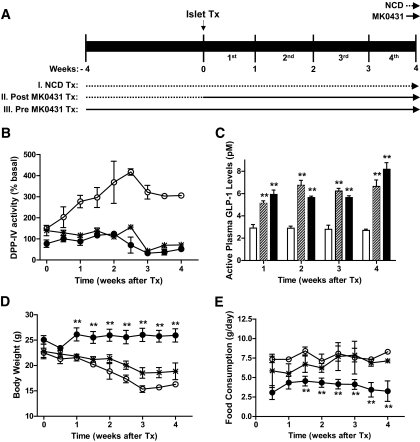
 and *: Post MK0431 Tx. ▪ and •: Pre MK0431 Tx.
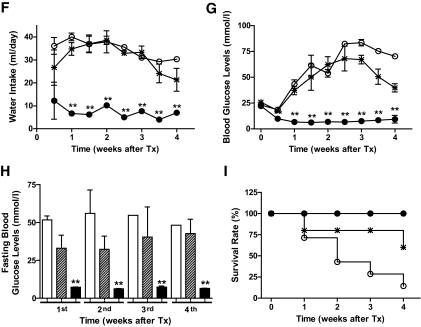 and *: Post MK0431 Tx. ▪ and •: Pre MK0431 Tx.
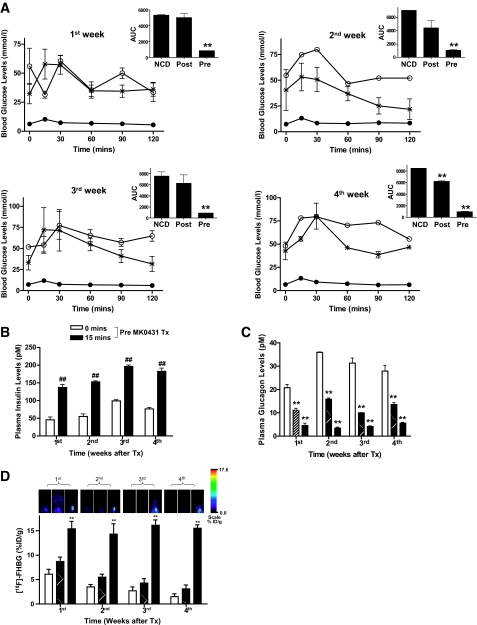 , Post MK0431 Tx; ▪, Pre MK0431 Tx. (Please see

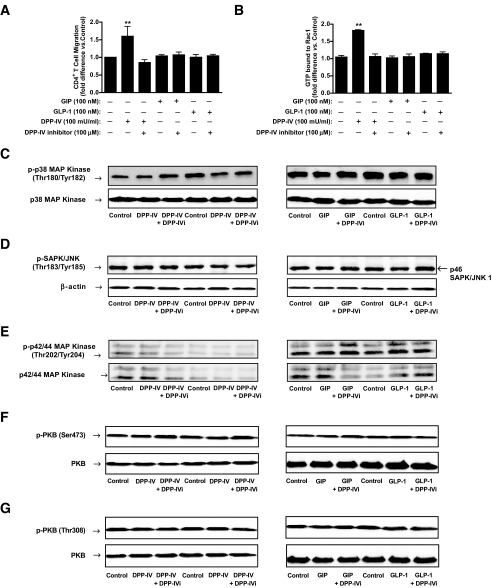

References
-
- Brubaker PL, Drucker DJ: Minireview: glucagon-like peptides regulate cell proliferation and apoptosis in the pancreas, gut, and central nervous system. Endocrinology 145: 2653–2659, 2004 - PubMed
-
- Yusta B, Baggio LL, Estall JL, Koehler JA, Holland DP, Li H, Pipeleers D, Ling Z, Drucker DJ: GLP-1 receptor activation improves beta cell function and survival following induction of endoplasmic reticulum stress. Cell Metab 4: 391–406, 2006 - PubMed
-
- Kim SJ, Choi WS, Han JS, Warnock G, Fedida D, McIntosh CHS: A novel mechanism for the suppression of a voltage-gated potassium channel by glucose-dependent insulinotropic polypeptide: protein kinase A-dependent endocytosis. J Biol Chem 280: 28692–28700, 2005 - PubMed
-
- Ehses JA, Casilla VR, Doty T, Pospisilik JA, Winter KD, Demuth HU, Pederson RA, McIntosh CHS: Glucose-dependent insulinotropic polypeptide promotes beta-(INS-1) cell survival via cyclic adenosine monophosphate-mediated caspase-3 inhibition and regulation of p38 mitogen-activated protein kinase. Endocrinology 144: 4433–4445, 2003 - PubMed
Publication types
MeSH terms
Substances
LinkOut - more resources
Full Text Sources
Other Literature Sources
Medical
Research Materials
