. 2008 Dec 10;28(50):13662-72.
doi: 10.1523/JNEUROSCI.4144-08.2008.

Enhanced sensitivity of striatal neurons to axonal transport defects induced by mutant huntingtin

Affiliations

Enhanced sensitivity of striatal neurons to axonal transport defects induced by mutant huntingtin

Lu-Shiun Her et al. J Neurosci. .

Abstract

Huntington's disease (HD) is an autosomal dominant neurodegenerative disease linked to a polyQ (polyglutamine) expansion in the huntingtin protein. Although general brain atrophy is found in HD patients, the striatum is the most severely affected region. Loss or mutant forms of huntingtin were reported to disrupt fast axonal transport in Drosophila, squid, and mice. However, previous work did not resolve whether mutant huntingtin affects global axonal transport or only a subset of cargoes, nor did it resolve whether striatal neurons are preferentially sensitive to huntingtin-mediated defects. We used amyloid precursor protein (APP)-yellow fluorescent protein and brain-derived neurotrophic factor (BDNF)-mCherry fusion proteins as markers for fast axonal transport when huntingtin is altered. We found that movement of APP and BDNF is impaired in striatal and hippocampal, but not cortical, neurons from presymptomatic homozygous mutant mice carrying 150Q huntingtin knock-in mutations. In addition, loss of huntingtin disrupts APP axonal transport, whereas overexpression of wild-type, but not mutant, huntingtin enhances APP transport in all three types of neurons tested. These data suggest that a loss of wild-type huntingtin function in fast axonal transport plays important roles in the development of cell-type-specific defects in HD.


Figures
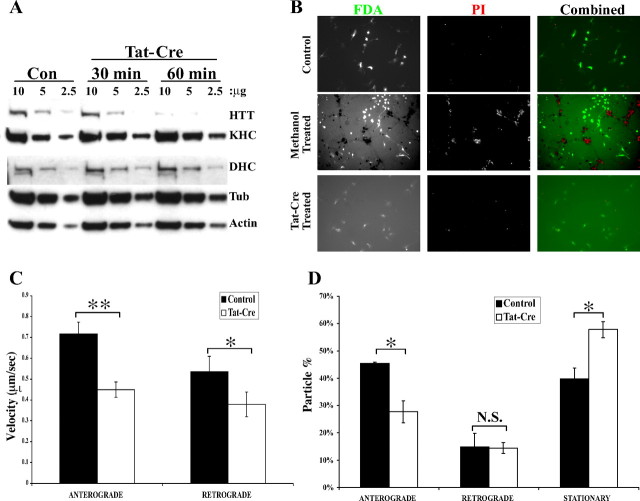
Figure 1.
Figure 1.
Depletion of huntingtin in primary mouse cortical neurons disrupts axonal transport of APP–YFP. A, Depletion of endogenous huntingtin by incubation of cortical neurons isolated from Hdh floxed mice with recombinant tat-cre protein. Con, Control; Tub, tubulin. B, Depletion of endogenous huntingtin from cortical neurons does not cause cell death. C, The velocity of both anterograde and retrograde movement of APP–YFP is reduced in huntingtin-depleted cortical neurons. Anterograde, 0.71 versus 0.45 μm/s, p = 0.002; retrograde 0.53 versus 0.38 μm/s, p < 0.032. D, The number of stationary APP–YFP particles increases whereas the number of anterograde moving particles decreases in huntingtin-depleted cortical neurons. Anterograde, 46 versus 26%, p < 0.05; stationary, 40 versus 60%, p < 0.05. N.S., Not significant. *p < 0.05; **p < 0.01. Error bars indicate SE.
Figure 2.
Figure 2.
Expression patterns of huntingtin. A, Western blot assays of primary cortical and striatal neurons. BDNF is expressed in cortical but not striatal neurons. Striatal neurons express high level of GAD67 and DARPP32 proteins. B, Expression of wild-type and mutant huntingtin in transfected primary cortical neurons. C, Expression of wild-type and mutant huntingtin in transfected primary striatal neurons. D, Western blot assay of soluble protein levels of wild-type (W.T.) and Hdh150Q/150Q mouse brains. There is no significant difference in the level of huntingtin, p150Glued, DHC, or KHC. The level of BDNF is lower in Hdh150Q/150Q mice. Tub, Tubulin.
Figure 3.
Figure 3.
Overexpression of full-length wild-type huntingtin enhances axonal transport of APP in primary cortical, striatal, and hippocampal neurons. A, Overexpression of wild-type huntingtin increases the velocity of both anterograde and retrograde APP–YFP movement in primary cortical neurons. Anterograde, 0.86 versus 1.33 μm/s, p < 0.0001; retrograde, 0.69 versus 1.01 μm/s, p = 0.0003. B, Overexpression of wild-type huntingtin does not change the distribution of moving APP–YFP particles in primary cortical neurons. C, Overexpression of wild-type huntingtin increases the velocity of both anterograde and retrograde APP–YFP movement in primary striatal neurons. Anterograde, 0.72 versus 0.99 μm/s, p < 0.001; retrograde, 0.47 versus 0.82 μm/s, p < 0.001. D, Overexpression of wild-type huntingtin does not change the distribution of moving APP–YFP particles in primary striatal neurons. E, Overexpression of wild-type huntingtin increases the velocity of both anterograde and retrograde APP–YFP movement in primary hippocampal neurons. Anterograde, 0.65 versus 0.85 μm/s, p < 0.001; retrograde, 0.37 versus 0.4 μm/s, p < 0.05. F, Overexpression of wild-type huntingtin does not change the distribution of moving APP–YFP particles in primary hippocampal neurons. N.S., Not significant. *p < 0.05; **p < 0.01. Error bars indicate SE.
Figure 4.
Figure 4.
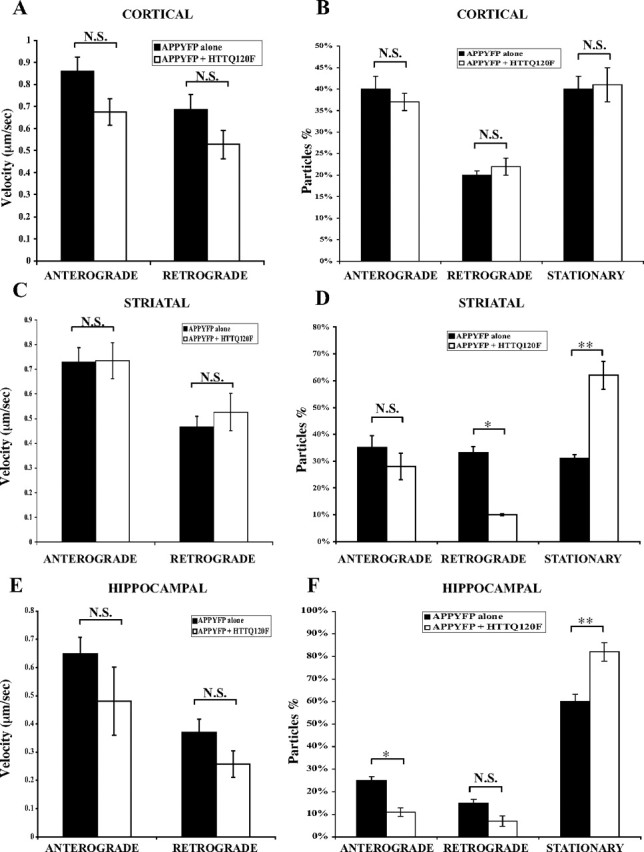
Overexpression of full-length mutant huntingtin increases the number of stationary APP–YFP particles in primary striatal and hippocampal, but not cortical, neurons. A, Overexpression of mutant huntingtin does not affect velocity of either anterograde or retrograde APP–YFP movement in primary cortical neurons. Anterograde, 0.86 versus 0.67 μm/s, p > 0.05; retrograde, 0.69 versus 0.53 μm/s, p > 0.05. B, Overexpression of mutant huntingtin does not change the distribution APP–YFP moving particles in primary cortical neurons. C, Overexpression of mutant huntingtin does not affect velocity of either anterograde or retrograde APP–YFP movement in primary striatal neurons. Anterograde, 0.73 versus 0.74 μm/s, p > 0.05; retrograde, 0.47 versus 0.52 μm/s, p > 0.05. D, Overexpression of mutant huntingtin increases the number of stationary APP–YFP particles whereas it decreases the number of retrograde moving particles in primary striatal neurons. Retrograde, 33 versus 10%, p < 0.05; stationary, 31 versus 62%, p < 0.01. E, Overexpression of mutant huntingtin does not affect velocity of either anterograde or retrograde APP–YFP transport in primary hippocampal neurons. Anterograde, 0.65 versus 0.48 μm/s, p > 0.05; retrograde, 0.37 versus 0.26 μm/s, p > 0.05. F, Overexpression of mutant huntingtin increases the number of stationary APP–YFP particles whereas it decreases the number of anterograde moving particles in primary hippocampal neurons. Anterograde, 25 versus 11%, p < 0.05; stationary, 60 versus 82%, p < 0.01. N.S., Not significant. *p < 0.05; **p < 0.01. Error bars indicate SE.
Figure 5.
Figure 5.
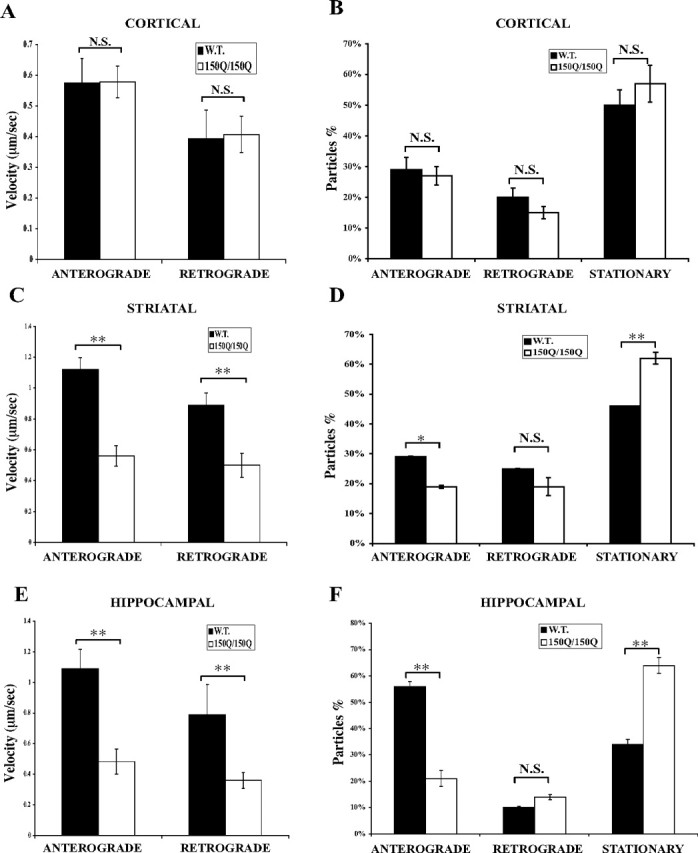
APP transport is disrupted in striatal and hippocampal, but not cortical, neurons of homozygous Hdh150Q mice. A, Endogenous mutant huntingtin does not affect velocity of either anterograde or retrograde APP–YFP movement in primary cortical neurons. Anterograde, 0.57 versus 0.58 μm/s, p > 0.05; retrograde, 0.39 versus 0.40 μm/s, p > 0.05. B, Endogenous mutant huntingtin does not change the distribution of APP–YFP moving particles in primary cortical neurons. C, Endogenous mutant huntingtin reduces the velocity of both anterograde and retrograde APP–YFP movement in primary striatal neurons. Anterograde, 1.12 versus 0.56 μm/s, p < 0.0001; retrograde, 0.89 versus 0.50 μm/s, p = 0.0016. D, Endogenous mutant huntingtin increases the number of stationary APP–YFP particles whereas it decreases the number of anterograde moving APP–YFP particles in primary striatal neurons. Anterograde, 29 versus 19%, p < 0.05; stationary, 46 versus 62%, p < 0.01. E, Endogenous mutant huntingtin reduces the velocity of both anterograde and retrograde APP–YFP movement in primary hippocampal neurons. Anterograde, 1.09 versus 0.48 μm/s, p = 0.0006; retrograde, 0.79 versus 0.36 μm/s, p = 0.0064. F, Endogenous mutant huntingtin increases the number of stationary APP–YFP particles whereas it decreases the number of anterograde moving APP–YFP particles in primary hippocampal neurons. Anterograde, 56 versus 21%, p < 0.01; stationary, 34 versus 64%, p < 0.01. W.T., Wild type; N.S., not significant. *p < 0.05; **p < 0.01. Error bars indicate SE.
Figure 6.
Figure 6.
Retrograde BDNF transport is disrupted in striatal but not cortical neurons of homozygous Hdh150Q mice. A, Endogenous mutant huntingtin does not affect velocity of either anterograde or retrograde BDNF-mCherry movement in primary cortical neurons. Anterograde, 1.23 versus 1.06 μm/s, p > 0.05; retrograde, 0.72 versus 0.2 μm/s, p > 0.05. B, Endogenous mutant huntingtin does not change the distribution BDNF-mCherry moving particles in primary cortical neurons. C, Endogenous mutant huntingtin reduces the velocity of retrograde BDNF-mCherry movement in primary striatal neurons. Anterograde, 0.74 versus 0.64 μm/s, p > 0.05; retrograde, 0.86 versus 0.56 μm/s, p = 0.03. D, Endogenous mutant huntingtin increases the number of stationary BDNF-mCherry particles in primary striatal neurons. Anterograde, 30 versus 15%, p < 0.05; retrograde, 32 versus 10%, p < 0.05; stationary, 38 versus 65%, p < 0.05. W.T., Wild type; N.S., not significant. *p < 0.05. Error bars indicate SE.
Figure 7.
Figure 7.
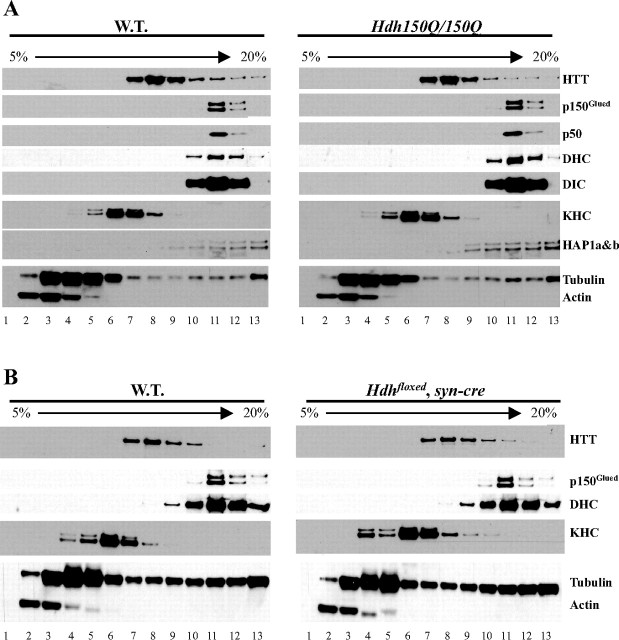
Biochemical behavior of huntingtin, kinesin-I, HAP1, and dynactin complexes are not altered in HD model mice. A, Sucrose gradient assay of brain extracts from wild-type and 8-month-old homozygous Hdh150Q knock-in mice. B, Sucrose gradient assay of brain extracts from wild-type and conditional Hdh knock-out mice. W.T., Wild type.

References

    1. Altar CA, Cai N, Bliven T, Juhasz M, Conner JM, Acheson AL, Lindsay RM, Wiegand SJ. Anterograde transport of brain-derived neurotrophic factor and its role in the brain. Nature. 1997;389:856–860. - PubMed
    1. Bhide PG, Day M, Sapp E, Schwarz C, Sheth A, Kim J, Young AB, Penney J, Golden J, Aronin N, DiFiglia M. Expression of normal and mutant huntingtin in the developing brain. J Neurosci. 1996;16:5523–5535. - PMC - PubMed
    1. Block-Galarza J, Chase KO, Sapp E, Vaughn KT, Vallee RB, DiFiglia M, Aronin N. Fast transport and retrograde movement of huntingtin and HAP1 in axons. Neuroreport. 1997;8:2247–2251. - PubMed
    1. Brewer GJ. Serum-free B27/neurobasal medium supports differentiated growth of neurons from the striatum, substantia nigra, septum, cerebral cortex, cerebellum, and dentate gyrus. J Neurosci Res. 1995;42:674–683. - PubMed
    1. Brewer GJ. Isolation and culture of adult rat hippocampal neurons. J Neurosci Methods. 1997;71:143–155. - PubMed

Publication types

MeSH terms

LinkOut - more resources