Incidence and burden of road traffic injuries in urban India
- PMID: 19074239
- PMCID: PMC2777413
- DOI: 10.1136/ip.2008.019620
Incidence and burden of road traffic injuries in urban India
Abstract
Background: The scale of road traffic injuries (RTIs) in India is uncertain because of limitations in the availability and reliability of incidence data.
Objective: To report these data for Hyderabad city in southern India.
Methods: In a cross-sectional population-based survey, 10 459 participants aged 5-49 years (94.3% participation), selected using three-stage systematic cluster sampling, were interviewed. Participants recalled RTIs in the preceding 3 months and RTI-related death and disability in the household in the preceding 3 years. RTI was defined as an injury resulting from a road traffic crash irrespective of the severity.
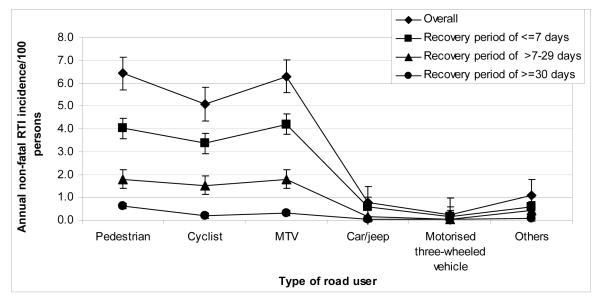
Results: The age/sex-adjusted annual incidence of non-fatal RTI requiring a recovery period of < or =7, 8-29, and > or =30 days was 13% (95% CI 12.6% to 13.4%), 5.8% (95% CI 5.5% to 6.0%), and 1.2% (95% CI 1.1% to 1.4%), respectively. The overall adjusted rate for non-fatal RTI was 20.7% (95% CI 20.0% to 21.3%). The relative risk of RTI requiring a recovery period of >7 days was significantly higher in the third per capita monthly income quartile (1.24 (95% CI 1.12 to 1.37); p<0.05). The incidence of non-fatal RTI was highest in pedestrians, motorized two-wheeled vehicle users, and cyclists: 6.4, 6.3, and 5.1/100 persons/year, respectively. Annual RTI mortality and disability rates were 38.2 (95% CI 17.5 to 58.8) and 35.1 (95% CI 12.4 to 57.7) per 100,000 population, respectively.
Conclusions: There is a high burden of RTI in this urban population. With the recent attention focused on RTI by the Government of India, these findings may assist in planning appropriate initiatives to reduce the RTI burden.
Figures
References
-
- Peden M, Scurfield R, Sleet D, et al. World report on road traffic injury prevention. World Health Organization; Geneva: 2004.
-
- World Health Organization Global Burden of Disease Project Revised Global Burden of Disease 2002 Estimates. [Accessed 29 April 2008]. ( http://www.who.int/healthinfo/statistics/gbdwhoregionmortality2002.xls)
-
- Kopits E, Cropper ML. Traffic Fatalities and Economic Growth. 2003. World Bank Policy Research Working Paper No. 3035. - PubMed
-
- Ameratunga S, Hijar M, Norton R. Road traffic injuries: confronting disparities to address a global-health problem. Lancet. 2006;367:1533–40. - PubMed
-
- World Health Organization Cause of death and burden of disease estimates by country. [Accessed 29 April 2008]. 2002. ( http://www.who.int/healthinfo/statistics/bodgbddeathdalyestimates.xls)
Publication types
MeSH terms
Grants and funding
LinkOut - more resources
Full Text Sources
Medical