


Novel evolutionary engineering approach for accelerated utilization of glucose, xylose, and arabinose mixtures by engineered Saccharomyces cerevisiae strains
- PMID: 19074603
- PMCID: PMC2643596
- DOI: 10.1128/AEM.02268-08
Novel evolutionary engineering approach for accelerated utilization of glucose, xylose, and arabinose mixtures by engineered Saccharomyces cerevisiae strains
Abstract
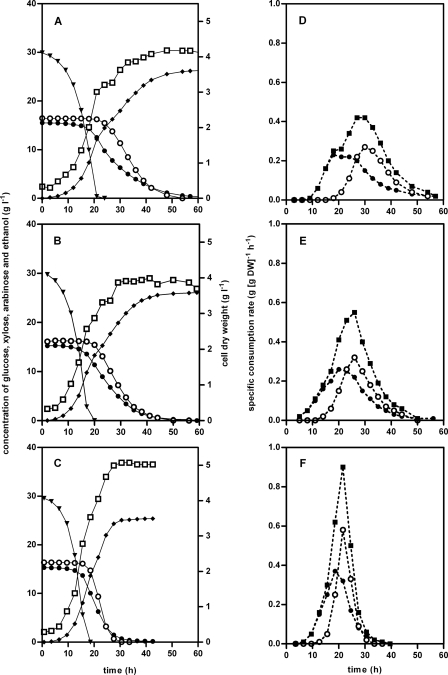
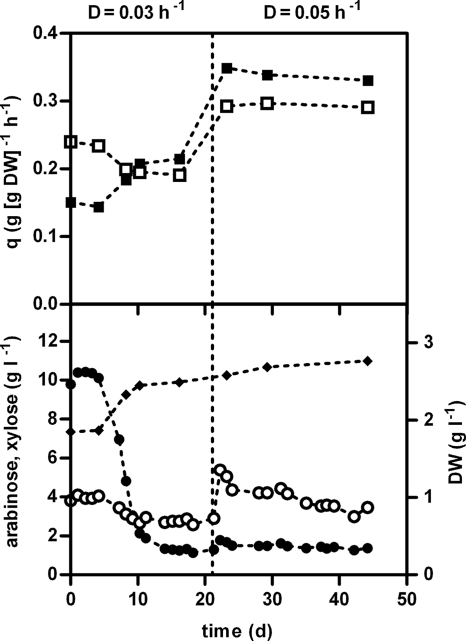
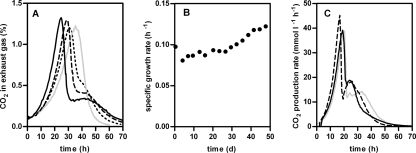
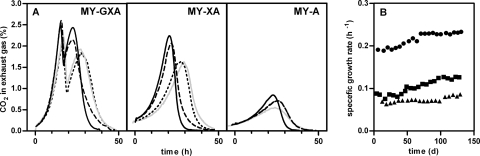
Lignocellulosic feedstocks are thought to have great economic and environmental significance for future biotechnological production processes. For cost-effective and efficient industrial processes, complete and fast conversion of all sugars derived from these feedstocks is required. Hence, simultaneous or fast sequential fermentation of sugars would greatly contribute to the efficiency of production processes. One of the main challenges emerging from the use of lignocellulosics for the production of ethanol by the yeast Saccharomyces cerevisiae is efficient fermentation of D-xylose and L-arabinose, as these sugars cannot be used by natural S. cerevisiae strains. In this study, we describe the first engineered S. cerevisiae strain (strain IMS0003) capable of fermenting mixtures of glucose, xylose, and arabinose with a high ethanol yield (0.43 g g(-1) of total sugar) without formation of the side products xylitol and arabinitol. The kinetics of anaerobic fermentation of glucose-xylose-arabinose mixtures were greatly improved by using a novel evolutionary engineering strategy. This strategy included a regimen consisting of repeated batch cultivation with repeated cycles of consecutive growth in three media with different compositions (glucose, xylose, and arabinose; xylose and arabinose; and only arabinose) and allowed rapid selection of an evolved strain (IMS0010) exhibiting improved specific rates of consumption of xylose and arabinose. This evolution strategy resulted in a 40% reduction in the time required to completely ferment a mixture containing 30 g liter(-1) glucose, 15 g liter(-1) xylose, and 15 g liter(-1) arabinose.
Figures
References
-
- Andreasen, A. A., and T. J. Stier. 1953. Anaerobic nutrition of Saccharomyces cerevisiae. I. Ergosterol requirement for growth in a defined medium. J. Cell Physiol. 41:23-36. - PubMed
-
- Andreasen, A. A., and T. J. Stier. 1954. Anaerobic nutrition of Saccharomyces cerevisiae. II. Unsaturated fatty acid requirement for growth in a defined medium. J. Cell Physiol. 43:271-281. - PubMed
-
- Aristidou, A., and M. Penttilä. 2000. Metabolic engineering applications to renewable resource utilization. Curr. Opin. Biotechnol. 11:187-198. - PubMed
-
- Attfield, P. V., and P. J. L. Bell. 2006. Use of population genetics to derive nonrecombinant Saccharomyces cerevisiae strains that grow using xylose as a sole carbon source. FEMS Yeast Res. 6:862-868. - PubMed
Publication types
MeSH terms
Substances
LinkOut - more resources
Full Text Sources
Other Literature Sources
Molecular Biology Databases
