


Novel noninvasive breath test method for screening individuals at risk for diabetes
- PMID: 19074994
- PMCID: PMC2646023
- DOI: 10.2337/dc08-1578
Novel noninvasive breath test method for screening individuals at risk for diabetes
Abstract
Objective: Diagnosis of pre-diabetes and early-stage diabetes occurs primarily by means of an oral glucose tolerance test (OGTT), which requires invasive blood sampling. The aim of this study was to determine whether differences exist in breath (13)CO(2) excretion during a (13)C-labeled OGTT between individuals with normal glucose tolerance (NGT) and individuals with pre-diabetes and early-stage diabetes (PDED) and whether these differences correlated with blood glucose kinetics.
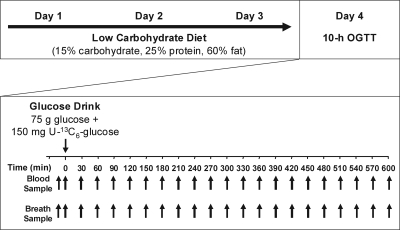
Research design and methods: Blood and breath samples were collected at baseline and every 30 min for a 10-h period after ingestion of 75 g glucose isotopically labeled with 150 mg [U-(13)C(6)]D-glucose.
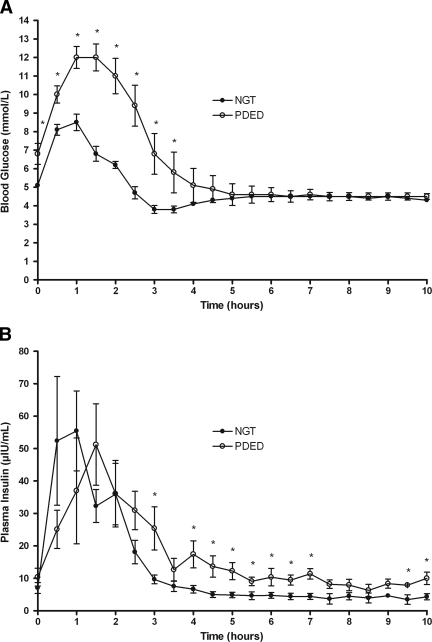
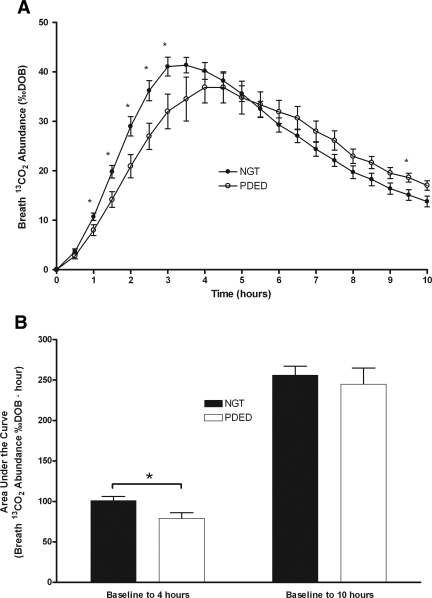
Results: Age (56 +/- 5 vs. 47 +/- 3 years) and BMI (31 +/- 2 vs. 31 +/- 2 kg/m(2)) were not different between individuals with NGT (n = 10) and PDED (n = 7), respectively. Blood glucose concentrations were significantly higher in those with PDED compared with those with NGT from baseline to 4.5 h after glucose ingestion (P <or= 0.05). Glucose-derived breath (13)CO(2) was significantly lower in individuals with PDED compared with those with NGT from 1 to 3.5 h after glucose (P <or= 0.05). Peak breath (13)CO(2) abundance occurred at 4.5 and 3.5 h in individuals with PDED and NGT, respectively (36.87 +/- 3.15 vs. 41.36 +/- 1.56 per thousand delta over baseline).
Conclusions: These results suggest that this novel breath test method may assist in recognition of pre-diabetes or early-stage diabetes in at-risk persons without the need for invasive blood sampling, thus making it an attractive option for large-scale testing of at-risk populations, such as children.
Figures
Comment in
-
Novel noninvasive breath test method for screening individuals at risk for diabetes: response to Dillon et al.Diabetes Care. 2009 Jul;32(7):e88; author reply e89. doi: 10.2337/dc09-0518. Diabetes Care. 2009. PMID: 19564467 No abstract available.
References
-
- Hegarty BD, Furler SM, Ye J, Cooney GJ, Kraegen EW: The role of intramuscular lipid in insulin resistance. Acta Physiol Scand 178:373–383, 2003 - PubMed
-
- Reaven GM: insulin resistance/compensatory hyperinsulinemia, essential hypertension, and cardiovascular disease. J Clin Endocrinol Metab 88:2399–2403, 2003 - PubMed
-
- Hanley AJ, Festa A, D'Agostino RB Jr, Wagenknecht LE, Savage PJ, Tracy RP, Saad MF, Haffner SM: Metabolic and inflammation variable clusters and prediction of type 2 diabetes: factor analysis using directly measured insulin sensitivity. Diabetes 53:1773–1781, 2004 - PubMed
-
- Lakka HM, Laaksonen DE, Lakka TA, Niskanen LK, Kumpusalo E, Tuomilehto J, Salonen JT: The metabolic syndrome and total and cardiovascular disease mortality in middle-aged men. JAMA 288:2709–2716, 2002 - PubMed
-
- Malik S, Wong ND, Franklin SS, Kamath TV, L'Italien GJ, Pio JR, Williams GR: Impact of the metabolic syndrome on mortality from coronary heart disease, cardiovascular disease, and all causes in United States adults. Circulation 110:1245–1250, 2004 - PubMed
Publication types
MeSH terms
Substances
Grants and funding
LinkOut - more resources
Full Text Sources
Other Literature Sources
Medical
