


In vitro efficacy of ST246 against smallpox and monkeypox
- PMID: 19075062
- PMCID: PMC2650551
- DOI: 10.1128/AAC.01044-08
In vitro efficacy of ST246 against smallpox and monkeypox
Abstract
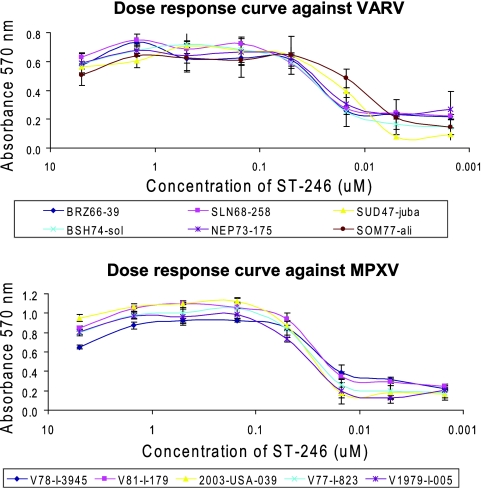
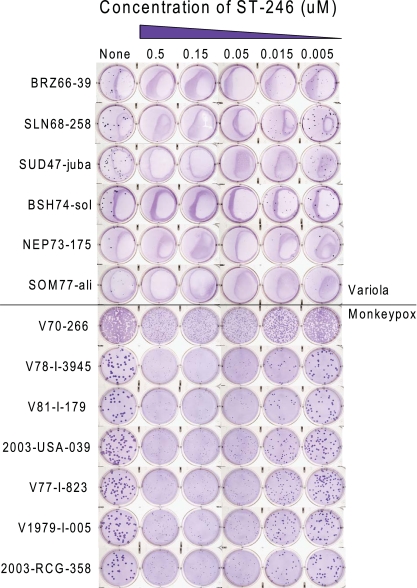
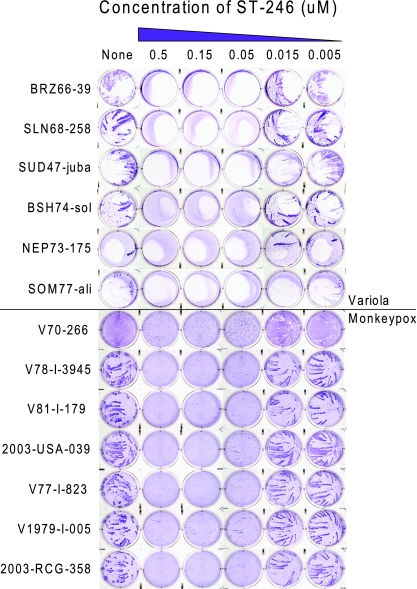
Since the eradication of smallpox and the cessation of routine childhood vaccination for smallpox, the proportion of the world's population susceptible to infection with orthopoxviruses, such as variola virus (the causative agent of smallpox) and monkeypox virus, has grown substantially. In the United States, the only vaccines for smallpox licensed by the Food and Drug Administration (FDA) have been live virus vaccines. Unfortunately, a substantial number of people cannot receive live virus vaccines due to contraindications. Furthermore, no antiviral drugs have been fully approved by the FDA for the prevention or treatment of orthopoxvirus infection. Here, we show the inhibitory effect of one new antiviral compound, ST-246, on the in vitro growth properties of six variola virus strains and seven monkeypox virus strains. We performed multiple assays to monitor the cytopathic effect and to evaluate the reduction of viral progeny production and release in the presence of the compound. ST-246 had 50% effective concentrations of <or=0.067 microM against variola virus and <0.04 microM against monkeypox virus. In a dose-dependent manner, plaque size and comet tail formation were markedly reduced in the presence of the drug at low, noncytotoxic concentrations between 0.015 and 0.05 microM. Our in vitro phenotype data suggest that ST-246 inhibits variola and monkeypox viruses similarly by reducing the production and release of enveloped orthopoxvirus and support the development of ST-246 as an antiviral therapeutic compound for the treatment of severe systemic orthopoxvirus infections.
Figures
References
-
- Chen, Z., P. Earl, J. Americo, I. Damon, S. K. Smith, Y. H. Zhou, F. Yu, A. Sebrell, S. Emerson, G. Cohen, R. J. Eisenberg, J. Svitel, P. Schuck, W. Satterfield, B. Moss, and R. Purcell. 2006. Chimpanzee/human mAbs to vaccinia virus B5 protein neutralize vaccinia and smallpox viruses and protect mice against vaccinia virus. Proc. Natl. Acad. Sci. USA 103:1882-1887. - PMC - PubMed
-
- Douglass, N. J., M. Richardson, and K. R. Dumbell. 1994. Evidence for recent genetic variation in monkeypox viruses. J. Gen. Virol. 75(Pt 6):1303-1309. - PubMed
-
- Esposito, J. J., S. A. Sammons, A. M. Frace, J. D. Osborne, M. Olsen-Rasmussen, M. Zhang, D. Govil, I. K. Damon, R. Kline, M. Laker, Y. Li, G. L. Smith, H. Meyer, J. W. Leduc, and R. M. Wohlhueter. 2006. Genome sequence diversity and clues to the evolution of variola (smallpox) virus. Science 313:807-812. - PubMed
-
- Fenner, F., D. A. Henderson, I. Arita, Z. Jezek, and I. D. Ladnyi. 1988. Smallpox and its eradication. World Health Organization, Geneva, Switzerland.
MeSH terms
Substances
LinkOut - more resources
Full Text Sources
Other Literature Sources
Medical
