


Dietary pattern influences breast cancer prognosis in women without hot flashes: the women's healthy eating and living trial
- PMID: 19075284
- PMCID: PMC2645853
- DOI: 10.1200/JCO.2008.16.1067
Dietary pattern influences breast cancer prognosis in women without hot flashes: the women's healthy eating and living trial
Abstract
Purpose: To determine whether a low-fat diet high in vegetables, fruit, and fiber differentially affects prognosis in breast cancer survivors with hot flashes (HF) or without HF after treatment.
Patients and methods: A secondary analysis was conducted on 2,967 breast cancer survivors, age 18 to 70 years, who were randomly assigned between 1995 and 2000 in a multicenter, controlled trial of a dietary intervention to prevent additional breast cancer events and observed through June 1, 2006. We compared the dietary intervention group with a group who received five-a-day dietary guidelines.
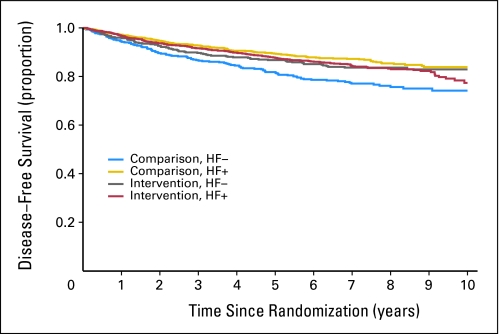
Results: Independent of HF status, a substantial between-group difference among those who did and did not receive dietary guidelines was achieved and maintained at 4 years in intake of vegetable/fruit servings per day (54% higher; 10 v 6.5 servings/d, respectively), fiber (31% higher; 25.5 v 19.4 g/d, respectively), and percent energy from fat (14% lower; 26.9% v 31.3%, respectively). Adjusting for tumor characteristics and antiestrogen treatment, HF-negative women assigned to the intervention had 31% fewer events than HF-negative women assigned to the comparison group (hazard ratio [HR] = 0.69; 95% CI, 0.51 to 0.93; P = .02). The intervention did not affect prognosis in the women with baseline HFs. Furthermore, compared with HF-negative women assigned to the comparison group, HF-positive women had significantly fewer events in both the intervention (HR = 0.77; 95% CI, 0.59 to 1.00; P = .05) and comparison groups (HR = 0.65; 95% CI, 0.49 to 0.85; P = .002).
Conclusion: A diet with higher vegetable, fruit, and fiber and lower fat intakes than the five-a-day diet may reduce risk of additional events in HF-negative breast cancer survivors. This suggestive finding needs confirmation in a trial in which it is the primary hypothesis.
Figures
Comment in
-
Dietary changes after breast cancer in women without hot flashes: a simple and inexpensive way to target tumor and host?J Clin Oncol. 2009 Jan 20;27(3):323-5. doi: 10.1200/JCO.2008.19.7764. Epub 2008 Dec 15. J Clin Oncol. 2009. PMID: 19075255 No abstract available.
References
-
- Cuzick J: Hot flushes and the risk of recurrence: Retrospective, exploratory results from the ATAC trial. 30th Annual San Antonio Breast Cancer Symposium, San Antonio, TX, December 13-16, 2007. (poster 2069)
-
- Wilbur J, Miller AM, Montgomery A, et al: Sociodemographic characteristics, biological factors, and symptom reporting in midlife women. Menopause 5:43-51, 1998 - PubMed
-
- Matthews KA, Wing RR, Kuller LH, et al: Influence of the perimenopause on cardiovascular risk factors and symptoms of middle-aged healthy women. Arch Intern Med 154:2349-2355, 1994 - PubMed
-
- Randolph JF Jr, Sowers M, Bondarenko I, et al: The relationship of longitudinal change in reproductive hormones and vasomotor symptoms during the menopausal transition. J Clin Endocrinol Metab 90:6106-6112, 2005 - PubMed
Publication types
MeSH terms
Substances
Grants and funding
LinkOut - more resources
Full Text Sources
Medical
Research Materials
Miscellaneous
