Relationship between HIV protease inhibitors and QTc interval duration in HIV-infected patients: a cross-sectional study
- PMID: 19076152
- PMCID: PMC2668087
- DOI: 10.1111/j.1365-2125.2008.03332.x
Relationship between HIV protease inhibitors and QTc interval duration in HIV-infected patients: a cross-sectional study
Abstract
Aims: QTc interval prolongation and torsades de pointes have been reported in HIV-infected patients. Protease inhibitors (PIs) are suspected to contribute to this adverse reaction. However, many factors can prolong QTc interval. We examined factors influencing QTc duration in HIV-infected patients.
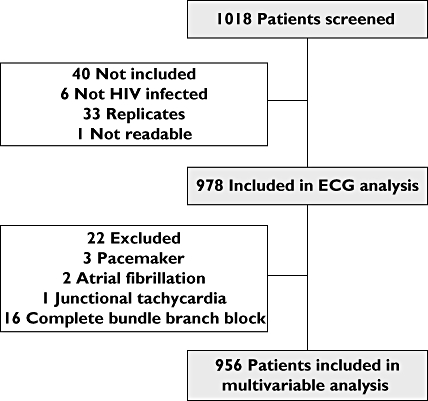
Methods: Unselected HIV-infected patients (n = 978) were enrolled in this prospective, single-centre cross-sectional study. Variables related to infection and treatments were collected. A digital electrocardiographic record was recorded in each patient and QT interval duration was measured and corrected using both Bazett's (QTcB) and Fridericia's (QTcF) formula. Results were analysed with a multivariable linear model.
Results: After excluding arrhythmias and complete bundle branch blocks, QT interval was measured in 956 patients. The mean (SD) QTcB was 418 ms (23) and QTcF was 405 ms (20). QTc was found prolonged (>450 ms in women and >440 ms in men) in 129 [13.5%; 95% confidence interval (CI) 11.5, 15.8] and 38 (4%; 95% CI 2.9, 5.4) patients using Bazett and Fridericia corrections, respectively. On multivariable analysis, incomplete bundle branch block, ventricular hypertrophy, signs of ischaemic cardiopathy, female gender, White ethnic origin and age were significantly associated with QTc prolongation. The only HIV variable independently associated with QTc prolongation was the duration of infection (P = 0.023). After adjustment, anti-HIV treatment, in particular PI (P = 0.99), was not associated with QTc prolongation.
Conclusions: Although PIs block in vitro hERG current, they are not independently associated with QTc interval prolongation. Prolonged QTc interval in HIV-infected patients is primarily associated with factors commonly known to prolong QT and with the duration of HIV infection.
References
-
- Anson BD, Weaver JG, Ackerman MJ, Akinsete O, Henry K, January CT, Badley AD. Blockade of HERG channels by HIV protease inhibitors. Lancet. 2005;365:682–6. - PubMed
-
- Busti AJ, Tsikouris JP, Peeters MJ, Das SR, Canham RM, Abdullah SM, Margolis DM. A prospective evaluation of the effect of atazanavir on the QTc interval and QTc dispersion in HIV-positive patients. HIV Med. 2006;7:317–22. - PubMed
-
- Bednar MM, Harrigan EP, Anziano RJ, Camm AJ, Ruskin JN. The QT interval. Prog Cardiovasc Dis. 2001;43:1–45. - PubMed
-
- Bernardi M, Calandra S, Colantoni A, Trevisani F, Raimondo ML, Sica G, Schepis F, Mandini M, Simoni P, Contin M, Raimondo G. QT interval prolongation in cirrhosis: prevalence, relationship with severity, and etiology of the disease and possible pathogenetic factors. Hepatology. 1998;27:28–34. - PubMed
-
- Schillaci G, Pirro M, Ronti T, Gemelli F, Pucci G, Innocente S, Porcellati C, Mannarino E. Prognostic impact of prolonged ventricular repolarization in hypertension. Arch Intern Med. 2006;166:909–13. - PubMed
Publication types
MeSH terms
Substances
LinkOut - more resources
Full Text Sources
Medical
Research Materials
Miscellaneous