


Review
doi: 10.1111/j.1365-2249.2008.03834.x.
The role of infections in autoimmune disease
Affiliations
- PMID: 19076824
- PMCID: PMC2665673
- DOI: 10.1111/j.1365-2249.2008.03834.x
Item in Clipboard
Review
The role of infections in autoimmune disease
Clin Exp Immunol.
2009 Jan.
Abstract
Autoimmunity occurs when the immune system recognizes and attacks host tissue. In addition to genetic factors, environmental triggers (in particular viruses, bacteria and other infectious pathogens) are thought to play a major role in the development of autoimmune diseases. In this review, we (i) describe the ways in which an infectious agent can initiate or exacerbate autoimmunity; (ii) discuss the evidence linking certain infectious agents to autoimmune diseases in humans; and (iii) describe the animal models used to study the link between infection and autoimmunity.
Figures
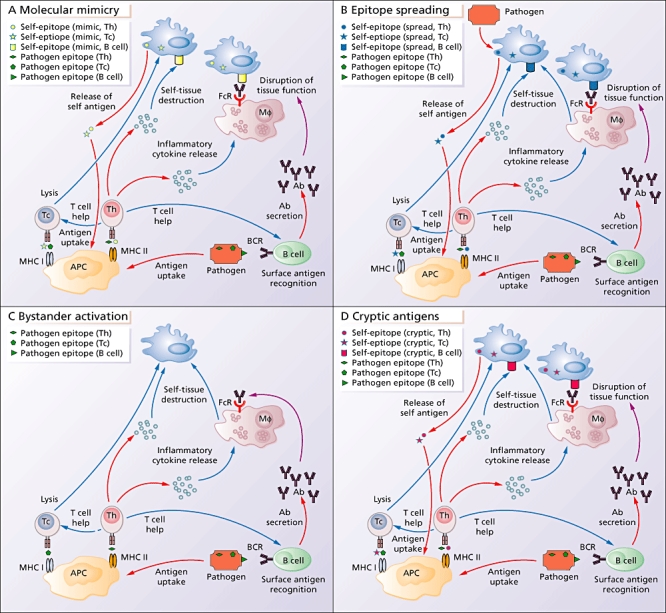
Mechanisms by which pathogens may cause autoimmunity. (a) Molecular mimicry occurs when pathogen-derived epitopes are cross-reactive with self-derived epitopes. Pathogen-derived epitopes are taken up by antigen-presenting cells (APCs) and presented to cytolytic T cells (Tc) via major histocompatibility complex (MHC) class I or to helper T cells (Th) via MHC class II. T cells activated by pathogenic epitopes that are cross-reactive with self-epitopes can then damage self-tissue via lysis (Tc) or release of cytokines (Th). Cytokines released by activated Th cells can activate macrophages (Mφ) or provide help to B cells. Pathogen-derived surface antigens are recognized by a B cell's B cell receptor (BCR), which triggers the secretion of antibodies. These antibodies can cause damage by binding to cross-reactive epitopes on the surface of tissues and disrupting tissue function, or the Fc portion of the antibody can bind simultaneously to the Fc receptor (FcR) on Mφ; this will trigger the Mφ to produce tissue-damaging cytokines. Damaged tissue will release more cross-reactive antigens, which will be taken up by APCs, propagating further damage. (b) In epitope spreading, the immune response to a persisting pathogen, or direct lysis of self-tissue by the persisting pathogen, causes damage to self-tissue. Antigens released from damaged tissue are taken up by APCs, and this initiates an immune response directed towards self-antigens. (c) In bystander activation, the various parts of the immune system respond to the invading pathogens. The inflammatory environment triggered by this response damages self-tissue in an antigen non-specific manner, and in addition triggers non-specific activation of immune cells. (d) In contrast to dominant antigenic determinants, subdominant cryptic antigens are normally invisible to the immune system. The inflammatory environment that arises after infection can induce increased protease production and differential processing of released self-epitopes by APCs.
Comment in
-
Giant cell arteritis, infections and biologics.Ann Rheum Dis. 2017 Sep;76(9):e29. doi: 10.1136/annrheumdis-2016-210955. Epub 2017 Jan 5. Ann Rheum Dis. 2017. PMID: 28057665 No abstract available.
-
Response to eLetter: 'Infections in giant cell arteritis and therapeutic implications' by Moiseev et al.Ann Rheum Dis. 2017 Sep;76(9):e30. doi: 10.1136/annrheumdis-2016-210976. Epub 2017 Jan 17. Ann Rheum Dis. 2017. PMID: 28096072 No abstract available.
References
-
- Bowles NE, Richardson PJ, Olsen EG, Archard LC. Detection of Coxsackie-B-virus-specific RNA sequences in myocardial biopsy samples from patients with myocarditis and dilated cardiomyopathy. Lancet. 1986;1:1120–3. - PubMed
-
- Pauschinger M, Doerner A, Kuehl U, et al. Enteroviral RNA replication in the myocardium of patients with left ventricular dysfunction and clinically suspected myocarditis. Circulation. 1999;99:889–95. - PubMed
-
- Fairweather D, Kaya Z, Shellam GR, Lawson CM, Rose NR. From infection to autoimmunity. J Autoimmun. 2001;16:175–86. - PubMed
Publication types
MeSH terms
Grants and funding
LinkOut - more resources
Full Text Sources
Medical
